Super Mario 64
- This article is about the Nintendo 64 game. For other uses, see Super Mario 64 (disambiguation).
| Super Mario 64 | |||||||||||||||||
|---|---|---|---|---|---|---|---|---|---|---|---|---|---|---|---|---|---|
 For alternate art, see the related gallery. | |||||||||||||||||
| Developer | Nintendo EAD | ||||||||||||||||
| Publisher | Nintendo | ||||||||||||||||
| Platforms | Nintendo 64, 64DD, iQue Player, Virtual Console (Wii, Wii U), Nintendo 64 – Nintendo Classics | ||||||||||||||||
| Release dates | Nintendo 64: June 23, 1996[1] June 23, 1996[1] September 29, 1996[2] September 29, 1996[2] March 1, 1997[3] March 1, 1997[3] March 1, 1997[4] July 18, 1997 (Rumble Pak Compatible Version)[5] March 1, 1997[4] July 18, 1997 (Rumble Pak Compatible Version)[5]iQue Player:  November 18, 2003[6] November 18, 2003[6]Player's Choice: January 26, 1998[7]Virtual Console (Wii): November 19, 2006[8] December 2, 2006[9] December 7, 2006[10] December 8, 2006[11]Virtual Console (Wii U): April 1, 2015[12] April 1, 2015[11] April 2, 2015[13] April 2, 2015[14] April 8, 2015[15] April 2, 2015[14] April 8, 2015[15]Nintendo 64 – Nintendo Classics: October 25, 2021[16] October 26, 2021[17] October 26, 2021[18] October 26, 2021[19] October 26, 2021[20] October 26, 2021[20] October 26, 2021[21] October 26, 2021[21] | ||||||||||||||||
| Languages | English (United States) English (United Kingdom) Japanese Chinese (Simplified) French (Europe) German | ||||||||||||||||
| Genres | 3D platformer, action-adventure | ||||||||||||||||
| Ratings | Original release:
| ||||||||||||||||
| Mode | Single player | ||||||||||||||||
| Format |
 Game Pak Game Pak Digital download Digital download64DD:
 Magneto-optical drive Magneto-optical driveWii: Digital download Digital download | ||||||||||||||||
| Input | Wii:  Joy-Con (horizontal) Joy-Con (horizontal) | ||||||||||||||||
| Serial codes | NUS-NSMJ-JPN NUS-NSME-USA NUS-NSMP-EUR 11011[23] NUS-NSME-HKG[24] | ||||||||||||||||
 - Kids to Adults
 - All ages
 - Three years and older
 - Three years and older
 - All ages
 - All ages
 - General
 - Everyone




Super Mario 64 is a 3D action-adventure platform game released for the Nintendo 64 in 1996 in NTSC regions and in 1997 in PAL regions. It is the eighth entry in the Super Mario series.[25][26] This game was one of two (three in Japan and four in Europe) launch titles for the Nintendo 64, along with Pilotwings 64, which helped drive initial sales of the console. Since its release, Super Mario 64 has been widely acclaimed as one of the greatest and most important games of all time.[27][28][29]
In entering the third dimension, Super Mario 64 largely eschews the obstacle course–based design of the 2D platformers in the Super Mario franchise for a mission structure and gameplay focused on exploring a larger area. Though not the first 3D platform game, Super Mario 64 codified many of the controls and design conventions of the genre.[30] Being the first 3D game of the Super Mario franchise, Super Mario 64 has introduced several moves, including triple-jumping, ground-pounding, long-jumping, diving, and side-somersaulting, which would be used in most subsequent installments of the Super Mario series. Punching and kicking were also introduced but would not appear in any later title other than its DS remake. The game popularized Charles Martinet's portrayal as Mario (being the first game of the Super Mario series to feature his voice) and Princess Toadstool's name as Peach in the West, and made them both series standards.
In 1996, a 64DD version of the game was shown at Shoshinkai 1996.[31] A sequel, named Super Mario 64 2, was being developed for the 64DD, but it was canceled due to the 64DD's commercial failure. In 2000, another sequel, named Super Mario 128, was shown at Space World 2000, but the game would remain unreleased.
On November 17, 2003, Super Mario 64 was rereleased for the iQue Player as one of the launch titles, and a timed demo of the game was bundled with every iQue Player. This would also make it the first Super Mario game to be localized in Simplified Chinese. The game was digitally rereleased for the Wii's Virtual Console service in November 2006 and for the Wii U's Virtual Console service in April 2015. Super Mario 64 was among the first games released on both Virtual Console services.
A sequel titled Super Mario Sunshine was developed for the Nintendo GameCube and released in 2002. In 2004, a remake was released for the Nintendo DS, titled Super Mario 64 DS. It has several differences, especially the inclusion of Luigi, Yoshi, and Wario as playable characters. An emulation of the Rumble Pak Compatible Version rerelase of the game is bundled in with Super Mario 3D All-Stars for the Nintendo Switch, though with upscaled graphics and a redrawn HUD. The original game is one of the launch titles for Nintendo 64 – Nintendo Classics.
As of 2015, Super Mario 64 has sold over 11 million copies worldwide[32] and is the best-selling Nintendo 64 game. The game became the second-best-selling game on the Wii's Virtual Console after Super Mario Bros., as of June 2007.[33]
Storyline


The following is the story given on pages 4 and 5 of the Super Mario 64 instruction booklet. The colors given in the instruction booklet signify who is talking: Mario, Princess Peach, Bowser, and Toad, with black being narration.
"Mario, please come to the castle. I've baked a cake for you. Yours truly, Princess Toadstool".
"Wow, an invitation from Peach! I'll head out right away. I hope she can wait for me!"
Mario is so excited to receive the invitation from the Princess, who lives in the Mushroom Castle, that he quickly dresses in his best and leaves right away."Hmmm, something's not quite right here... It's so quiet..".
Shaking off his uneasy premonition, Mario steps into the silent castle, where he is greeted by the gruff words,"No one's home! Now scram! Bwa, ha, ha".
The sound seems to come from everywhere."Who's there?! I've heard that voice somewhere before..".
Mario begins searching all over the castle. Most of the doors are locked, but finding one open, he peeks inside. Hanging on the wall is the largest painting he has ever seen, and from behind the painting comes the strangest sound that he has ever heard..."I think I hear someone calling. What secrets does this painting hold?"
Without a second thought, Mario jumps at the painting. As he is drawn into it, another world opens before his very eyes.And so begins the grandest of all adventures!
Once inside the painting, Mario finds himself in the midst of battling Bob-ombs. According to the Bob-omb Buddies, someone...or something...has suddenly attacked the castle and stolen the "Power Stars". These stars protect the castle; with the stars in his control, the beast plans to take over the Mushroom Castle.
To help him accomplish this, he plans to convert the residents of the painting world into monsters as well. If nothing is done, all those monsters will soon begin to overflow from inside the painting.
"A plan this maniacal, this cunning...this must be the work of Bowser!"
Princess Toadstool and Toad are missing, too. Bowser must have taken them and sealed them inside the painting. Unless Mario recovers the Power Stars immediately, the inhabitants of this world will become Bowser's army."Well, Bowser's not going to get away with it, not as long as I'm around!"
Stolen Power Stars are hidden throughout the painting world. Use your wisdom and strength to recover the Power Stars and restore peace to the Mushroom Castle."Mario! You are the only one we can count on".
Gameplay
The player controls Mario. In addition to his jump and a basic punch string, Mario's repertoire includes a variety of advanced acrobatic moves (many of them carried over from the 1994 game Donkey Kong) accomplished through precise timing and various combinations of the analog stick and the jump button, such as the somersaulting Triple Jump and the low but far-ranged Long Jump. Eschewing the "Super Mario to Small Mario" mechanic found in most of the previous mainline games, Super Mario 64 employs an eight-sided health meter called the Power Meter, which is depleted when Mario makes contact with enemies or obstacles, and is replenished by collecting coins, running through Spinning Hearts, or submerging Mario in a body of water. Like the previous games, Super Mario 64 employs a life system, although as the game saves after most progression tasks, the effect of a Game Over is marginal, simply booting the player to the starting menu with a defeated Mario.
When the player starts a game, Mario is situated outside the Mushroom Castle, a hub with minimal obstacles and no enemies. Inside the castle is a multi-story hub containing rooms with paintings and other surfaces serving as portals to the game's various courses. The main goal of the game is to collect Power Stars. There is a total of 120 Power Stars in the game, though only 70 need to be collected in order to complete the game. The Power Stars are split between the fifteen main courses, nine secret courses that are smaller and usually contain only one or two Stars, and various secrets inside the Mushroom Castle. The main courses contain six numbered missions each plus a hidden Power Star for collecting 100 coins. Only a limited portion of the castle is explorable at first, but as Mario collects more Stars, he can open more rooms and unlock Bowser levels. Defeating Bowser in his first level on the ground floor opens the castle's basement, and defeating him in the second level in the basement unlocks top floor.
The game employs a mission-based structure. When the player enters a main course, a screen shows them the Stars they have collected and the newest mission unlocked, each having a title hinting at the mission tasks. Missions vary widely in nature, ranging from defeating enemies to reaching a point of interest on the map to racing friendly characters, though every course features a mission that requires collecting eight Red Coins scattered around the map. Accomplishing a mission rewards the player with a Power Star; collecting it boots Mario back to the room he came from, although collecting 100-Coin Stars allows him to stay on the map. The fifteen main courses consist of large open worlds, with many points of interest and paths, and as such, many of the missions can be completed out of order. Some missions, however, can be completed only by selecting a specific scenario from the course-selection screen, as to prompt the appearance or disappearance of a character or object needed to complete the task.
The courses feature various enemies, most who chase or attack Mario on sight. Most enemies can be defeated by kicking, punching, or jumping on them and leave coins when defeated; some missions also require Mario to defeat a specific type of enemy. Multiple missions involve fighting a large boss, whose defeat usually involves a puzzle or more advanced maneuvering than standard enemies. Not all NPCs are hostile, however. Friendly NPCs include Toads sealed inside the castle's walls who give hints or backstory when spoken to, Bob-omb Buddies who give clearance to use a cannon on the course, and mission-specific characters who challenge Mario to a race or ask him to fetch an object in exchange for a Power Star.
Various power-ups can help Mario on his adventure. Koopa Shells can be ridden on land, water, lava, or quicksand to provide temporary invincibility, and by hitting Cap Switches found in the secret courses, Mario can activate blocks containing the Wing Cap, Vanish Cap, and Metal Cap, whose powers are necessary to complete many of the missions. As the game is a showcase title for a new console and the first 3D Super Mario game, many aspects of the game showcase the Nintendo 64's features. The various cutscenes of the game use the camera to pan and show off the environments. One of the Lakitu Bros. controls the camera to augment these graphics and assist Mario on navigating and platforming the world. Multiple sections take advantage of the analog stick's precision requiring Mario to walk slowly over narrow passageways or tiptoe to sneak up on enemies. Some bridges and platforms sway under Mario's weight.
Controls
The charts below refer to the original game and subsequent ports, such as those released through Virtual Consoles and Nintendo Switch Online. For the control scheme of the remake released for the Nintendo DS, see Super Mario 64 DS § Controls. For the iteration included in Super Mario 3D All-Stars for Nintendo Switch systems, see Super Mario 3D All-Stars § Super Mario 64. A "→" (right arrow) conveys buttons to press in succession, and a "+" (plus sign) conveys buttons to press simultaneously. A "/" (slash) conveys an alternative combination of button presses for the action. The controls for the Wii U and Nintendo Switch can be customized in the emulator settings, with the respective columns displaying the default mappings.
Nintendo 64, iQue, Wii, and Wii U controls
| Action(s) | Input(s) | |||
|---|---|---|---|---|
| Nintendo 64 Controller / iQue Player | Nintendo GameCube Controller | Classic Controller | Wii U controllers | |
| Mario controls | ||||
| Move | 
|

|

|

|
| Sidestep | ◀▶ along a wall
|
◀▶ along a wall
|
◀▶ along a wall
|
◀▶ along a wall
|
| Jump, swim, fire cannon | 
|

|

|

|
| Double-jump | Jump when making contact with the ground while moving (do twice) | |||
| Triple-jump, take off in Wing form | Jump when making contact with the ground while running (do thrice) | |||
| Side-somersault | ◀ → (▶ + )
|
◀ → (▶ + )
|
◀ → (▶ + )
|
◀ → (▶ + )
|
| Wall-kick | → against a wall
|
→ against a wall
|
→ against a wall
|
→ against a wall
|
| Backward-somersault |  + +
|
 + +
|
 + +
|
 + +
|
| Long-jump | + while running
|
+ while running
|
+ while running
|
+ while running
|
| Climb up ledge | + while hanging from ledge
|
+ while hanging from ledge
|
+ while hanging from ledge
|
+ while hanging from ledge
|
| Hang on to wire net | + hold
|
+ hold
|
+ hold
|
+ hold
|
| Grab or release pole | alongside a pole
|
alongside a pole
|
alongside a pole
|
alongside a pole
|
| Talk, read, engage object, punch | 
|

|

|

|
| Scroll text | /
|
/
|
/
|
/
|
| Kick | + +
|
+ +
|
+ +
|
+ +
|
| Jump-kick | in midair
|
in midair
|
in midair
|
in midair
|
| Throw item | +
|
+
|
+
|
+
|
| Swing and toss Bowser by the tail | → ↻ →
|
→ ↻ →
|
→ ↻ →
|
→ ↻ →
|
| Dive | while running
|
while running
|
while running
|
while running
|
| Slide-kick | while sliding
|
while sliding
|
while sliding
|
while sliding
|
| Sweep-kick | +
|
+
|
+
|
+
|
| Crouch |
|
|
|
|
| Slide | while running
|
while running
|
while running
|
while running
|
| Crawl | +
|
+
|
+
|
+
|
| Ground-pound | in midair
|
in midair
|
in midair
|
in midair
|
| Lakitu Bro controls | ||||
| Rotate camera |  / / 
|
 left or right left or right
|
 left or right left or right
|
 left or right left or right
|
| Zoom in, enter first-person view | 
|
up
|
up
|
up
|
| Zoom out | 
|
down
|
down
|
down
|
| Shift camera view | 
|

|

|

|
| Menu controls | ||||
| Navigate menu |
|
|
|
|
| Confirm command |
|
|
|
|
| Cancel command |
|
|
|
|
| Display pause menu | 
|

|

|

|
Nintendo Switch controls
In addition to the controllers listed below, wireless Nintendo 64 Controllers are compatible with Nintendo Switch systems. Nintendo GameCube Controllers can be used through the GameCube Controller Adapter, but it is recognized as a wired Nintendo Switch Pro Controller by Super Mario 64. As there is no default button for to perform certain actions on the GameCube Controller, it must be remapped through the Suspend Menu (using a Nintendo Switch controller) first.
| Action(s) | Input(s) | |||
|---|---|---|---|---|
| Dual Joy-Con / Nintendo Switch Pro Controller / Nintendo Switch Lite | Horizontal Joy-Con | GameCube Controller | ||
| Mario controls | ||||
| Move | 
|

|
| |
| Sidestep | ◀▶ along a wall
|
◀▶ along a wall
|
◀▶ along a wall
| |
| Jump, swim, fire cannon | 
|

|
| |
| Double-jump | Jump when making contact with the ground while moving (do twice) | |||
| Triple-jump, take off in Wing form | Jump when making contact with the ground while running (do thrice) | |||
| Side-somersault | ◀ → (▶ + )
|
◀ → (▶ + )
|
◀ → (▶ + )
| |
| Wall-kick | → against a wall
|
→ against a wall
|
→ against a wall
| |
| Backward-somersault |  + +
|
 + +
|
(No default mapping) | |
| Long-jump | + while running
|
+ while running
|
(No default mapping) | |
| Climb up ledge | + while hanging from ledge
|
+ while hanging from ledge
|
+ while hanging from ledge
| |
| Hang on to wire net | + hold
|
+ hold
|
+ hold
| |
| Grab or release pole | alongside a pole
|
alongside a pole
|
alongside a pole
| |
| Talk, read, engage object, punch | 
|

|
| |
| Scroll text | /
|
/
|
/
| |
| Kick | + +
|
+ +
|
+ +
| |
| Jump-kick | in midair
|
in midair
|
in midair
| |
| Throw item | +
|
+
|
+
| |
| Swing and toss Bowser by the tail | → ↻ →
|
→ ↻ →
|
→ ↻ →
| |
| Dive | while running
|
while running
|
while running
| |
| Slide-kick | while sliding
|
while sliding
|
while sliding
| |
| Sweep-kick | +
|
+
|
(No default mapping) | |
| Crouch |
|
|
(No default mapping) | |
| Slide | while running
|
while running
|
(No default mapping) | |
| Crawl | +
|
+
|
(No default mapping) | |
| Ground-pound | in midair
|
in midair
|
(No default mapping) | |
| Lakitu Bro controls | ||||
| Rotate camera |  / /  / /  + +
|
 / /  + +
|
| |
| Zoom in, enter first-person view | / + 
|
+ 
|
| |
| Zoom out | / / +
|
/ +
|
| |
| Shift camera view | 
|

|
| |
| Menu controls | ||||
| Navigate menu |
|
|
| |
| Confirm command |
|
|
| |
| Cancel command |
|
|
| |
| Display pause menu | 
|
 + +  / + / +
|
| |
Locations
Setting


Super Mario 64 takes place within the walls of the Mushroom Castle in the Mushroom Kingdom. It is the first game of the Super Mario series to explicitly include the Mushroom Kingdom as a location since Super Mario Bros.: The Lost Levels. The game's levels, called "courses", are accessed through paintings hung on the walls, but some are more cryptically hidden or require the player to accomplish a task in the castle before becoming accessible. Unlike in previous games, the courses are not naturally occurring places. They are "painting worlds" that Bowser has corrupted and modified to his liking using the stolen Power Stars. He has turned some of the inhabitants into monsters,[34][35] and there apparently is concern that his creations will escape the boundaries of the paintings and enter the real world.[36][37][38] Some paratextual material and subsequent titles present the courses introduced in this game as visitable places outside the paintings.
Generally, a course is a sprawling location with interactive environmental elements and several levels of elevation. Courses often have sub-areas and collectibles obscured in the landscape that passively encourage the player to rotate the camera and explore. Most courses feature prominent landmarks, such as the mountain on the Bob-omb Battlefield and the volcano in Lethal Lava Land, that provide the player with a consistent point of reference that mitigates their chance of getting lost.[39] Like the ones in the game's more immediate predecessors, courses are themed after real-life ecosystems (i.e., deserts, mountains, seas) and more fantastical settings (i.e., haunted houses, clocktowers, rainbow roads in the sky). The theme informs the types of objects that can be interacted with in the level, the types of enemies that can be encountered, and the non-playable characters that can be spoken to. For example, cactus enemies, a condor, and quicksand are in the desert-themed Shifting Sand Land. Penguins, slippery ice, and deep snow appear on Cool, Cool Mountain and Snowman's Land. Most courses contain switches and strikable objects that modify elements of the course, such as the Crystal Taps in Wet-Dry World.
Unlike the levels of prior two-dimensional entries, the courses in this game are open-ended and largely do not funnel the player towards one goal. This was an intentional departure from the level design principles of prior games because the development team did not believe they could be replicated for a fun experience in a three-dimensional environment. Director and series creator Shigeru Miyamoto wanted Super Mario 64 to be a game where players "create their own vision", a decision partially influenced by the technical difficulty of making a precise jump in a 3D environment.[40][41][39] This mindset manifested in levels where players were largely free to interact with the world in ways they wanted to, with larger platforms and sprawling spaces that encouraged exploration rather than carry out precise actions to reach a goal. The courses themselves were created using hakoniwa or "box garden" design principles.[42][41][B][39][43] A hakoniwa is a intricately arranged miniature garden within an enclosed space, with layers of depth and detail that become apparent to an onlooker when carefully examined.[44][45][43] Applying these principles allowed the development team to create complex levels that surprise players, another important tenet during development.[40][41][39] In the West, where creating miniature gardens is not as culturally prevalent, these types of levels are most often likened to sandboxes.[43]
Courses
Overview


Bottom image: The mission-selection screen
Most of the courses are accessed through paintings inside the Mushroom Castle, the hub world of the game. The surface of a painting ripples like water when Mario is near, and he is brought to the course it represents by physically jumping through it. Accessing levels in this manner is a departure from the overworld system in previous platform games (see below). However, the castle is divided into several sections that are analogous to the world structure of proceeding games, where multiple levels are available to the player on a single section and the player must complete a boss-dedicated course in order to gain access to the next one. As Mario advances through the castle, he encounters some courses that are accessed through portals other than paintings, such as Shifting Sand Land, which is accessed through what looks like a brick wall at a dead end in the basement, and Tick Tock Clock, which is entered through a clock face. The locations of courses on subsequent sections are generally more complex and are puzzles in themselves, such as the painting for Snowman's Land that is viewable only through a mirror.[46]
Rather than present a unilateral scenario that leads to a single spatially fixed goal, most courses in the game host multiple objectives called "missions" that each have a goal in a different location from each other. For most courses, entering a painting (or equivalency) brings the player to a mission-selection screen, where selecting one sends Mario to the course within the confines of the mission's specific scenario and its unique goal. In nearly all courses, this goal is a Power Star, a collectible token resembling the Super Star of prior entries. Touching one completes the level and returns Mario to the castle. The number of Power Stars collected is tracked by the game and communicated to the player on the user interface in the upper right corner of the screen. Accumulating Power Stars is how new courses become accessible to the player. On the first floor, some ★ doors that seal away certain paintings open only after Mario has collected a specified number of Stars. Mario can access a new section only after clearing the current one's Bowser Course, itself becoming accessible only after a specified number of Power Stars has been obtained. However, there are 120 obtainable Power Stars in a game that requires only 70 to access the final level. The player has some discretion on how many or which ones are obtained to finish the game, as well as the order.
In most courses, one mission correlates with one Power Star, and its name on the mission-selection screen hints at the Star's location in the course. However, some Power Stars can be encountered outside their dedicated missions and collected. Some mission-dedicated Power Stars become available to the player only once they have cleared specific missions (e.g., "Footrace with Koopa the Quick" becomes available only after "Big Bob-omb on the Summit" has been completed) or accomplish tasks outside the paintings (e.g., striking the Cap Switch in the Cavern of the Metal Cap makes the titular power-up accessible in "Through the Jet Stream", in which it is not optional). Certain actions completed within a course permanently change elements within it regardless of the mission subsequently played. Recurring examples are the cannons found in most courses, which Mario can enter and launch from to reach distant areas. A cannon becomes useable in a course after Mario has spoken to a Bob-omb Buddy, a friendly non-playable character that controls the cannon, and it remains accessible for all subsequent revisits.
Like in Super Mario World 2: Yoshi's Island and a departure from previous games of the Super Mario series, there is no time limit in effect within courses, but there are a few cases where there is one. For example, Blue Coins appear for only a brief period of time once a Blue Coin Block is struck, and Mario must outrun Koopa the Quick in order to earn a Power Star. All power-ups in this game change Mario's form for a limited time, and one cannot be brought outside a course even if he completes it while still under its effect—another similarity to Yoshi's Island.
There are two different types of courses in Super Mario 64.
- Normal Courses,[47] or main courses,[48] contain six dedicated missions and an unlisted 100-coin mission. Some of the dedicated missions build off each other environmentally or narratively. (This means the events that transpire in the completion of one mission are reflected in the events of the subsequent mission.) However, some Power Stars can be encountered before the mission-dedicated one and can be collected, resulting in some instances where the Stars are obtained out of the intended "order". These courses are the most intricate levels in the game. Most include objects that can enable quick traversal between areas, such as cannons and Warp Points. Some courses include accessible sub-areas, such as the volcano in Lethal Lava Land and the pyramid in Shifting Sand Land. There are 15 Normal Courses in the game, and they are the only levels explicitly numbered and listed on the pause menu.
- Mini courses[48][49] are smaller and structured more like traditional obstacle courses that emphasize precise platforming. They lack dedicated missions to select, and most contain only one Power Star. Power Stars obtained in mini courses are counted together as "Secret Stars" on the pause menu. Mini courses can further be classified into three subtypes, as detailed below.
- Bowser Courses[47] (also lowercased)[50] lead to an arena where Mario must defeat Bowser. Each Bowser Course features a Power Star obtained by collecting eight Red Coins, but doing so does not complete the level. In the first two courses, defeating Bowser awards Mario a key, a different kind of token that completes the level when touched. The key is used to permanently unlock the Key Door to another section of the castle. In Bowser in the Sky, the final course, defeating Bowser releases the Jumbo Star. Collecting it does not contribute to the player's Power Star total, instead freeing Princess Peach. There are three Bowser Courses in the whole game, one for each section.
- Secret Courses[47] (also lowercased)[51] are cryptically hidden in the castle. All Secret Courses have at least one Power Star to collect, with the sole exception being The Princess's Secret Slide, which has two. None of these courses are accessed through paintings, and they often require the player to investigate a space within the castle to find.[46] There are three Secret Courses in the game.
- Switch Cap Courses[47] are where Mario is under the effect of a power-up immediately upon entering a course and is needed to reach a Cap Switch. When one is stood on, it activates and causes the power-up to permanently become accessible within the Normal Courses. They are analogous to the Switch Palaces in Super Mario World, though unlike in them, striking the switch does not make Mario exit the course. These are the only courses (along with Wing Mario Over the Rainbow) in the game where Mario can fall down a pit without losing a life; he is instead brought back to the castle.
Table
There are a number of courses in each section. At least four of them are Normal Courses, and at least two are mini courses. One of the mini courses is always a Bowser Course. Including the Mushroom Castle, there are 25 courses in the game. The chart below lists all of them. Each one is provided with a screenshot, a brief description, and a list of its missions. The order in which the courses and missions are listed follows their organization in the Super Mario 64 Player's Guide.[52] Only the names of the missions in Normal Courses are provided in-game. When available, the missions that lack in-game names, such as the 100-coin missions, are also derived from the Super Mario 64 Player's Guide. Where no such name exists, the mission assumes the name of its course.
| Courses | ||
|---|---|---|
.png) First Floor and Mezzanine First Floor and Mezzanine
| ||
01. Bob-omb Battlefield ×7 ×7  ×6 ×6  ×1 ×1
|
Missions | |

|
 Big Bob-omb on the Summit Big Bob-omb on the Summit
|
Footrace with Koopa the Quick
|
| Shoot to the Island in the Sky
|
Find the 8 Red Coins
| |
| Mario Wings to the Sky
|
Behind Chain Chomp's Gate
| |
| Grassy fields surrounding a spiraled mountain. A battle is waged here between the peaceful Bob-omb Buddies and the enemy Bob-ombs. Once the battle is over, the Bob-omb Buddies allow Mario to access their cannons. There is a floating island in the east and a barred cave towards the center with a Chain Chomp leashed in front of it. Unlock criterion: None. | ||
| 02. Whomp's Fortress×7 ×1 ×1
|
Missions | |

|
Chip Off Whomp's Block
|
To the Top of the Fortress
|
| Shoot into the Wild Blue
|
Red Coins on the Floating Isle
| |
| Fall onto the Caged Island
|
Blast Away the Wall
| |
| A fortress in the sky. It is ruled by the Whomp King, who sits at the top of the fortress. The path leading to him has falling platforms and stone enemies. Once he is defeated, a climbable tower appears at the top. A chain of floating islands is in the northeast. They can be reached with the help of Hoot, a sleepy owl found in the course's single tree. Unlock criterion: Collect 1 Power Star. | ||
| 03. Jolly Roger Bay×7 ×1
|
Missions | |

|
Plunder in the Sunken Ship
|
Can the Eel Come Out to Play?
|
| Treasure of the Ocean Cave
|
Red Coins on the Ship Afloat
| |
| Blast to the Stone Pillar
|
Through the Jet Stream
| |
| A cove containing the wreck of a sunken ship. A giant moray eel called Unagi nests in the ship and stirs when approached. An underwater corridor in the northwest leads to a cave that holds Treasure Chests. Solving the puzzle of the chests reveals a Power Star. Unlock criterion: Collect 3 Power Stars. | ||
| 04. Cool, Cool Mountain×7 ×3
|
Missions | |

|
Slip Slidin' Away
|
Li'l Penguin Lost
|
| Big Penguin Race
|
Frosty Slide for 8 Red Coins
| |
| Snowman's Lost His Head
|
Wall Kicks Will Work
| |
| A snow-covered mountain inhabited by penguins and snowmen. Wooden bridges and an operating gondola are built into the side of the mountain. A log cabin is near its peak. It contains the Cabin's Snow Slide, where Mario is challenged to a race by the Big Penguin. Unlock criterion: Collect 3 Power Stars. | ||
| 05. Big Boo's Haunt×7 ×4
|
Missions | |

|
Go on a Ghost Hunt
|
Ride Big Boo's Merry-Go-Round
|
| Secret of the Haunted Books
|
Seek the 8 Red Coins
| |
| Big Boo's Balcony
|
Eye to Eye in the Secret Room
| |
| The haunted house hidden in Princess Peach's courtyard. The rooms of the house contain Boos and animated furniture that try to strike Mario. Navigation requires solving puzzles and memorizing patterns in the halls. Failing to do so often brings Mario to the house's flooded basement, where a spinning carousel filled with Boos can be found. Unlock criterion: Collect 12 Power Stars. | ||
| Bowser in the Dark World×1 ×1
|
Missions | |

|
 Bowser in the Dark World Bowser in the Dark World
|
8 Red Coins
|
| A winding path in a cavernous void. The path bears Amps and shifting platforms. It ultimately leads to Bowser, who is fought on a circular platform surrounded by floating bombs. Unlock criterion: Collect 8 Power Stars. | ||
| The Princess's Secret Slide×2
|
Missions | |

|
The Princess's Secret Slide
|
Second Star[53]
|
| A carpeted slide hidden on the mezzanine. Reaching the bottom of the slide gives Mario access to a Power Star—the first Secret Star available to the player. Reaching the bottom within 21 seconds awards Mario a second one. Unlock criterion: Collect 1 Power Star. | ||
| The Secret Aquarium×1
|
Mission | |

|
The Secret Aquarium
| |
| A closed tank housing blue fish and Red Coins. Collecting all of the Red Coins reveals a Secret Star. The aquarium is accessed through a little alcove in the same room that holds the painting for Jolly Roger Bay. Unlock criterion: Collect 3 Power Stars. | ||
| Tower of the Wing Cap×1
|
Mission | |

|
Flying for Coins[54]
| |
| Towers in a sea of clouds. The turret in the middle holds the Wing Cap Switch that makes the Wing Cap permanently available in Normal Courses once struck. Red Coins appear around the towers and can be collected by Mario only in his Wing form. Unlock criterion: Collect 10 Power Stars. | ||
.png) The Castle Basement The Castle Basement
| ||
| 06. Hazy Maze Cave×7
|
Missions | |

|
Swimming Beast in the Cavern
|
Elevate for 8 Red Coins
|
| Metal-Head Mario Can Move!
|
Navigating the Toxic Maze
| |
| A-Maze-Ing Emergency Exit
|
Watch for Rolling Rocks
| |
| An underground labyrinth filled with dead ends, traps, and bottomless pits. There are two floors. The first one has a large chamber in the southeast with a controllable elevator, hallways with rolling rocks in the northwest, and a maze with strange clouds in the northeast. The lower floor leads to a pool that holds Dorrie. Unlock criterion: Complete Bowser in the Dark World. | ||
| 07. Lethal Lava Land×7 ×2
|
Missions | |

|
Boil the Big Bully
|
Bully the Bullies
|
| 8-Coin Puzzle with 15 Pieces
|
Red-Hot Log Rolling
| |
| Hot-Foot-It into the Volcano
|
Elevator Tour in the Volcano
| |
| Platforms in a lava sea. Some of them shift back and forth or can be manually rolled. They surround a small volcano that can be physically entered. Bullies appear in this course and knock Mario into lava on contact. Podoboos and other fiery obstacles that burn him when touched also appear. Unlock criterion: Complete Bowser in the Dark World. | ||
| 08. Shifting Sand Land×7 ×1 ×1
|
Missions | |

|
In the Talons of the Big Bird
|
Shining Atop the Pyramid
|
| Inside the Ancient Pyramid
|
Stand Tall on the Four Pillars
| |
| Free Flying for 8 Red Coins
|
Pyramid Puzzle
| |
| Desert sands surrounding a pyramid. Klepto flies through the sky here. Much of the course is covered in quicksand and steep dunes. Little tornados can be used to avoid obstacles. Narrow walkways are found in the northeast, and a small oasis is in the northwest. The pyramid can be entered, where a labyrinth leads to Eyerok. Unlock criterion: Complete Bowser in the Dark World. | ||
| 09. Dire, Dire Docks×7
|
Missions | |

|
Board Bowser's Sub
|
Chests in the Current
|
| Pole-Jumping for Red Coins
|
Through the Jet Stream
| |
| The Manta Ray's Reward
|
Collect the Caps...
| |
| Deep water. A whirlpool is at the center of the seabed and is circled by Sushi and a Manta Ray. A corridor in the east leads to a wider area where Bowser has hidden a submarine. Unlock criteria: Complete Bowser in the Dark World and collect 30 Power Stars. | ||
| Bowser in the Fire Sea×1 ×1
|
Missions | |

|
Bowser in the Fire Sea
|
Power Star for 8 Red Coins[55]
|
| Three narrow pathways surrounded by lava. Portions of the course gently rise and fall in lava, making traversal challenging. The pathway leads to the second battle against Bowser. Unlock criterion: Complete Board Bowser's Sub. | ||
| Cavern of the Metal Cap×1
|
Mission | |

|
Grab 8 Red Coins[56]
| |
| An underground streambed that holds the Metal Cap Switch. Striking it makes the Metal Cap accessible in other courses. The water moves rapidly in this course. If Mario is swept up in it, he is brought to the Castle Grounds. Unlock criterion: Complete Bowser in the Dark World. | ||
| Vanish Cap Under the Moat×1
|
Mission | |

|
8 Red Coins
| |
| A hidden area accessible only once the castle's moat is drained. When Mario enters the course, he is in his Vanish form, and he must navigate the course while the power-up is still in effect to access the Vanish Cap Switch. Striking it makes the Vanish Cap accessible in other courses. Unlock criterion: Complete Bowser in the Dark World. | ||
.png) Upper Floors and Tower Upper Floors and Tower
| ||
| 10. Snowman's Land×7 ×1 ×1
|
Missions | |

|
Snowman's Big Head
|
Chill with the Bully
|
| In the Deep Freeze
|
Whirl from the Freezing Pond
| |
| Shell Shreddin' for Red Coins
|
Into the Igloo
| |
| A chilly land surrounding a giant snowman. Slippery ice and freezing ponds appear in this course. The Chill Bully is on a floating island of ice in the east. Narrow paths allow Mario to ascend the snowman, but he begins to blow gusts of air when he nears his head. An enterable igloo is near the base of the snowman. Unlock criterion: Complete Bowser in the Fire Sea. | ||
| 11. Wet-Dry World×7 ×1
|
Missions | |

|
Shocking Arrow Lifts!
|
Top o' the Town
|
| Secrets in the Shallows & Sky
|
Express Elevator--Hurry Up!
| |
| Go to Town for Red Coins
|
Quick Race Through Downtown!
| |
| A flooded empty town. There are Crystal Taps at several locations in the town that cause the water level to rise or fall. There is a hidden downtown area that can be accessed only through the cage in the southeast. Unlock criterion: Complete Bowser in the Fire Sea. | ||
| 12. Tall, Tall Mountain×7 ×1
|
Missions | |

|
Scale the Mountain
|
Mystery of the Monkey Cage
|
| Scary 'Shrooms, Red Coins
|
Mysterious Mountainside
| |
| Breathtaking View from Bridge
|
Blast to the Lonely Mushroom
| |
| A tall mountain surrounded by Mushroom Platforms high above the sea. Gusts of wind and the Fwoosh make ascending the mountain challenging. The entrance to the Mysterious Mountain Slide can be found near the summit. Ukkikis live in this course, one of which attempts to steal Mario's cap. Unlock criterion: Complete Bowser in the Fire Sea. | ||
| 13. Tiny-Huge Island×7 ×1 ×2
|
Missions | |

|
Pluck the Piranha Flower
|
The Tip Top of the Huge Island
|
| Rematch with Koopa the Quick
|
Five Itty Bitty Secrets
| |
| Wiggler's Red Coins
|
Make Wiggler Squirm
| |
| An island that presents itself in two different ways depending on which painting it is accessed from in the castle. One is large with vast areas and giant versions of normal enemies. Mario can easily access the interior of this version of the island, which is home to Wiggler. The other is tiny with small enemies. Changing the terrain in one version of the island affects the other two, and doing so is required to obtain all of its Power Stars. Unlock criterion: Complete Bowser in the Fire Sea. | ||
| 14. Tick Tock Clock×7
|
Missions | |

|
Roll into the Cage
|
The Pit and the Pendulums
|
| Get a Hand
|
Stomp on the Thwomp
| |
| Timed Jumps on Moving Bars
|
Stop Time for Red Coins
| |
| A vertical obstacle course within the tower's clock. Moving platforms are found throughout the clockwork, and they can help Mario reach hidden alcoves or throw him back towards the bottom. The speed of these platforms (and whether they move at all) is determined by where the clock's hands are positioned when he enters the course. Unlock criteria: Complete Bowser in the Fire Sea and collect 50 Power Stars. | ||
| 15. Rainbow Ride×7 ×1
|
Missions | |

|
Cruiser Crossing the Rainbow
|
The Big House in the Sky
|
| Coins Amassed in a Maze
|
Swingin' in the Breeze
| |
| Tricky Triangles!
|
Somewhere Over the Rainbow
| |
| Floating islands and moving platforms high in the sky. Magic carpets travel along rainbows in large stretches of the course, one of which feeds through the Big House. The Rainbow Cruiser can be found in the northeast. Unlock criteria: Complete Bowser in the Fire Sea and collect 50 Power Stars. | ||
| Wing Mario Over the Rainbow×1 ×2
|
Mission | |

|
Cloud Hopping for Coins[57]
| |
| Clouds and checkerboard platforms in the sky. The platforms are bridged by rainbows. Unlock criteria: Complete Bowser in the Fire Sea and collect 50 Power Stars. | ||
| Bowser in the Sky×1 ×1
|
Missions | |

|
Bowser in the Sky
|
8 Red Coins
|
| A challenging obstacle course that leads to the final confrontation with Bowser. Some of the platforms on this course allow Mario to walk up walls if he maintains momentum, while others shift under his weight. Bowser starts to break the arena he is fought on, leaving it in the shape of a five-pointed star. The reward for defeating him, the Jumbo Star, is not incorporated into Mario's total Power Star count. Unlock criteria: Complete Bowser in the Fire Sea and collect 70 Power Stars. | ||
.png) Other Other
| ||
| Mushroom Castle×5 ×1
|
Missions | |

|
Toad near Course 6[58]
|
Toad near Course 12[58]
|
| Toad near Course 15[58]
|
Catch the Yellow Rabbit (1st time)[58]
| |
| Catch the Yellow Rabbit (2nd time)[58]
| ||
| Princess Peach's castle in the Mushroom Kingdom. Toads and MIPS are sealed inside. Some of the former give Mario a Power Star when spoken to. The Castle Grounds are the first area of the game and where Mario initially appears every time the player loads their save file. Nearly all other courses are accessed from inside the castle, with the Cavern of the Metal Cap and Vanish Cap Under the Moat being the sole exceptions. Unlock criterion: None. | ||
| Level chart information and legend: The Normal Courses are designated with the unique number they are given in-game. Bowser, secret, and Switch Cap Courses lack numerical designation and are listed as they appear in the Super Mario 64 Player's Guide. Three symbols convey attributes about each course: denotes the total number of obtainable Power Stars, denotes the total number of accessible cannons, and denotes the number of boss battles. The name of each mission is accompanied by a symbol that indicates what type of mission it is. denotes a mission where the reward is a Power Star, denotes a mission where the reward is the Jumbo Star, and denotes a mission where the reward is a key.
| ||
Mushroom Castle
- Main article: Peach's Castle

The Mushroom Castle is a connective space from which Mario can access the game's levels. It is a white-bricked palace with a red-tiled roof. Five towers are built into the castle: four at each corner and a large one in the center. Each one is topped with a spire, and the four outermost ones are also topped with a red pennant. A stained glass portrait of Princess Peach is above the front doors, in which Peach has been imprisoned by Bowser. The smaller windows on the castle are shaped like mushrooms. The Mushroom Castle overall bears a superficial resemblance to a keep. It is framed as the place where Peach lives in the Mushroom Kingdom and usually contains Power Stars for protection.[59] Several Toads, the princess's subjects, also live in the castle.
In the majority of prior platform games, the player selects levels on a map-like menu with a cursor. The cursor itself may represent the player character, as is done in Super Mario Land 2 - 6 Golden Coins and Super Mario World 2: Yoshi's Island, but the degree of control the player has on the cursor is more limited than they would have in the actual levels. Super Mario 64 instead has a fully interactive level as the "map", where Mario controls exactly the same as he does in the courses, and the map itself is an expansive level with its own secrets to find.
The Castle Grounds are the first area in the game where the player takes control of Mario, and it is a risk-free environment for the player to familiarize themselves with his controls.[46][60][61][42][41] There are no enemies here, nor concrete objectives. While the player is directed to the castle in Peach's letter to Mario, nothing forces them to enter it, implicitly encouraging them to explore. The Castle Grounds are a grassy area with gently sloping hills, trees, picket fences, and a small lake that feeds into the castle's moat. Several readable signs that detail Mario's available actions are near his starting position, but they are not forced upon the player.
The castle's interior is divided into three sections analogous to the worlds of prior games of the Super Mario series: a first floor and mezzanine, a basement and courtyard, and a second and third floor that leads to the central tower. With the exception of the basement, the castle's flooring has a checkerboard pattern and red carpeting. A hilly vista with a blue sky behind it is painted on the walls. The basement is a flooded dungeon-like area lit by torches that can burn Mario. One of the basement's corridors has a pair of brick pillars that, when ground-pounded, drain the moat. The courtyard is a grassy space behind the Mushroom Castle with a fountain at its center. It is filled with Boos, one of which contains a miniature carousel that holds Big Boo's Haunt. Among the courses of a section, Mario can typically play them in any order. There are some exceptions, such as at the start of the game, when only the Bob-omb Battlefield is initially accessible.
Rather than list them individually on the pause menu, all Power Stars collected from the mini courses are collectively listed as the castle's "Secret Stars", and indeed, most of them are well hidden when compared to the main courses in the game. Finding them necessitates exploration and puzzle-solving within the castle's walls. For example, the only way to access Vanish Cap Under the Moat is by draining the moat, the means of which are never explicitly communicated in-game but instead come from familiarity with Mario's moves. The window that leads to The Princess's Secret Slide is not in the center of its room, departing from what is established in the other rooms that contain paintings, and can be found only if the player deviates from what is established. This design principle permeates throughout the castle and often awards the player 1UP Mushrooms, hidden courses, or interactable elements.[46][60]
As in the main courses, several non-playable characters appear in the Mushroom Castle. Toads (including the Toad, as relayed in some paratextual material)[59] can be found on each floor, where they provide gameplay tips and words of encouragement when prompted. Some of them give Mario a Power Star when spoken to. MIPS can be found hopping around the basement once Mario has obtained a certain number of Power Stars (see chart above). He will give Mario one if caught. Yoshi appears on the castle's roof after Mario has collected all 120 Stars. Mario can reach him with a cannon that opens on the Castle Grounds after the former character completes Bowser in the Sky with all 120 Stars collected.
Characters
Mario
Owing to his removal during development, Super Mario 64 is one of the few games of the Super Mario series not to feature Luigi, along with Super Mario Land, Super Mario Land 2 - 6 Golden Coins, and Super Mario Sunshine. Many data structures in the code have unused references to Luigi's object slot, but he is considered irrecoverable from the final game's codebase.[62] A prerelease model and textures only surfaced through the Nintendo data leak. However, Luigi was included as a playable character in the game's Nintendo DS remake, Super Mario 64 DS.
| Name | Description |
|---|---|
 Mario |
The hero of the Mushroom Kingdom and the game's protagonist. He was invited to the Mushroom Castle by Princess Peach, only to find that she had been kidnapped by Bowser. Mario has significantly expanded movement options to reflect the 3D environment of Super Mario 64. Some new moves include the Triple Jump, the Wall Kick, the Pound the Ground attack, and a punch-punch-kick. Unlike in previous installments, Mario has a health meter and does not shrink in size if struck by an enemy. |
Non-playable characters
| Name | Description | Locations |
|---|---|---|
 Princess Peach |
The ruler of the Mushroom Kingdom. She invited Mario to the Mushroom Castle for cake, but she is missing by the time he arrives. Toad informs him that she was kidnapped by Bowser and sealed away within the castle's walls. The game follows Mario's quest to restore the castle's Power Stars and liberate the princess. | Castle Grounds |
 Lakitu Bros. |
A pair of cloud-riding Koopas that are documenting Mario's quest to liberate the Mushroom Castle and rescue Princess Peach from Bowser. One Lakitu Bro is with Mario throughout the entirety of the game, serving as an in-game explanation for the title's 3D camera controls. That Lakitu Bro is generally unseen, but his reflection can be spotted in a large mirror on the second floor of the Mushroom Castle. The Lakitu Bros. work for the Kingdom News Network. | All courses |
 Toad |
One of Princess Peach's attendants and an old friend of Mario's. He is one of several Mushroom Retainers that have been trapped inside the castle. He gives Mario hints, tips, and words of encouragement when spoken to. Some Toads give Mario a Power Star if prompted. | Mushroom Castle |
 Bob-omb Buddies |
Friendly Bob-ombs that lack fuses. They reside on the Bob-omb Battlefield, where they are at war with the Big Bob-omb and his army. A Bob-omb Buddy is hidden away in nearly all subsequent courses. If spoken to, it prepares a cannon for Mario to use. The cannon remains open and accessible for all subsequent revisits. | Bob-omb Battlefield; Whomp's Fortress; Jolly Roger Bay; Cool, Cool Mountain; Shifting Sand Land; Snowman's Land; Wet-Dry World; Tall, Tall Mountain; Tiny-Huge Island; Rainbow Ride; Wing Mario Over the Rainbow |
 Koopa the Quick |
A Giant Koopa from Tiny-Huge Island. He challenges Mario to a race when spoken to and rewards him with a Power Star if he defeats him without using certain shortcuts. Mario first encounters Koopa the Quick on the Bob-omb Battlefield in the mission "Footrace with Koopa the Quick" after defeating the Big Bob-omb, and he encounters him again on the "huge" side of Tiny-Huge Island in the mission "Rematch with Koopa the Quick". | Bob-omb Battlefield; Tiny-Huge Island |
 Hoot |
A talking owl who roosts in a tree near Mario's starting position on Whomp's Fortress. Once Hoot is woken up, Mario can grab on to Hoot's talons and be carried high into the air for a limited time. Hoot slowly descends while carrying Mario and drops him if he hangs on for too long, citing his weight. | Whomp's Fortress |
.png) Penguins |
Big talking birds found in courses that feature snow. Penguins are instrumental in several Power Star missions. The Mother Penguin found at the base of Cool, Cool Mountain awards Mario a Power Star if her lost chick, Tuxie, is returned to her, while the Big Penguin found in the cabin at the top of the mountain gives him a Star if beaten in a race. Revisiting this penguin after collecting all 120 Power Stars reveals that he has let himself go. The extra weight makes him a tougher opponent to out-sleigh. The Penguin Defender on Snowman's Land helps Mario by blocking the wind with its body. | Cool, Cool Mountain; Snowman's Land |
 Headless Snowman |
This giant snowman is the focus of the mission "Snowman's Lost His Head". His head is on a pedestal halfway down the mountain, while his sentient snowball body appears towards the top, by Mario's starting position. Either piece asks Mario to help put him together when prompted. Once assembled, the snowman gifts Mario a Power Star. A second snowman named Snowman Mountain is the primary fixture of Snowman's Land, where he can be climbed. As Mario nears his head, the Snowman Mountain starts to complain about an irritating crawling sensation on his body and tries to blow Mario off. A Power Star is on the very top of his head. | Cool, Cool Mountain; Snowman's Land |
 MIPS |
Princess Peach's pet rabbit.[63] He is found in the castle's basement and flees if approached. He gives Mario a Power Star if caught. While captured, MIPS claims to be late for tea. | Mushroom Castle |
 Dorrie |
A gentle giant that resembles a plesiosaur. It can be found swimming in an underground lake, where it can be ridden. Mario can steer Dorrie's body while standing on its back and lower its neck by performing a Pound the Ground attack on its head. | Hazy Maze Cave |
 Ukkiki |
A monkey found in Tall, Tall Mountain during "Mystery of the Monkey Cage", taunting Mario. If grabbed, the Ukkiki begs to be released in exchange for a Power Star. | Tall, Tall Mountain |
 Yoshi |
An old friend of Mario's. He is a dinosaur-like creature with a long tongue. He can be found on the roof of the Mushroom Castle once all 120 Power Stars are collected. Yoshi awards the player 100 lives and a special Triple Jump for fully completing the game, then disappears off the side of the castle. | Castle Grounds |
Enemies and obstacles
Enemies
Sorting the "Courses" columns organizes them by occurrence in-game, not alphabetically.
| Name | Description | Courses | Dam. | Spoils | New | |
|---|---|---|---|---|---|---|
| First | Last | |||||
 Goomba |
Squat mushroom creatures that chase Mario when he is in their line of sight. Goombas can be defeated with any attack. | Bob-omb Battlefield | Bowser in the Sky | 1 |  ×1 ×1
|
— |
 Micro-Goomba |
Small Goombas. Micro-Goombas pursue Mario when near, but they cause only pushback, an action that also defeats them. They are otherwise vulnerable to any attack. | Tiny-Huge Island | 0 | ×1
|
— | |
 Grand Goomba |
Giant Goombas. It is easier for Mario to avoid their detection than it is with smaller Goombas. Grand Goombas are immune to punches and kicks. | Tiny-Huge Island | 2 | ×1 ×1 ×1
|
— | |
 Bob-omb |
Walking bombs. Bob-ombs actively pursue Mario until they explode. He can pick one up and toss it like a projectile to destroy blocks. | Bob-omb Battlefield | Bowser in the Sky | 2 | ×1
|
— |
 Koopa Troopa |
Green-shelled turtles. Attacking one knocks it out of its shell, leaving it vulnerable to defeat and its shell accessible. An unshelled Koopa frantically tries to return to its shell in this state. | Bob-omb Battlefield | Tiny-Huge Island | 0 |  ×1×1 ×1×1
|
— |
 Small Koopa Troopa |
A tiny Koopa Troopa that is defeated on contact. | Tiny-Huge Island | 0 | ×1
|

| |
 Chain Chomp |
A giant metal enemy with snapping jaws. It is shackled to a stake and lunges at Mario when he is near. Ground-pounding the stake frees the Chain Chomp. | Bob-omb Battlefield | 3 | 
|
— | |
 Piranha Plant |
Carnivorous plants that sleep in flowerbeds. One stays asleep if Mario approaches it slowly, but it otherwise is easy to stir. Disturbed Piranha Plants snap at Mario. | Whomp's Fortress | 3 | ×1
|
— | |
 Piranha Flower |
Large Venus Fire Traps that spit fireballs. They erupt and recede into the ground in set intervals. | Tiny-Huge Island | 2 | ×2×1
|
| |
 Small Piranha |
Small Venus Fire Traps. They behave like the giant Piranha Flowers. | Tiny-Huge Island | Bowser in the Sky | 2 | ×1
|
|
 Whomp |
Walking slabs similar to nurikabe. Whomps slam their bodies into the ground when Mario is in front of them in an attempt to crush him. Whomps are defeated when ground-pounded while they are collapsed on the ground. Repeatedly jumping on one's back awards Mario an additional five Yellow Coins. | Whomp's Fortress | Bowser in the Sky | 3 | ×5
|
|
 Thwomp |
Grimacing stones. They slam into the ground every few seconds, crushing Mario if he is underneath. The top of a Thwomp can be safely stood on. | Whomp's Fortress | Tick Tock Clock | 3 |
|
— |
 Bullet Bill |
Missiles fired from the Turtle Cannon on Whomp's Fortress. A Bullet Bill swerves to hit Mario when he is in close proximity. Bullet Bills are destroyed only when they collide with obstructions. | Whomp's Fortress | 3 | None | — | |
 Unagi |
A giant moray eel enemy nestled within a sunken ship. Luring it out grants Mario access to the ship's interior. In subsequent missions, Unagi occurs swimming in open water. Direct contact damages Mario. | Jolly Roger Bay | 3 |
|
| |
 Spindrift |
Flying flower enemies that slowly follow Mario when near. Stomping on one launches him into the air, spinning. Spindrifts occur only in snow-themed courses. | Cool, Cool Mountain | Snowman's Land | 2 | ×3
|
|
 Mr. Blizzard |
Snowman enemies. Stationary Mr. Blizzards throw snowballs at Mario and rotate to follow his movement. The ones that hop along bridges are indestructible. If Mario loses his cap, he may find it on the head of a Mr. Blizzard upon entering a course with Mr. Blizzards in it. | Cool, Cool Mountain | Snowman's Land | 2 | ×3 ×1 ×1
|
|
 Amp |
Smiling electrical orbs that shock Mario on contact. They typically travel in fixed circular patterns. | Bowser in the Dark World | Bowser in the Sky | 1 |
|
|
 Scuttle Bug |
Big spiders. They scuttle after Mario when he is near. In the Hazy Maze Cave, there is an abyss from which Scuttle Bugs indefinitely leap. | Big Boo's Haunt | Hazy Maze Cave | 1 | ×3
|
|
 Boo |
Ghost enemies. Boos pursue Mario when his back is turned towards them. If Mario looks directly at one, it stops moving and turns translucent. It is invulnerable in this state. While Boos can be knocked away, this does not permanently defeat them. Boos phase through walls. | Courtyard | Big Boo's Haunt | 2 | ×1×1 ×1 ×1
|
— |
 Mr. I. |
Unblinking eyeballs fixed in space that fire projectile bubbles. Mr. I.s rotate to follow Mario's position. Running around one eventually makes it spin out of control, defeating it. Touching a Mr. I. directly damages Mario. | Big Boo's Haunt | Lethal Lava Land | 2 | ×1
|
|
 Bookend |
Spirited books. In the library of Big Boo's Haunt, Bookends rapidly fly from opposing shelves and damage Mario on impact. Some Bookends slowly emerge from the shelves and snap their pages as if they were jaws. These ones can be stomped. | Big Boo's Haunt | 2 | ×1
|
| |
 Mad Piano |
A toothy enemy. The Mad Piano sits inert like a normal piano. It springs to life when approached, doggedly snapping at Mario. Its keys clatter as it moves. | Big Boo's Haunt | 3 |
|
| |
 Swoop |
Bat enemies. Swoops idly hang upside-down until Mario draws near, at which point they drop and start to fly towards him. The sound of one's wingbeats is percussive. | Hazy Maze Cave | 1 | ×1
|
— | |
 Snufit |
Ghostly Snifits that spit bullets at Mario. | Hazy Maze Cave | Cavern of the Metal Cap | 2 | ×2
|
|
 Monty Mole |
Mole enemies that pop out of holes. They toss small rocks at Mario that damage him on contact. | Hazy Maze Cave | Tall, Tall Mountain | 1 |  ×1 ×1
|
— |
 Flame thrower |
Tiny stationary Fire Chomps. One releases a fireball at Mario when it is approached. The flame follows him. | Hazy Maze Cave | Bowser in the Sky | 3 |
|
|
 Bully |
Horned, orb-shaped enemies that persistently attempt to shove Mario. Bullies cannot be damaged, but striking one knocks it back. Knocking one into lava defeats it. | Lethal Lava Land | Bowser in the Fire Sea | 0 | ×1
|
|
 Podoboo |
Bouncing fiery plumes that hop across narrow strips of terrain. | Lethal Lava Land | Bowser in the Sky | 3 |
|
— |
 Fly Guy |
Flying Shy Guys that spit fireballs and try to headbutt Mario when he is close. Stomping one propels Mario high into the air. | Shifting Sand Land | Rainbow Ride | 2 | ×2
|
— |
 Pokey |
A segmented cactus enemy that slowly shuffles towards Mario. Striking a segment knocks it away and shortens the Pokey's overall body. Hitting the head is ultimately what defeats it. | Shifting Sand Land | 2 | ×1
|
— | |
 Tox Box |
Multifaced iron boxes that roll around in set trajectories. Tox Boxes are the same width of the paths they travel, making them difficult to avoid. One of their sides is open and can be safely stood under. | Shifting Sand Land | 3 |
|
| |
 Grindel |
Mummified stone enemies. One Grindel slams up and down like a Thwomp. The other hops along narrow paths. | Shifting Sand Land | 3 |
|
| |
 Spindel |
Rolling stone enemies. Spindels roll back and forth along narrow paths. | Shifting Sand Land | 3 |
|
| |
 Klepto |
A condor that steals Mario's cap. Klepto soars through the sky in Shifting Sand Land and drops low only to grab Mario's cap. Striking the bird makes it let go. In one mission, it carries a Power Star. | Shifting Sand Land | 0 | ×1×1
|
| |
 Bub |
Pudgy orange fish. They slowly swim towards Mario when he is in close proximity. | Dire, Dire Docks | 1 |
|
— | |
 Bubba |
Large Bubs that pursue Mario in shallow water. They swallow him whole when he is close, costing him a life. | Tiny-Huge Island | KO |
|
| |
 Sushi |
A white shark enemy that swims in a wide circle. It does not actively pursue or attack Mario, but it damages him on contact. | Dire, Dire Docks | 3 |
|
| |
 Manta Ray |
A mobula that undulates around a whirlpool. Only the end of its tail can damage Mario. The Manta Ray leaves a trail of bubble rings as it swims. Swimming through five of them awards Mario a Power Star. | Dire, Dire Docks | 3 |
|
| |
 Money Bags |
Hopping purse-like creatures. A Money Bags disguises itself as a coin and materializes when approached, at which point it erratically hops around. | Snowman's Land | 2 | ×5
|
| |
 Skeeter |
Water strider enemies that skim across water. They scuttle their legs rapidly when restricted to land. Contact damages Mario. | Wet-Dry World | 2 | ×3
|
| |
 Heave-Ho |
Windup machines that slowly track Mario's movements. They hurl him backwards if they manage to slide their shovels under him. Heave-Hos usually occur around other enemies and items of interest, making them easy to overlook. | Wet-Dry World | Tick Tock Clock | 0 |
|
|
 Chuckya |
Big Bob-omb enemies that grip on to Mario and throw him across great distances. Mario can defeat a Chuckya only by tossing it first. | Wet-Dry World | Bowser in the Sky | 0 | ×5
|
|
 Fwoosh |
A cloud enemy that blows gusts of wind to knock Mario off ledges. | Tall, Tall Mountain | 0 |
|
| |
Ukkiki |
A mischievous monkey who can steal Mario's cap when grabbed. Mario must grab the Ukkiki again in order to get it back, but he runs away if approached and must be cornered. | Tall, Tall Mountain | 0 | ×1
|
| |
 Lakitu |
Cloud-riding Koopas that drop Spiny bombs. The Lakitu Bros. are of this species. | Tiny-Huge Island | Rainbow Ride | 2 | ×5
|
— |
 Spiny |
Squat, spiked Koopas that slowly pursue Mario. They are defeated when drawn to water. | Tiny-Huge Island | Rainbow Ride | 2 | None | — |
 Spiny bomb |
The eggs dropped by Lakitus. They hatch into Spinies when they hit the ground. | Tiny-Huge Island | Rainbow Ride | 2 | None | — |
Obstacles
| Name | Description | Courses | |
|---|---|---|---|
| First | Last | ||
 Bomb |
A stationary spiked explosive used to defeat Bowser. | Bowser in the Dark World | Bowser in the Sky |
 Casket |
Caskets rise and fall. They can crush Mario if he goes under one. | Big Boo's Haunt | |
 Chair |
A haunted piece of furniture that flings itself at Mario. | Big Boo's Haunt | |
 Clam |
A giant shellfish that opens and closes its valves, sometimes containing an item. | Jolly Roger Bay | Dire, Dire Docks |
 Cold water |
Chilled water that hurts Mario on contact, either gradually or immediately depending on how cold it is. | Snowman's Land | |
 Current |
Rapidly moving water that can forcibly remove Mario from the course if it pulls him far enough. | Jolly Roger Bay | Tall, Tall Mountain |
 Endless stairs |
A magic staircase that loops Mario forever if he tries to climb it without enough Stars. | Mushroom Castle | |
 Falling pillar |
A giant precariously balanced stone that tips at Mario. | Jolly Roger Bay | |
 Fireball |
A basic flame that appears as either a standalone obstacle or an enemy projectile. | Bowser in the Dark World | Mushroom Castle |
 Fire bar |
A rotating rock with a constantly lit flamethrower on either side. | Lethal Lava Land | |
 Flamethrower |
A jet of fire that usually comes from small holes but can also come from other openings and even lava. | Bowser in the Dark World | Bowser in the Sky |
 Hidden smasher |
A giant mass of metal hidden in a wall that tries to crush Mario when he approaches. | Lethal Lava Land | |
 Ice |
Icy floors that reduce Mario's traction. Ice makes it difficult to make precise jumps and avoid oncoming hazards. The Chill Bully is fought on an arena entirely made of ice. | Cool, Cool Mountain | Snowman's Land |
 Ice block shooter |
A giant hole with Shy Guy masks that shoots triangular ice blocks. | Snowman's Land | |
 Ice sculpture |
Icy blocks arranged into a small maze. In the igloo, there are similar walls that contain coins. Vanish Mario is required to phase through them. | Snowman's Land | |
Iron ball |
A variably sized large black sphere that rolls down slopes. | Bob-omb Battlefield | Tiny-Huge Island |
 Ivy [conjectural] |
Slows Mario's speed and also makes it difficult to jump. | Tall, Tall Mountain | |
 Lava |
Molten rock that burns Mario. | Lethal Lava Land | Bowser in the Fire Sea |
 Moving Bar |
A variably designed wall protrusion that tries to push Mario but can also be used as a platform. | Whomp's Fortress | Tick Tock Clock |
 Pendulum |
A swinging obstacle that can block Mario's path. Its speed can change depending on the time Mario enters Tick Tock Clock. | Tick Tock Clock | |
 Quicksand |
Sand that pulls Mario under at varying speeds. | Shifting Sand Land | |
 Rolling rock |
A giant boulder. | Hazy Maze Cave | |
 Slide Box |
A skull-marked crate that moves back and forth on the rocking ship. | Jolly Roger Bay | |
 Strange cloud |
Putrid gas found in deep, stagnant caves. | Hazy Maze Cave | |
 Tornado |
A whirlwind that makes Mario spin. | Shifting Sand Land | |
 Turtle Cannon |
A metal cube that shoots out Bullet Bills. | Whomp's Fortress | |
 Water bomb |
A bouncing balloon that pursues Mario after being shot from a cannon. | Bob-omb Battlefield | |
 Water tide |
Water that rises up or down. | Wet-Dry World | Mushroom Castle |
 Whirlpool |
A vortex that can suck Mario inside. | Dire, Dire Docks | |
 Wind |
A gust that can either help or hinder Mario. | Cool, Cool Mountain | Bowser in the Sky |
.jpg) Wire net (vertical) |
A wall made of iron bars or wire nets. Vanish Mario is required to pass through these walls. | Vanish Cap Under the Moat | Tick Tock Clock |
Bosses
Bosses are listed in the order that they are first encountered.
| Name | Description | Mission(s) |
|---|---|---|
 Big Bob-omb |
A giant Bob-omb on the Bob-omb Battlefield. He appears as the first boss in the game and has the first Power Star. He refers to himself as the "baron of all blasting matter". | Big Bob-omb on the Summit |
 Whomp King |
A giant Whomp on top of Whomp's Fortress. He has the first Power Star, and after he is defeated, there is a tower on top of the fortress. | Chip Off Whomp's Block |
 Bowser |
Bowser appears in Bowser in the Dark World, Bowser in the Fire Sea (where the arena tilts), and Bowser in the Sky (where he must be thrown three times). Mario needs to swing him by the tail clockwise or counterclockwise and hurl him at bombs on the outside of his circular arena. | Bowser in the Dark World; Bowser in the Fire Sea; Bowser in the Sky |
 Big Boo |
A giant Boo that appears three times in Big Boo's Haunt. He initially appears once all the Boos in the mansion have been defeated, again in the underground merry-go-round, and lastly on the top balcony of the mansion. | Go on a Ghost Hunt; Ride Big Boo's Merry-Go-Round; Big Boo's Balcony |
 Big Mr. I. |
A giant Mr. I. that appears only in the attic of Big Boo's Haunt. | Eye to Eye in the Secret Room |
 Big Bully |
A large Bully that appears in Lethal Lava Land. On both occasions, Big Bullies try to knock Mario into the lava. | Boil the Big Bully; Bully the Bullies |
 Eyerok |
A being composed of two stone hands with eyes on each palm. He appears when Mario blasts open the top of the pyramid in Shifting Sand Land and rides the elevator inside. | Stand Tall on the Four Pillars |
 Chill Bully |
A large Bully made of ice. He tries to ram Mario onto a lethally frozen pond in Snowman's Land. | Chill with the Bully |
 Wiggler |
A giant caterpillar. He becomes angry when his home on Tiny-Huge Island gets flooded. | Make Wiggler Squirm |
Items and objects
Items
These are collectibles, pickups, and health-restoring objects.
| Name | Description |
|---|---|
 Power Stars |
Power Stars fuel the Mushroom Castle and are stolen by Bowser to seal the castle's inhabitants away. They are the primary objective within missions, and accumulating Stars unlocks new missions. A larger token called the Jumbo Star is made available after the final battle with Bowser. Collecting it does not contribute to the player's total, but it does liberate Princess Peach. |
 Keys |
Tokens awarded to Mario after the first two Bowser battles. A key permanently unlocks a Key Door. |
 Yellow Coins |
Collecting a Yellow Coin restores one wedge to Mario's Power Meter. Collecting 100 during a mission rewards Mario with a Power Star. He also gains an extra life for every 50 coins he has when he completes a mission, but only up to three (i.e., no more than 150 coins). |
 Red Coins |
Red Coins are worth two coins. Eight are scattered around most courses, and collecting them all causes a Power Star to appear. They restore two wedges to Mario's Power Meter when collected. |
 Blue Coins |
Blue Coins are worth five coins. They typically appear after Mario ground-pounds a Blue Coin Block or after he defeats a strong enemy, such as a Mr. I. |
 Spinning Hearts |
Spinning Hearts restore Mario's Power Meter when he passes through one. The amount of health recovered and how fast it does so are dependent on how quickly Mario moves through it. |
 1UP Mushrooms |
Green mushrooms that give Mario an extra life each when obtained. |
 Bubbles |
Bubbles are released from opened underwater Treasure Chests. Making contact with one refills Mario's Power Meter. |
 Koopa Shells |
Shells from Koopa Troopas that Mario can ride, allowing him to defeat enemies he runs over and move around the course quicker. Pressing causes the shell to disappear.
|
 Mario's cap |
Mario can lose his cap: It can be stolen by Klepto or an Ukkiki or blown away by wind. He takes more damage without it. Mario can complete a mission or exit a course without his cap, but it is still missing when he returns to the Mushroom Castle. He has to return to the specific course where he lost his cap to retrieve it. |
 Crates |
Small blocks that can be picked up and tossed to defeat enemies. Crates break on impact and release collectible Yellow Coins. |
 Crazed Crates |
Living crates. When Mario grabs a Crazed Crate, it immediately bounces three times in the direction he was facing when it is grabbed, taking him with it. Each bounce is progressively higher. A Crazed Crate breaks at the end of the third bounce, releasing Yellow Coins. |
Power-ups
These are items that transform Mario's appearance and give him unique abilities. Power-ups are available in Cap Blocks, and they start appearing in the main courses only once their corresponding Cap Switches are struck in the hidden switch courses. Unlike in previous games of the Super Mario series, all power-ups in Super Mario 64 only temporarily transform Mario, each one for 60 seconds. If he completes a mission in one of these forms, he will revert to his normal form. Additionally, Mario lacks a weak, diminutive Small form in this game. Mario can be under the effect of two of these power-ups simultaneously in Dire, Dire Docks, namely the Metal and Vanish Caps.
| Cap Block | Power-up | Form | Description |
|---|---|---|---|
 Red block |
 Wing Cap |
 Wing Mario |
The Wing Cap is available only in red blocks and transforms Mario into Wing Mario. Performing a Triple Jump or launching from a cannon makes Wing Mario fly. Pressing up on makes him descend, and pushing down makes him gain altitude. Alternating between both is necessary to keep Wing Mario airborne. Pressing brings him back to the ground.
|
 Green block |
 Metal Cap |
 Metal Mario |
The Metal Cap is available in green blocks and turns Mario into Metal Mario, a nearly invincible form. He can receive only fall damage in this form. Metal Mario functions the same as his normal form, but he can destroy enemies just by making contact and is impervious to most hazardous obstacles. Wind and currents cannot push him. While he does not need air, Metal Mario cannot swim and sinks to the bottoms of bodies of water, enabling him to circumvent jet streams and other underwater obstacles. |
 Blue block |
 Vanish Cap |
 Vanish Mario |
The Vanish Cap is the final unlockable power-up and is contained in blue blocks. It transforms Mario into Vanish Mario, a form that allows Mario to phase through certain barriers and walls. Vanish Mario is undetectable to enemies, and they cannot harm him. He otherwise has the same abilities as normal Mario. |
Objects
Objects are interactable elements of the environment that cannot be picked up or collected by Mario. For objects that primarily function as obstructions or hazards, see above.
| Name | Description | |
|---|---|---|
| Trigger objects | ||
 Blue Coin Block |
A block that causes a trail of Blue Coins to appear for a temporary period of time when ground-pounded. It disappears for the remainder of the accessed mission once struck. | |
 Brick pillar |
A pair of brick pillars is in the basement of the Mushroom Castle. Ground-pounding them permanently drains the moat. | |
 Bubble ring |
An underwater ring released by the Manta Ray. Swimming through five consecutive bubble rings rewards Mario with a Power Star. | |
 Cap Switch |
A type of ! Switch found only in switch courses. Ground-pounding one permanently makes corresponding semi-visible blocks turn solid, granting Mario access to the power-ups they contain. There are only three Cap Switches in the game, and they correspond as follows: The red one makes the Wing Cap available, the green one makes the Metal Cap available, and the blue one makes the Vanish Cap available. | |
 Crystal Tap |
An octahedron in Wet-Dry World that causes the water level to either rise or fall when touched. | |
 Purple Switch |
Purple Switches cause temporary changes to the surrounding environment when stepped on. | |
 Secret point |
One of five cryptically hidden spots within a course. Finding one causes a corresponding red number to appear onscreen, and locating all five secret points causes a Power Star to appear. | |
 Stake |
A stake needs to be struck by a Pound the Ground attack three times to be fully embedded into the earth, and doing so may produce a Yellow Coin or trigger a nearby event. Running around one may produce multiple coins. | |
 Treasure Chest |
A wooden chest that contains a bubble and opens when touched. In some missions, five Treasure Chests appear and either release a Power Star or trigger a change in the environment when opened in a specific order. Opening a chest out of order electrocutes Mario and forces the player to start over. | |
| Climbable objects | ||
 Pole |
Mario clings to climbable poles by jumping onto them. He can ascend, descend, and change which face of a pole he is on when the player moves . Pressing makes Mario jump from whichever face he is on. Poles' height and designs depend on where they are encountered. The finish line for footraces against Koopa the Quick is marked by a flagpole that operates the same way.
| |
 Tree |
Trees function like poles. Reaching the top of one sometimes triggers an event or releases a 1UP Mushroom that homes in on Mario. | |
.png) Wire net (horizontal) |
A ceiling of climbable metal netting. | |
| Blocks and platforms | ||
 15-Piece Puzzle |
A sliding puzzle of Bowser suspended over lava. The individual pieces constantly shift positions, forming and unforming the image of Bowser on the puzzle. | |
 Accordion-like platform[47] |
Blue platforms connected to bridges in Bowser in the Fire Sea that gradually rise up and drop down. | |
 Activatable staircase [conjectural] |
A stairway that briefly appears when a switch is pressed. | |
 Arrow Lift |
A floating block that begins to move back and forth once stood on. An activated Arrow Lift stops moving for two-second intervals before moving again. | |
 Big House |
A large floating building in Rainbow Ride. Magic carpets travel through the Big House on a rainbow that weaves through it. The fireplace in the building shoots flames. | |
Block |
Blocks contain Yellow Coins and release them once struck. They are visually identical to crates, but they are about the same height as Mario and cannot be picked up. | |
 Bowser's Sub |
The submarine appears only in Dire, Dire Docks during "Board Bowser's Sub", during which it floats on the surface of the water. Bowser's Sub does not appear in subsequent missions, and completing "Board Bowser's Sub" unlocks access to Bowser in the Fire Sea. | |
 Conveyor belt |
A platform with a moving surface. The speed and direction vary depending on the position of the clock hands on Tick Tock Clock's face when Mario enters the course. | |
 Drawbridge |
An object in Lethal Lava Land that opens and closes. | |
 Falling Block |
A floating platform that falls when stepped on. Thin, holeless Falling Blocks drop quickly, and Mario will lose ground if he does not keep moving forward. | |
  Flipping block |
A block platform that flips in set intervals. The speed and direction vary depending on the position of the clock hands on Tick Tock Clock's face when Mario enters the course. | |
 Floating wooden platform[64] |
Floating wooden platforms sink slightly in water when stepped on, then rise back up. | |
 Gondola |
A moving platform on Cool, Cool Mountain. The gondola moves once Mario steps on it. It stops if it returns to the bottom after Mario has walked off it. | |
 Lift |
A moving platform. Some lifts move along tracks. Others move only up and down, like elevators. Lifts' designs and environmental context for moving depend on where they are encountered. | |
 Magic carpet |
A type of lift in Rainbow Ride that travels along a rainbow. If Mario remains off a magic carpet for too long, it will disappear and respawn back at its original position. | |
 Merry-go-round |
A spinning platform in the basement of Big Boo's Haunt. | |
 Metal crate[65] |
A large stone block that can be pushed. | |
 Minute hand |
A long platform in Tick Tock Clock. It rotates in incremental intervals around a pivot point at the center of the course. The speed and direction vary depending on the position of the clock hands on Tick Tock Clock's face when Mario enters the course. | |
 Mushroom |
A tall platform that looks like a giant mushroom. | |
 Paddle wheel |
A set of four lifts attached to a pivot. Standing on a lift causes the paddle wheel to rotate. | |
 Pillar |
An object in Shifting Sand Land that can be stood upon to open the top of the pyramid. | |
 Propeller-like platform [conjectural] |
A platform in Rainbow Ride that spins. It can either be ridden or hinder Mario's path. | |
 Pyramid platform |
A platform that flips upside down for a few seconds once activated by a Purple Switch. | |
 Rainbow Cruiser |
A six-winged airship flying in the direction of strong winds. | |
 Rolling log |
Logs roll when stood on. Mario must keep pace with a log's roll to avoid falling off. | |
 Rotating bar |
A thin platform embedded in the side of Tick Tock Clock. The speed and direction vary depending on the position of the clock hands on Tick Tock Clock's face when Mario enters the course. | |
 Rotating bridge[66] |
A wooden platform in Whomp's Fortress that rotates 180˚ around a pivot point. | |
 Seesaw |
A long platform that tilts left or right depending on where Mario walks. Seesaws have different appearances depending on where they are found, as well as unconventional shapes. | |
 Semi-visible block |
A transparent block that turns solid and is able to be used after the player hits the Cap Switch. | |
 Ship |
A sunken ship appears at the bottom of Jolly Roger Bay, and it is where Unagi nests. Approaching it causes Unagi to stir and exit the vessel, granting Mario access to its hull. The ship subsequently can be found floating on the surface of the water during "Red Coins on the Ship Afloat". | |
 Sliding platform[67] |
A long rectangular platform in Bowser in the Dark World and Bowser in the Sky that slides in and out. | |
  Spinning disc[68] |
A spinning circular platform suspended in the air. Spinning discs' designs and environmental context for moving depend on where they are encountered. In Tick Tock Clock, triangular and hexagonal variants serve the same function as spinning discs, where the speed and direction vary depending on the time Mario enters the course. In Lethal Lava Land, there is a ringed spinning disc around the volcano that periodically stops, during which the volcano erupts. | |
 Square |
One of a pair of square-shaped platforms that move within the rims of a larger square-shaped frame. | |
 Swing |
A lift that moves back and forth like a pendulum. | |
 Tapering platform |
A square or rectangular platform that floats in lava, occasionally partially sinking. The middle section is higher than the edges and, as such, is the only safe place to stand. | |
 Wire platform |
A mesh lift in lava. Some wire platforms move along tracks that temporarily submerge them in lava. | |
 Wobbly platform[69] |
A prism-shaped platform that tilts toward the direction that Mario is standing on, dipping the nearest corner into lava. | |
 Wooden beam[70] |
A plank in Whomp's Fortress. Kicking or punching the wooden beam causes it to fall over and become useable as a bridge. | |
 Work Elevator |
A large flat platform with four arrow-emblazoned buttons. Stepping on a button causes the Work Elevator to move in that direction until it meets an obstruction. | |
 Yellow block |
A floating ! Block that contains items. It releases its content when Mario jumps underneath it. It is functionally comparable to the ? Blocks of prior Super Mario games and is the only ! Block available at the start of the game. | |
| Transportation objects | ||
 ★ door |
A door to a room that holds (a) painting(s), four of which open only once Mario has collected the required numbers of Power Stars indicated on the fronts of the doors. Not all paintings are locked behind ★ doors. | |
 Big Star Door |
A larger ★ door that has a higher Power Star threshold to unlock. Three of the four Big Star Doors lead to rooms that contain Bowser courses. | |
 Cannon |
Cannons launch Mario to distant areas. They are accessed like pipes. Most cannons are overseen by Bob-omb Buddies and become accessible only after Mario speaks to them. | |
 Clock |
The portal for Tick Tock Clock. The placement of the clock's hands when Mario enters the face determines the speed and direction of the platforms and obstacles in the course. None of these objects move if he enters the face with the minute hand on 12, and they move slowly if it is on 3. | |
 Key Door |
A door that requires a key to open. Key Doors lead to new sections of the castle. | |
 Painting |
A magical portal created by Bowser. Paintings lead to the courses of the game. | |
.png) Painting (Boo) |
Paintings of Boos appear only in Big Boo's Haunt, and Mario can pass through them only in his Vanish form. | |
 Volcano |
The volcano is at the center of Lethal Lava Land and periodically shoots fire. The volcano's interior can be accessed, and two Power Stars can be obtained in it. | |
 Warp pipe |
A pipe going through the ground that brings Mario to a new area. He enters one by physically jumping into it. The cabin chimney on Cool, Cool Mountain functions like a warp pipe. Some pipes are Shrinker Pipes that change Mario's size and bring him to the two different versions of Tiny-Huge Island. | |
 Warp Point |
Warp Points are hidden spots within a course that teleport Mario from one point to another. | |
| Other objects | ||
 Arrow Sign |
A sign that directs the player towards the intended focus of the mission they enter. | |
 Butterfly |
Butterflies may turn into 1UP Mushrooms or giant iron balls that pursue Mario through the air before exploding if he persistently bothers them. They otherwise fly around passively. | |
 Cloud[71] |
A cloud in Wing Mario Over the Rainbow that cannot be used as a platform. Some transparent clouds contain a Red Coin. | |
 Rainbow |
Rainbows passively indicate an intended direction for the player to follow. Magic carpets move along them in Rainbow Ride, and arches connect different clouds in Wing Mario Over the Rainbow. A ring-shaped rainbow in Rainbow Ride provides a visual target for the player to launch Mario out of a cannon. All rainbows are intangible. | |
 Sign |
A posted board that contains information on actions, scenarios, and locations. Signs can be ground-pounded into the ground. There are variants found hanging on walls. | |
 Star Marker |
A Power Star appears above a Star Marker in missions where Mario must collect eight Red Coins. | |
Reissues
Super Mario 64: Rumble Pak Compatible Version
Super Mario 64: Rumble Pak Compatible Version[72] (Japanese: スーパーマリオ64 振動パック対応バージョン, Super Mario 64: Shindō Pak Taiō Version) is a version of the original game released in Japan on July 18, 1997, that includes Rumble Pak support. This game is the same as the international release of the game, as it retains all of the glitch fixes as well as graphical and sound changes (except Mario calling Bowser by his name in the "So long-a, Bowser!"[C] voice clip, which was changed to "Buh-bye!"). Other differences include a new title screen Easter egg and the fixing of the "Backwards Long Jump" glitch. The Japanese Virtual Console and Nintendo 64 – Nintendo Classics rereleases use this version of the game as a basis.
Super Mario 64 DS
- Main article: Super Mario 64 DS
Super Mario 64 DS is a remake of the game for the Nintendo DS, bearing some new features in its storyline, gameplay, and graphics. Unlike in Super Mario 64, Mario is not the only playable character (nor is he even available at the start; the only character available at the start of the game is Yoshi); in addition to Yoshi, Luigi and Wario also join the adventure in order to rescue Princess Peach from Bowser. Yoshi's being on the roof at the start of the game is a reference to the fact that he is there at the end of the original version. Other new features within the game include a multiplayer mode, in which up to four players can play simultaneously on each Nintendo DS connected together locally; minigames to play with each character; and new additions to the story mode such as new missions and levels.
Super Mario 3D All-Stars
- Main article: Super Mario 3D All-Stars
Super Mario 3D All-Stars is a compilation game for the Nintendo Switch featuring high-definition remasters of Super Mario 64 (specifically the Rumble Pak Compatible Version,[75] marking its first international release), Super Mario Sunshine, and Super Mario Galaxy. It was released on September 18, 2020, as part of the 35th anniversary of Super Mario Bros. The game is displayed in 720p resolution and contains redone textures.
Version differences
There is a total of four Nintendo 64 releases of Super Mario 64: the original Japanese version, the North American release, the European and Australian release, and the Japanese Super Mario 64: Rumble Pak Compatible Version rerelease.
Changes to the North American release
Text changes
- The script is exclusively in English.
- Princess Peach signs her letter with a large pink "Peach". In the Japanese release, she signs her letter in normal-sized black text.
Audiovisual changes


- The entrance to Jolly Roger Bay is changed. In the original release, it is a painting of bubbles in a blue frame. In Western releases, it is a painting of a sunken ship in a gold frame.
- In the Japanese version, the animation that plays when Mario collects a key after defeating Bowser depicts him dancing with a Power Star, as he does after completing a Power Star mission in all versions of the game. In Western releases, this is changed to a new animation in which Mario dances with the key itself.
- The unused "key" HUD icon is removed from this version. It is replaced with a corrupted graphic.
- The J, Q, V, Z, %, &, !, and ‼ characters are removed from the game's multicolored font and replaced with corrupted graphics similar to the key. None of these symbols are actually used anywhere in the game.
- The Chain Chomp's bark has been changed to a completely different sound.
- The Red Coin sound effect increases in pitch with each coin collected. In the Japanese release, all Red Coins make the same sound.
- The intro cutscene has several additional sound effects not present in the original release:
- The blowing of wind when Lakitu is flying
- The click of the camera shutter when the in-game camera moves to Lakitu's perspective
- The spring sound and voice line "Ha ha!" when Mario jumps out of the pipe
- A sound effect not present in the Japanese game plays when Mario exits a course through the pause menu.
- When Mario enters certain substages, such as the Tower of the Wing Cap, the Power Star collection sound effect plays.
- When Lakitu appears to explain things to Mario, a short tune entitled "Lakitu's Message" plays. Since this tune is not in the original Japanese release, it is not found on the official soundtrack.
- Western releases add more voice acting for Mario:
- "Hello!" when his face greets the player on the title screen
- "Okey-dokey!" when the player chooses a save file
- "Let's-a go!" when the player chooses a Star before entering a course
- "Game over!" when he runs out of lives
- "Press START to play!" during the title screen demo
- "Boing!" when he jumps off a Spindrift
- "I'm-a tired!" and the names of various pastas when he is sleeping
- "Mamma mia!" when falling out of a non-painting course after Mario loses a life
- In the original Japanese version, Mario says, "Here we go!" when he throws Bowser. In Western versions, he says, "Here we go!" only when throwing Bowser a short distance. When he throws Bowser a long distance, he instead says, "So long-a, Bowser!"
- Similarly, when Mario hits a wall in the Japanese version, he grunts. In Western versions, Mario grunts if he hits a wall at a low speed, but he says, "D'oh!" if he long-jumps or dives into a wall.
- When Mario triple-jumps in the Japanese release, he says, "Yahoo!" In Western releases, he randomly says, "Yahoo!", "Wha-ha!", or "Yippee!"; however, he says only "Yahoo!" when using the improved Triple Jump obtained after he talks to Yoshi.
- All of Princess Peach's voice acting is new in this version of the game.
Fixed glitches

- When Mario steps on one of the Cap Switches, a text box that explains the function of the switch is triggered. In the Japanese release, this text box causes the action in-game to pause until the text box is closed. If a Power Star is collected before this text box appears, the Star does not vanish as it is supposed to do upon collection. In Western releases, the text box does not cause the action to pause, which fixes this glitch.
- If 1,000 coins are collected, the coin counter is intended to immediately set itself back to 999 coins. In the Japanese release, it instead sets the life counter to 999. Because the life counter is stored in memory as a one-byte-wide signed field, this causes an overflow, and Mario's life total becomes -25. Western releases correctly set the coin counter to 999, rather than the life counter.
- The first two times Bowser is defeated, he leaves behind a key. If Mario is standing where the key lands and the player presses to activate the first-person camera, Mario continues to look that way during the key collection cutscene.
- In Shifting Sand Land's pyramid, collecting the fifth secret point may cause the audio to stop playing. If this happens, attempting to leave the course in any way causes the game to crash.
- If Mario exits a course while standing on a moving platform, he retains his momentum when the Mushroom Castle loads. This causes Mario to spawn in an abnormal location.
Level design changes
- In the mission "Blast to the Stone Pillar", the Power Star is in a yellow block, rather than in the open as it was in the Japanese release.
- In the mission "Li'l Penguin Lost", the Power Star's spawn location has been moved from directly above the Mother Penguin to an empty area adjacent to her. This was done apparently because the penguin's hitbox made it difficult to collect the Star in its original location.
Changes to the European and Australian release
These releases feature all the changes of the North American release, plus the following additional changes:
Text changes
- The script can be switched between English, German, and French.
- The North American version's "Sound" menu has been renamed "Options", reflecting the fact that the in-game language can be changed from this menu.
- The characters Ä, Ö, and Ü have been added to the multicolored font, to allow proper representation of the German language. The Ü character is not actually used anywhere in the game. V and Z, which are present in the Japanese release but changed to corrupted characters in the North American release, are restored in this edition of the game.
Audiovisual changes
.png)


- The copyright date on the title screen is changed to reflect the release year of the European and Australian editions. The trademark symbol was changed for unknown reasons, and the logo is slightly narrower.
- The intro screen says "PRESS START" in the NTSC versions but just "START" in the PAL version. The text was also moved slightly to the left in the PAL version.
- The NTSC versions have slight letterboxing, while the PAL version does not. This is most noticeable with the gap between the edge of the HUD elements and the edge of the screen.
- In the intro, Mario jumps out of a pipe and a variation on the classic Mario pipe sound effect plays. In this edition of the game, the sound effect plays at a much quieter volume.
- The sound of a Big Star Door closing is now more similar to the sound of the door opening.
- The Yellow Coin collecting sound is slightly slowed down.
- The sound effect of grabbing and then releasing Mario's face on the title screen is changed.
- Mario's Double Jump sound is different.
Gameplay changes
- This version of the game outputs a signal compatible with the PAL television standard, rather than the NTSC standard used by the North American and Japanese releases. Therefore, it outputs 25 frames per second instead of 30. This causes everything in the game to happen at five sixths of the speed that it happens in the North American release.
Changes in Super Mario 64: Rumble Pak Compatible Version
This release features all the changes of the North American release, plus the following additional changes:
Text changes
- The original Japanese script is restored.
- Text that mentioned pressing to read signs in both the original Japanese and localized scripts now additionally mentions can be pressed as an alternative.
Audiovisual changes


- The copyright date on the title screen is updated to reflect the release date of Super Mario 64: Rumble Pak Compatible Version. The trademark symbol is changed.
- A notice in the lower right corner of the intro screen informs players that this release is compatible with the Rumble Pak.
- If the player presses on the intro screen, the background fills with images of Mario's face. These faces are copied from the frame buffer, so they move in synchronization with the modeled Mario face.
- The voice line "So long-a, Bowser!" is changed to "Buh-bye!" likely since Bowser's Japanese name is Koopa.
- Mario's Double Jump sound is a higher-pitched version of the same sound from the European and Australian version.
- One of Mario's single jump sounds is higher-pitched.
- Mario faces the camera after grabbing a tree.
Gameplay changes
- The game is compatible with the Rumble Pak.
- The "Backwards Long Jump" glitch has been fixed. Although the move itself can be performed, the player is prevented from gaining high speeds.
- The Power Star in "Blast to the Stone Pillar" is out in the open like in the original Japanese release rather than in a yellow block like in the international releases.
Notable mistakes and errors

- If the player copies a save file to another file that already has data, it will say "Save Data Exits" instead of "Save Data Exists". This was fixed in Super Mario 3D All-Stars.
- On the floating island of the Bob-omb Battlefield, one of the signs says, "Pull back to to fly up". This was fixed in Super Mario 3D All-Stars.
- On Cool, Cool Mountain, the Headless Snowman says, "Have you run in to any headhunters lately??" instead of "into".
- At the end of the game, when Mario speaks to Yoshi on the castle roof, he says, "Mario!!! It that really you???" instead of "Mario!!! Is that really you???"
- If Mario is one Star short of opening a ★ door, the message still refers to the word needed in the plural: "You need 1 more Stars" instead of "You need 1 more Star".
Those errors remained in the Virtual Console version. However, they were removed in Super Mario 64 DS, as Yoshi is a playable character and the message that appears when the player does not have enough Stars to open a ★ door is instead "You need [number] more".
Pre-release and unused content
- Main article: List of Super Mario 64 pre-release and unused content
One unused asset is the Blargg, which is still in the game's data, and would have appeared in Lethal Lava Land, Bowser in the Fire Sea, and Wing Mario Over the Rainbow. Also, the Big Boo held a key instead of a Star inside him. The purpose of the keys was to unlock many of the doors in Big Boo's Haunt—there was even a "key counter". 32 levels were planned for the game, but only fifteen of them made it into the final product.
Staff
- Main article: List of Super Mario 64 staff
Game director
- Shigeru Miyamoto
Assistant directors
- Yoshiaki Koizumi
- Takashi Tezuka
Mario face programmer
- Giles Goddard
Course designers
- Kenta Usui
- Naoki Mori
- Yoshiki Haruhana
- Makoto Miyanaga
- Katsuhiko Kanno
Development
During the development of Super Mario 64, the title screen featuring Mario's face came from 3D struggles, leading Miyamoto to suggest playing with Mario's model like a programmer. Additionally, Miyamoto took up swimming at the time, which is reflected in Mario's breaststroke move.[76]
Reception
Super Mario 64 received critical acclaim, garnering a score of 9.8 from IGN, 9.4 from GameSpot, and 9.75 from Game Informer. Although it was criticized for its camera system and difficulty, it was praised for its graphics, its level design, its soundtrack, and the Super Mario franchise's shift from 2D to 3D. Sometime after the game's release, rumors about secret glitches, Stars, and hidden characters circulated. Among the most notable is the widely publicized hoax that Luigi was hidden and fully playable, causing false rumors to circulate on how to unlock him.
Super Mario 64 was one of the games featured at The Art of Video Games, an exhibition held at the Smithsonian American Art Museum in 2012.[77] The game won voting in the "action" category for the Nintendo 64, beating out Banjo-Kazooie and Star Wars: Shadows of the Empire.
| Reviews | |||
|---|---|---|---|
| Release | Reviewer, Publication | Score | Comment |
| N64 | Doug Perry, IGN | 9.8/10 | "In fact, this game is exactly as one might hope it would be: Mario in 3D. More freedom, more space, more options, better graphics, improved and elaborated control schemes -- it's all there. Possibly the greatest videogame achievement ever. Don't rent. Buy." |
| N64 | Gamespot Staff, GameSpot | 9.4/10 | "Mario 64 is a game that rewards the curious, the original, and in some cases the bludgeoningly stubborn and tenacious. If Mario 64 is even a rough indication of what's to be expected from Nintendo, or from games in general, then we just might have a revolution of sorts in our very hands." |
| Wii | Corbie Dillard, Nintendo Life | 10/10 | "Finishing the game won't take you too long but as with most Mario games that's not really the point, it will take you weeks (and quite possibly months) to discover all the secrets contained within this game." |
| Aggregators | |||
| Compiler | Platform / Score | ||
| Metacritic | 94 | ||
| GameRankings | 96.41% | ||
Sales
Super Mario 64 is the best-selling game for the Nintendo 64, selling 11.91 million copies worldwide, as of December 2014.[78]
Appearances in other media
This section needs publication improvement. Specifically:
- Explain in which manga it has been adapted into
Super Mario 64 has received various manga adaptations.
 Super Mario-kun
 Super Mario-kun
 Super Mario-kun
 Super Mario-kun
 Super Mario (Kodansha manga)
 Super Mario (Kodansha manga)
 Super Mario (Kodansha manga)
 4-koma Gag Battle
 4-koma Gag Battle


Profiles and statistics
Descriptions
Wii U eShop
North American version: On a bright, sunny day in the Mushroom Kingdom, Mario goes to visit the princess but finds her castle eerily empty. Leaping through pictures hanging from the walls, he enters 15 magical worlds in a quest to collect the 120 Power Stars pilfered by evil Bowser and save the day. The game's vast worlds teem with daunting obstacle courses, hidden items, puzzles and more than 30 types of enemies. Take advantage of Mario's large selection of moves, including running, jumping, swimming, stomping, punching, and even backward somersaulting! Special caps give him short-lived powers, including the ability to fly. Super Mario 64 features unmatched camera control that makes adventuring in its 3D world a snap, even for newcomers.
European and Oceanian version: Invited to Princess Peach's castle, Mario discovers that she has once again been kidnapped by Bowser and his minions. However, something has changed... This time the adventure is in 3D!
Leaping through pictures hanging from the walls, Mario searches for 120 Power Stars stashed away in vast, magical worlds teeming with daunting obstacle courses, hidden items, puzzles and an army of enemies! Mario has a huge repertoire of moves, including running, jumping, swimming, stomping and punching, and performing a backward somersault that can help him reach even the highest platforms. Special caps give him short-lived powers, including the ability to fly - and if troublemakers swipe Mario's cap, he'll have to grab it back!
Mario runs freely in a grassy meadow, tiptoes through a gloomy dungeon, climbs to the top of a snow-covered mountain, hot-foots it over lava lakes and swims in the castle moat. He can explore an ancient pyramid and even race Koopas for fabulous prizes. And, of course, he must fight his arch-nemesis Bowser, King of the Koopas - not once, but three times!
Please note: Super Mario 64 on Wii U Virtual Console is the US version of the game.
Super Mario 3D All-Stars
Princess Peach has invited Mario to her castle to enjoy some cake! On his arrival, he's greeted by an eerie silence...until Bowser's laughter echoes through the halls. Thus begins an adventure to rescue the princess by exploring the magical worlds within the castle's many enchanted paintings. This first 3D action game in the Super Mario series launched alongside the Nintendo 64 system. The introduction of the analog Control Stick set a new standard for later games in the series.
Nintendo 64 - Nintendo Classics
Retrieve the Power Stars and confront the ruthless Bowser!
On a bright, sunny day in the Mushroom Kingdom, Mario goes to visit the princess but finds her castle eerily empty. Leaping through pictures hanging from the walls, he enters 15 magical worlds in a quest to collect the 120 Power Stars pilfered by evil Bowser and save the day. The game's vast worlds teem with daunting obstacle courses, hidden items, puzzles, and more than 30 types of enemies. Take advantage of Mario's large selection of moves, including running, jumping, swimming, stomping, punching, and even backward somersaulting! Special caps give him short-lived powers, including the ability to fly.
Super Mario 64 features revolutionary camera controls that make adventuring in its 3D world a snap, even for newcomers.
Nintendo official website
Super Mario Bros. 40th Anniversary
- The History of Super Mario Bros.:
- English:
Mario made his 3D debut in this Nintendo 64 launch title. Jumping through paintings hung in Princess Peach’s castle transported players to magical worlds filled with Power Stars to collect. - Other languages:
- Dutch:
Mario maakte in deze releasetitel voor de Nintendo 64 zijn debuut in 3D. Spelers konden in het kasteel van Peach door schilderijen springen om magische werelden vol krachtsterren te betreden. - French:
Mario fait ses débuts dans le monde de la 3D dans ce titre sur Nintendo 64. Sautant dans les tableaux accrochés aux murs du château de Peach, il est transporté dans des mondes magiques où il doit retrouver les étoiles de puissance. - German:
In diesem Launch-Titel für Nintendo 64 wagte Mario den Sprung in die dreidimensionale Welt. Hier galt es, die magischen Welten in den Gemälden von Prinzessin Peachs Schloss zu erkunden und Power-Sterne zu sammeln. - Italian:
Mario è apparso per la prima volta in 3D in questo titolo di lancio per Nintendo 64. Saltando nei dipinti appesi alle pareti del castello della principessa Peach, i giocatori venivano trasportati in mondi pieni di stelle da raccogliere. - Portuguese:
A estreia do Mario em 3D foi neste título de lançamento da Nintendo 64, que convida os jogadores a atravessar os quadros pendurados no castelo da Peach para viajar até mundos mágicos repletos de superestrelas para apanhar! - Spanish:
Mario hizo su debut en 3D con este título de lanzamiento para Nintendo 64. Los jugadores se colaban en los cuadros del castillo de la princesa Peach para viajar a mundos mágicos llenos de Estrellas de Poder a las que echar el guante.
- Dutch:
- English:
Nintendo Today!
The Super Mario Galaxy Movie Collectible Cards
- Featured Game Title:
- English:
Mario roams freely in the third dimension in the first 3D platforming action game in the Super Mario Bros. series! The Nintendo 64 controller's analogue Control Stick allowed for movement options, including flips and wall kicks. - Other languages:
- Japanese:
三次元空間の世界をマリオが自由自在に駆け巡る「スーパーマリオ」シリーズ初の3Dアクションゲーム。ひらりと宙返りしたり、壁を蹴って高くジャンプしたりと、3Dスティックを使ったアクションが楽しめる。 - Chinese (Traditional):
「超級瑪利歐」系列的首個3D動作遊戲,瑪利歐可以自由遊歷三次元空間世界。利用3D操控搖桿就可以靈巧地進行後空翻和踢牆跳躍等動作。 - Dutch:
Mario beweegt zich vrij rond in drie dimensies in het eerste 3D-platformavontuur in de Super Mario-serie! De richtingsstick van de Nintendo 64-controller zorgde voor nieuwe bewegingsopties, zoals achterwaartse salto's en muursprongen. - French (Europe):
Mario s'aventure dans la troisième dimension dans le premier jeu de plateforme en 3D de la série Super Mario Bros. ! Le stick analogique de la manette Nintendo 64 permettait d'effectuer de nombreuses actions, comme des sauts périlleux et muraux. - German:
Im ersten 3D-Jump-'n'-Run-Spiel der Super Mario Bros.-Reihe springt Mario in die dritte Dimension! Der analoge Control Stick des Nintendo 64-Controllers bot neue Bewegungsoptionen, darunter Wandsprünge und Saltos. - Italian:
Mario si muove liberamente in tre dimensioni nel primo gioco d'azione platform in 3D della serie Super Mario Bros.! Il Control Stick analogico di Nintendo 64 permetteva maggiori opzioni di movimento, tra cui capriole e salti a parete. - Korean:
3차원 공간의 세계를 마리오가 자유롭게 누비는 「슈퍼 마리오」 시리즈 최초의 3D 액션 게임. 가볍게 공중 돌기를 하거나 벽을 차고 더 높이 점프하는 등, 3D 스틱을 활용한 다양한 액션을 즐길 수 있다. - Portuguese (Brazil):
Mario vaga livremente em três dimensões no primeiro jogo de ação 3D da franquia Super Mario Bros.! Controles com botão analógico também permitem opções de movimento novas, incluindo piruetas e saltos de parede. - Spanish (Latin America):
¡Mario se desplaza con libertad en un entorno tridimensional en el primer juego de acción en 3D de la serie Super Mario Bros.! La palanca análoga del control de Nintendo 64 ofrecía opciones de movimiento como giros y saltos escalada. - Spanish (Europe):
Mario campa a sus anchas en la tercera dimensión en esta entrega, ¡el primer juego de acción y plataformas en 3D de la serie Super Mario Bros.! La palanca de control analógica del mando de Nintendo 64 ofrecía múltiples opciones a la hora de moverse, incluidas las opciones de pegar saltos y patadas contra la pared.
- Japanese:
- English:
Glitches
- Main article: List of Super Mario 64 glitches

A notable glitch is the Backwards Long Jump, which lets Mario slide upward on any staircase, including the endless stairs. Another notable glitch is the Black Room of Death, which traps Mario behind the boundaries of the castle walls. It can be achieved in several ways, including using the Backwards Long Jump glitch. Another rather known glitch is the cloning glitch, often used to collect more coins than the actual number of coins in the game.
As in many other N64 titles, the cartridge can be tilted in the console to achieve glitched results. For example, Mario's body will flip horizontally, but he can still be controlled. Also, the music will be heavily corrupted.
In multiple areas of the game in the Japanese version, there are unintended invisible walls that Mario can bump into. An example is the one on Tall, Tall Mountain just above the wooden log.
Using a well-timed Triple Jump on the slope near the castle, Mario can climb the castle without the cannon. Also, when he reaches a corner, he can fall down slightly and grab on to a ledge. Mario can then pull himself back up onto the roof, at which point he loses a life. For unknown reasons, he also loses his cap. This occurs because when Mario grabs the ledge, he is out of bounds, but the game waits until he pulls himself back up before causing him to lose a life. Something similar can happen if a door leads out of bounds or into a wall, but that can happen only through modding or glitches.
Angled dive
When Mario enters the water, the angle he was facing before entering is preserved in a datum; therefore, when he jumps and lands on dry land, the next dive he performs starts with this angle. A few frames afterward, the angle fixes itself and the dive is completed correctly. Several things "reset" the angle, including grabbing a ledge, shooting from a cannon, changing areas, and jumping while facing a slope. This glitch does not affect the dive itself, just the animation.
Gallery
- For this subject's image gallery, see Gallery:Super Mario 64.
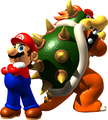 Mario and Bowser
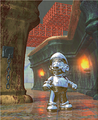 Metal Mario in the Hazy Maze Cave


Soundtrack
- Main article: Super Mario 64 Original Soundtrack
Super Mario 64's soundtrack comprises 34 music cues composed by veteran composer Koji Kondo. The majority of the cues are new material, with some being interpretations of familiar melodies from earlier media. In an interview, Kondo stated that it took him about eight months to compose the game's music.[79] It also includes hundreds of sound effects; sound designer Yoji Inagaki felt that sound effects were equally as important as music.[80]
An album tying in with the game was published by Pony Canyon under license from Nintendo as the first of ten soundtracks in the Nintendo 64 Sound Series. In addition to all of the game's music cues, the album includes Mario's opening voiceover and a piano arrangement of the Piranha Plant's lullaby.
The music for Super Mario 64 was scored using Best Service's Voice Spectral, Brüse & Brüse AudioProduction's Acoustic Drums, Digidesign's SampleCell II CD-ROM Library #1, the E-mu Proteus/1, ILIO's Synclavier World & Orchestral, the Korg Wavestation, Optical Media International's Universe of Sounds: Sonic Images Vol. 1, Q-Up Arts' The Denny Jaeger Private Collection Vol. 1, Rarefaction's A Poke in the Ear With a Sharp Stick, Roland's JD-990 synthesizer and Sound Canvas SC-88 module, Spectrasonics' Bass Legends and Supreme Beats, and the Yamaha VL1.[81] Many of the sound effects in the game were sourced from Sound Ideas' General Series 6000 and Series 1000 sound effects libraries and the sound effects libraries of American film studios Warner Bros. and Universal Pictures.[82]
Multimedia
- For the complete list of media files for this subject, see Multimedia:Super Mario 64.
 Bob-omb Battlefield - Speedrun of Big Bob-omb on the Summit Bob-omb Battlefield - Speedrun of Big Bob-omb on the Summit | File info 1:12 |
 Title Theme Title Theme | File info 0:29 |
| Main Theme | File info 0:30 |
| Peach's Castle | File info 0:29 |
| Piranha Plant's Lullaby | File info 0:29 |
| Powerful Mario | File info 0:28 |
References to other games

- Carvings of Mario and Bowser from this game appear on several pillars in Bowser in the Sky.
- An arrangement of "Ground BGM" plays on the title screen.
- The "Game Start" music track is an arrangement of "Ground BGM".
- "Underground BGM" can be heard in the music for the Hazy Maze Cave and Wet-Dry World.
- The Work Elevator used during the mission "Elevate for 8 Red Coins" is based on the Directional Lifts of World 7-6.
- The Cap Switches look and function similarly to the ! Switches in this game.
- When Yoshi is met, he says to Mario, "It has been so long since our last adventure!" possibly referring to this game.
- The soundtrack follows the same composition technique used in Super Mario World in a similar way where there is a signature melody in the game that is heard across different levels in several variations ("Super Mario 64 Main Theme", "Cool, Cool Mountain", "Slider").
- The theme used for invincibility in this game, specifically the string instruments playing in the background, is reworked into the "Powerful Mario" music track.
- The idea of collecting Red Coins first appeared in this title.
- Fly Guys appear as enemies.
- Ukkikis appear as non-playable characters.
- The grunts made by certain enemies and bosses, such as Bullies and the Whomp King, are based on those made by the bosses of this game when hit.
References in later media

- A possible theme for Wrinkly's Save Cave is similar to "Inside the Castle Walls", the music for the Mushroom Castle, suggesting that Wrinkly Kong is playing this game.
- The Castle Grounds and the Mushroom Castle appear on Royal Raceway.
- Penguins in Sherbet Land have an identical appearance to the ones in this game.
- This game was created using a modified version of Super Mario 64's engine, and it was developed alongside it.
- The notes for the Song of Storms are displayed as stars in the night paintings of the second floor in the Mushroom Castle.[83]
- The board Mario's Rainbow Castle is similar to the secret course Tower of the Wing Cap.
- Mario's title screen (if he is the most recent winner of a board game) depicts him with the Wing Cap flying with the other playable characters.
- Most of Mario's moves, animations, and voice clips in this game are derived from the ones in Super Mario 64.
- Although Luigi did not appear in the game, his moves, animations, and voice clips are identical to Mario's in Super Mario 64, except his voice clips are higher-pitched versions of Mario's.
- Metal Mario appears as a boss.
- The Mushroom Castle appears as a stage.
- One of the Lakitu Bros. appears in the background.
- The Meta Crystal stage is based on the Cavern of the Metal Cap.
- Trade & Battle: Card Hero series
- One of the collectible monsters introduced in the first game resembles the Big Bob-omb and shares the same name in Japanese, ボムキング ("Bomb King"). The monster's redesign in Kousoku Card Battle: Card Hero makes the similarities even more apparent.
- This game starts the same way, with a letter being sent from Peach.
- Peach's Castle design in this game is similar to that used in the box art of Super Mario 64.
- The main room of Peach's Castle is nearly identical.
- Peach's Castle reappears in the background of Peach Circuit, Mario Circuit 1, and Mario Circuit 4.
- The music for Bowser's Castle 1, Bowser's Castle 2, Bowser's Castle 3, and Bowser's Castle 4 is a sped-up arrangement of "Bowser's Theme" from this game.
- The Mushroom Castle appears as a stage and trophy.
- Rainbow Cruise is based on Rainbow Rainbow Ride.
- Metal Mario reappears as a boss and a trophy.
- The Metal Box returns in this game as an item and a trophy.
- Mario still has his voice clips, moves, and animations, and Luigi still has Mario-like voice clips, moves, and animations.
- One of Kirby's Stone forms is based on the Thwomp's design first used in this game.
- A section of "Inside the Castle Walls" plays on the status screen.
- A brief clip of Mario's fight with Bowser in Bowser in the Dark World is seen when FLUDD scans Mario.
- Hole 8 of Peach's Castle Grounds has a mountain with a similar layout to the one in the Bob-omb Battlefield, and the Big Bob-omb appears at the top.
- Shifting Sands is named after Shifting Sand Land.
- Skeeter's name appears on the Lakitu Cup leaderboard.
- An arrangement of "Peach's Castle" plays on Peach's Castle Grounds.
- An arrangement of "Bowser's Theme" plays on Bowser Badlands.
- In Woohoo Hooniversity, a room with four blocks can be seen in it; one of them is a block from Super Mario 64. The name of the game is even mentioned in the description of the blocks, and the professors are trying to figure out why the block vanishes when struck.
- The game starts in the same way: Peach sends Mario another letter.
- The music that plays during the minigame Artist on the Court is an arrangement of "Inside the Castle Walls".
- The artwork of Mario performing a Sweep Kick is reused as a silhouette for the dance mat and the instruction manual.
- Tick Tock Clock appears as a racetrack in this game.
- Several bosses from Super Mario 64 reappear in this game.
- The theme for Peach's Castle is a cover of "Inside the Castle Walls".
- Dorrie reappears.
- When Mario loses a life, an outline of Bowser's head is used to iris out.
- "Powerful Mario" plays when Mario turns into Invincible Mario.
- An arrangement of "Merry-Go-Round" plays when a Boo scores a goal.
- The game starts in the same way, with Peach sending Mario another letter.
- "Bowser's Road" is covered for Bowser's Star Reactor and Bowser's Dark Matter Plant.
- The falling asleep idle animation returns.
- The music from the Bob-omb Battlefield is unlockable.
- The Rainbow Cruise stage and Metal Box from the previous game return.
- Mario retains the moves and animations that originated in Super Mario 64.
- Both songs that play when the player plays in Peach Ice Garden and goes into said place in the Challenge mode are arrangements of "Inside the Castle Walls".
- The music for when the Mario Bros. first enter Peach's Castle and when everyone is removed from Bowser's Belly is a cover of "Inside the Castle Walls".
- This game ends with a view of a cake with Mario and Peach figures on it.
- In the Wii version, an arrangement of Cool, Cool Mountain and Snowman's Land's music is used in Dream Snowball Fight.
- The main theme and the Bowser stage theme are also used.
- In the Nintendo DS version, "Cool, Cool Mountain" is also rearranged as the second part of the Mario & Sonic Download Medley in Ultimate Figure Skating.
- Peach's Castle reappears in the game.
- Winning a Toad House minigame plays the jingle heard after Mario exits a course with a Power Star.
- When the player reveals a pair of Bowser or Bowser Jr. icons in the minigame Power-up Panels, the short tune that plays when Mario tries to enter a locked door is heard.
- Both games start with Peach sending a letter to Mario.
- In both Tall Trunk Galaxy (during the mission "Tall Trunk's Big Slide") and Rolling Coaster Galaxy, an arrangement of "Slider" plays at a moment.
- Whomp's Fortress reappears as the Throwback Galaxy, alongside Bob-omb Buddies and the Whomp King.
- An orchestral cover of "Bowser's Road" plays in Bowser's Lava Lair and Bowser's Gravity Gauntlet.
- The sound effect of Mario falling from a high place is reused, plus the platforming style is mixed together with Super Mario Bros. 3 and Super Mario Galaxy.
- When Mario waits outside a purple Mystery Box on the map screen, the endless stairs music can be heard.
- Metal Mario appears as a playable character.
- A cover of the music for Peach's Castle is used for Peach's Palace.
- On the Bowser's Castle court, a cover of the Bowser battle music is played.
- The first few notes of the theme for Peach's Castle are played during the intro.
- The theme "Slider" is covered during the minecart part of Bowser's Snow Fort.
- A cover of the theme "Slider" plays when the player rides Plessie.
- In Shifty Boo Mansion, there is a Green Star hidden behind a portrait of a Boo that can be entered like the pictures in the Mushroom Castle.
- The merry-go-round music from Big Boo's Haunt can be heard near the Aqua Cups ride in Water Park.
- A cover of "Bowser's Road" plays in Bowser's Peculiar Peak.
- Peach's Castle (64) appears as a DLC stage, which returns from the original Super Smash Bros.
- In Super Smash Bros. for Wii U, the original version of the main theme returns, and an arranged version of the theme is featured in the DLC stage in both games.
- The victory theme and the Game Over theme are used when the Mario, Silver Mario, and Gold Mario costumes complete a level or lose a life, respectively.
- When a Super Star is obtained, the Wing Cap theme is played for the Mario costume and the Metal Cap theme is played for the Silver Mario and Gold Mario costumes.
- King Bob-omb reappears as a boss in this game.
- As part of their promotion of Wave 2 of the Mario Kart 8 Deluxe – Booster Course Pass, several official Mario Kart Facebook pages localized for European audiences posted a screenshot showing Tanooki Mario driving near a penguin in GBA Snow Land, with descriptions that translate to "Penguins never forget" or "A penguin never forgets";[84][85][86][87] the descriptions, together with the picture, likely reference a popular gameplay act in Super Mario 64 wherein players would intentionally drop the Baby Penguin off-bounds in the course Cool, Cool Mountain,[88][89] implying that Mario is culpable for this act and that penguins hold a grudge against him as a result.
- The game marks a return to the non-linear, open-ended style of gameplay for 3D Super Mario platformers established by this game.
- The jingle that plays when Mario collects a Power Moon is an arrangement of "Star Catch Fanfare".
- An arrangement of "Bowser's Theme" can be heard in the song "Break Free (Lead the Way)".
- The Mushroom Kingdom contains various references to Super Mario 64.
- The regional currency is based on the design of the coins from Super Mario 64.
- A recreation of the courtyard appears as a sub-area.
- The trees in the kingdom resemble the deciduous trees from Super Mario 64.
- When the player collects a Power Star, the original version of "Star Catch Fanfare" plays.
- The brochure held by Hint Toad and in the Odyssey depicts the Bob-omb Battlefield.
- Mario can dress up as the original Super Mario 64 model of himself by buying the hat and costume separately at the Mushroom Kingdom Crazy Cap shop.
- The Metal outfit is the Super Mario 64 suit with a metal coat.
- An arrangement of Bowser's level and battle themes is played during the final battle against Bowcien in Adventure Mode.
- The Peach's Castle stage returns in this game, along with Princess Peach's Castle and Rainbow Cruise.
- The original theme "Slider" is featured as a sound effect under the "Musical" category, represented by the Nintendo 64 logo.
- A cannon from Super Mario 64 appears.
- The Main Theme and "Inside the Castle Walls" are arranged into the film's score.
- The Bob-omb Battlefield appears in the film when Mario, Peach, and Toad are journeying to the Jungle Kingdom.
- The sun floor pattern surrounding the map is similar to the floor pattern in the first floor of Peach's Castle.
- King Bob-omb appears at Bowser and Peach's wedding.
- A Maw-Ray appears.
- Bowser's laugh is used in "Press Start".
- One of the attacks used by the Mario Bros. against Bowser in the final battle involves grabbing him by his tail, spinning him, and tossing him upwards, similar to the attack used to defeat Bowser from Super Mario 64.
- The "Mechanical Harp (Lullabies)" treasure found in the second sublevel of the Cavern for a King plays "Piranha Plant's Lullaby" when being carried by Pikmin or interacted in the Treasure Catalog.
- Part of "Bowser's Theme" plays when Bowser is transformed into Castle Bowser from the effects of the Wonder Flower.
- An arrangement of "Slider" plays during the level Bonus: Coins Galore!
- A new variant of "Metal Mario", titled "Zappy Zone Wonder", plays during the Wonder Effect in High-Voltage Gauntlet.
Recycled assets from other games
- The Boo portraits in Big Boo's Haunt are based on their artwork from this game.
Names in other languages
| Language | Name | Meaning | Note(s) | Ref. |
|---|---|---|---|---|
| Japanese | スーパーマリオ64 Sūpā Mario Rokujūyon | Super Mario 64 | [90] | |
| Chinese (Simplified) | 神游马力欧 Shényóu Mǎlì'ōu (Mandarin) Sàhnyàuh Máhlihk'āu (Cantonese) | iQue Mario | iQue Player | [91] |
| 超级马力欧64 Chāojí Mǎlì'ōu Liùshísì (Mandarin) Chīukāp Máhlihk'āu Luhksahpsei (Cantonese) | Super Mario 64 | Super Mario 3D All-Stars | [92] | |
| Chinese (Traditional) | 超級瑪利歐64 Chāojí Mǎlì'ōu Liùshísì (Mandarin) Chīukāp Máhleih'āu Luhksahpsei (Cantonese) | [93] | ||
| 超級瑪琍歐64 Chāojí Mǎlì'ōu Liùshísì (Mandarin) Chīukāp Máhleih'āu Luhksahpsei (Cantonese) | Cartridge for Nintendo 64 | [94] | ||
| Korean | 슈퍼 마리오 64 Syupeo Mario Yuksipsa | Super Mario 64 | The "64" is pronounced in the Sino-Korean number system, same as Nintendo 64 | [95] |
Footnotes and references
Footnotes
- ^ Mizu-chan (21 Jan. 2014). Miniature Japanese garden. Minato, Tokyo: Muza-chan's Gate to Japan.
- ^ Private correspondence with shmuplations clarifies that the text they translated as "diorama"[41] was written as 箱庭 (hakoniwa) in the original text.[42]
- ^ Charles Martinet had previously claimed that the line was "So long, King-a Bowser!" (which he formatted as "So long kinga[sic] Bowser!"),[73] but he later clarified that it was likely "So long-a, Bowser!" in Mario's Italian accent.[74]
References
- ^ Scullon, Chris (June 23, 2021). The Nintendo 64 and Super Mario 64 Turn 25 Years Old Today. Gamer Network. Retrieved December 18, 2024 from Video Games Chronicle. (Archived July 26, 2021 via Wayback Machine.)
- ^ Kohler, Chris (September 29, 2016). Nintendo 64 Came Out 20 Years Ago. Here's How a Teenaged Me Reviewed It. Retrieved December 18, 2024 from Wired. (Archived September 29, 2016 via Wayback Machine.)
- ^ Yin-Poole, Wesley (March 1, 2017). The Nintendo 64 Turns 20 in Europe. Gamer Network. Retrieved December 18, 2024 from Eurogamer. (Archived March 3, 2017 via Wayback Machine.)
- ^ "On the 1st March 1997, Australia will be selling the world’s best games console in all its black and grey glory, retailing at around $399 with games being priced at approximately $99.95. But, unlike Japan and the USA, we should be able to choose from heaps of games right from the start, ranging from the flagship titles like Super Mario 64[...]" – November 1996. Nintendo Magazine System Issue 44. Catalyst Publishing (Australian English). Page 6. Retrieved March 27, 2026 from Internet Archive.
- ^ 「スーパーマリオ64 振動パック対応バージョン 1997年7月18日発売」– スーパーマリオ64. Nintendo (Japanese). Retrieved December 18, 2024. (Archived January 28, 1997 via Wayback Machine.)
- ^ iQue PLAYER优惠套装上海试卖,五款精品游戏同步发售!. iQue (Chinese). Archived December 25, 2005 from the original via Wayback Machine. Retrieved December 18, 2024.
- ^ March 1998. Electronic Gaming Monthly issue 104. Page 28. Retrieved November 19, 2024.
- ^ Kaluszka, Aaron (November 4, 2006). Virtual Console Details Exposed. Nintendo World Report (American English). Retrieved March 27, 2026. (Archived June 3, 2020, 22:29:24 UTC via Wayback Machine.)
- ^ VCスーパーマリオ64. Nintendo Co., Ltd. (Japanese). Retrieved March 27, 2026. (Archived March 2, 2026, 11:09:26 UTC via Wayback Machine.)
- ^ November 2, 2006. Wii VIRTUAL CONSOLE RELEASE DETAILS. Nintendo of Australia (Australian English). Archived December 11, 2006, 02:35:49 UTC from the original via Wayback Machine. Retrieved March 18, 2026.
- ^ a b Super Mario 64 | Nintendo 64 | Games | Nintendo UK. Nintendo of Europe SE (British English). Retrieved March 27, 2026. (Archived September 26, 2025, 23:18:00 UTC via Wayback Machine.)
- ^ Super Mario 64 for Wii U - Nintendo Game Details. Nintendo of America (American English). Archived December 14, 2020, 20:09:10 UTC from the original via Wayback Machine. Retrieved March 27, 2026.
- ^ Vuckovic, Daniel (April 2, 2015). Nintendo 64 and Nintendo DS games finally come to the Wii U Virtual Console. Vooks (Australian English). Retrieved March 17, 2026. (Archived April 4, 2015, 08:43:07 UTC via Wayback Machine.)
- ^ Super Mario 64 | Nintendo 64 | Games | Nintendo ZA. Nintendo of Europe SE (English). Retrieved March 27, 2026. (Archived January 11, 2026, 23:57:14 UTC via Wayback Machine.)
- ^ スーパーマリオ64 | Wii U | 任天堂. Nintendo Co., Ltd. (Japanese). Archived May 3, 2016, 10:44:19 UTC from the original via Wayback Machine. Retrieved March 27, 2026.
- ^ Nintendo (September 23, 2021). https://youtu.be/dG9fAtmYdlM&t=1260 Nintendo Direct - 9.23.2021. YouTube. Retrieved September 24, 2021.
- ^ Nintendo 公式チャンネル (September 24, 2021). Nintendo Direct 2021.9.24. YouTube. Retrieved September 24, 2021.
- ^ @NintendoEurope (September 23, 2021). "Play a growing library of Nintendo 64 and SEGA Mega Drive games anytime, anywhere with #NintendoSwitchOnline + Expansion Pack, a new membership launching in late October.". Twitter. Retrieved September 24, 2021.
- ^ @NintendoAUNZ (September 24, 2021). "Play a growing library of Nintendo 64 and SEGA Mega Drive games anytime, anywhere with #NintendoSwitchOnline + Expansion Pack, a new membership launching in late October.". Twitter. Retrieved September 24, 2021.
- ^ 《集合啦!動物森友會》將於11月5日發布免費更新(Ver.2.0),以及發售付費新增內容《集合啦!動物森友會 快樂家樂園》。. Nintendo HK. Retrieved October 16, 2021.
- ^ 「Nintendo Switch Online」을 더욱 즐겁게! 「Nintendo Switch Online + 추가 팩」이 10월 26일(화)부터 시작!. Nintendo Korea. Retrieved October 16, 2021.
- ^ North American box cover
- ^ Official Website. The link itself contains the right serial despite the page shows an incorrect one.
- ^ 香港版瑪利歐 64 顯示英文
- ^ Sakai, Kazuya (Ambit), kikai, Akinori Sao, Junko Fukuda, Kunio Takayama, and Ko Nakahara (Shogakukan), editors (2015). 『スーパーマリオブラザーズ百科: 任天堂公式ガイドブック』. Tokyo: Shogakukan (Japanese). ISBN 978-4-09-106569-8. Page 11–13.
- ^ Nintendo Co., Ltd. HISTORY → Series → Super Mario. Mario Portal. Retrieved November 6, 2024. (Archived October 3, 2024, 11:52:39 UTC via Wayback Machine.)
- ^ GameFaqs - The top 10 games Ever
- ^ Edge Online - The 100 Best Games to Play Today
- ^ Official Nintendo Magazine - 100 Best Nintendo Games
- ^ GameSpot - 15 Most Influential Games of All Time
- ^ http://gamingafterhours.com/2014/06/24/super-mario-64dd-version-discovered-in-japan/
- ^ O'Malley, James (September 11, 2015). 30 Best-selling Super Mario Games of All Time on the Plumber's 30th Birthday. Gizmodo. Archived from the original. Retrieved August 2, 2022.
- ^ https://www.gamespot.com/articles/wii-vc-47m-downloads-100-games/1100-6171850/
- ^ "Bowser has stolen the castle's Stars, and he's using their power to create his own world in the paintings and walls." – Toad (1996). Super Mario 64 by Nintendo EAD (North American localization). Nintendo of America.
- ^ "Bowser is trying to make a land of monsters inside the walls and the paintings by using the Power Star. Take back the star!" – Toad (1996). Super Mario 64 by Nintendo EAD (Japanese localization). Nintendo Co., Ltd.. (Archived via a translation by u/AlexLuis on Reddit.)
- ^ 「絵の世界のボム兵の話ではこうだ。「突然あらわれた怪物たちが、お城を守るちからの素、パワースターを大量に奪い取り、ピーチ姫やキノコ城の住人たちもこちらの世界に連れ去った。そして絵の世界の住人も怪物にしたてあげ、本当の世界に送りこんで、マリオたちの国を支配しようとしている」。」– Nintendo Co., Ltd. (1996). STORY. Super Mario 64 Official Site (Japanese).
- ^ "To help him accomplish this, [Bowser] plans to convert the residents of the painting world into monsters as well. If nothing is done, all those monsters will soon begin to overflow from inside the painting." – Nintendo of America (1996). "Story" in Super Mario 64 Instruction Booklet (pdf). Redmond: Nintendo of America. Page 5.
- ^ "Bowser stole the Power Stars that protected the castle and hid them away in magical painting worlds. These worlds look like paintings from the outside, but inside, they are real, three-dimensional places, filled with mysteries and all sorts of characters, both good and bad.... One school of thought believes that Bowser will turn Peach and her entourage into a sort of zombie army, then let them loose on our world. A competing theory suggests that Bowser will simply extend his painting worlds so that they encompass all of reality." – Pelland, Scott, and Dan Owsen (1996). "The Story of Super Mario 64" in The Super Mario 64 Player's Guide. Redmond: Nintendo of America. Page 5.
- ^ a b c d Koizumi, Yoshiaki (27 Nov. 2007). Super Mario Galaxy: The Journey from Garden to Galaxy. Montréal: Montreal International Games Summit, Alliance numériQC. Retrieved 27 Feb. 2021. (Archived 24 Sep. 2016 via YouTube by Eric St-Cyr and A Hover.)
- ^ a b 64編集部, editors (1996). 『スーパーマリオ64 マリオ・ザ・テクニック―完全攻略への最短ルート編』. Tokyo: Takarajimasha (Japanese). ISBN 978-4-79-661121-3. Cited in-text as Takarajimasha (1996).
- ^ a b c d e shmuplations (translator). "Super Mario 64 – 1996 Developer Interviews" (English translations of Takarajimasha and Shogakukan, 1996). shmuplations.com. Published 2022. Accessed 22 Jun 2023.
- ^ a b c Editing staff (1996). 『スーパーマリオ64 (ワンダーライフスペシャル―任天堂公式ガイドブック)』. Tokyo: Shogakukan (Japanese). ISBN 978-4-09-102554-8. Cited in-text as Shogakukan (1996).
- ^ a b c Trinen, Bill (14 Jun. 2017). What's in a Box?. Nintendo Treehouse Log. Retrieved 30 Jan. 2021.
- ^ Dean, Andrew R. (10 Dec. 2010). "Chapter 8: The Courtyard Garden" in Handbook, Part 1: Design & Craft (digital). North American Japanese Garden Association, najga.org. Retrieved 24 Jun. 2023.
- ^ Nihon Gaiji Kyōkai, editors (1957). Contemporary Japan: A Review of Far Eastern Affairs (25). Tokyo: Foreign Affairs Association of Japan. Page 246.
- ^ a b c d Design Doc (12 Oct. 2020). What Makes a Great Hub World? - How Mario 64, Spyro, and Hades Made Theirs ~ Design Doc. YouTube. Retrieved 18 Aug. 2023.
- ^ a b c d e Nintendo of America (1998). Super Mario 64 Strategy. Nintendo Official Site. Archived June 10, 1998, 06:41:37 UTC from the original via Wayback Machine.
- ^ a b Nintendo of Europe (1996). Super Mario 64 Instruction Booklet. Großostheim: Nintendo of Europe. Page 15.
- ^ Upchurch, David, editor (Mar. 1997). "Super Mario 64 The Essential Player's Guide" from Official UK Nintendo Magazine (54). London: East Midland Allied Press. Page 31.
- ^ Upchurch, p. 30
- ^ Upchurch, p. 32
- ^ Pelland, Scott and Dan Owsen (1996). The Super Mario 64 Player's Guide. Redmond: Nintendo of America.
- ^ Pelland and Owsen, p. 44
- ^ Pelland and Owsen, p. 45
- ^ Pelland and Owsen, p. 81
- ^ Pelland and Owsen, p. 82
- ^ Pelland and Owsen, p. 126
- ^ a b c d e Nintendo of America (1998). Bonus Stars - Super Mario 64 Strategy. Nintendo Official Site. Archived June 10, 1998, 03:54:13 UTC from the original via Wayback Machine.
- ^ a b Pelland and Owsen, p. 5
- ^ a b Rich Stanton. A Brief History Of Video Games: From Atari to Virtual Reality (digital). London: Little, Brown Book Group, 2015. ISBN: 978-1-47-211881-3.
- ^ Christopher W. Totten. "Hub Spaces". An Architectural Approach to Level Design. Boca Raton: CRC Press, 2018. pages 133-135. ISBN: 978-1-35-198292-4.
- ^ JoshDuMan. August 28, 2019. Decomp is out! …but what does that mean? – Ukikipedia News Week 10
- ^ Shogakukan. 2015. Super Mario Bros. Hyakka: Nintendo Kōshiki Guidebook, Super Mario 64 section, p. 85. 「ピーチ姫の飼っているウサギ。」 ("Princess Peach’s pet rabbit.")
- ^ Pelland and Owsen, p. 96
- ^ Upchurch, p. 20
- ^ Pelland and Owsen, pp. 25, 26, 28
- ^ Upchurch, p. 30
- ^ Pelland and Owsen, p. 119
- ^ Pelland and Owsen, p. 80
- ^ Pelland and Owsen, p. 28
- ^ Pelland and Owsen, p. 126
- ^ October 2, 2025. Nintendo Museum Official Book Vol. 01. Kyoto, Japan: Nintendo (English). Page 25.
- ^ Martinet, Charles (April 29, 2019). So long kinga Bowser!. Twitter. Retrieved February 6, 2021.
- ^ JoyConJames (February 2, 2025). Does Mario Really Say So Long Gay Bowser? | Voice of Mario Charles Martinet. YouTube. Retrieved April 17, 2026.
- ^ Master0fHyrule (September 18, 2020). 5 MAJOR Differences In Super Mario 64 That You Will Miss! (Super Mario 3D All Stars). YouTube. Retrieved September 23, 2020.
- ^ MacDonald, Keza (September 14, 2020). Super Mario at 35: Mario's makers on Nintendo's most enduring mascot. The Guardian. Retrieved November 15, 2020.
- ^ http://americanart.si.edu/exhibitions/archive/2012/games/#games
- ^ Celine (October 23, 2021). Nintendo software and hardware sales data from 1983 to present. Install Base. Retrieved July 13, 2026. (Archived July 4, 2026, 21:04:58 UTC via Wayback Machine.)
- ^ The Music Man. Nintendo of America (American English). Archived June 6, 1997, 11:41:22 UTC from the original via Wayback Machine. Retrieved February 8, 2025.
- ^ 効果音は空気のような存在. Nintendo Online Magazine. Archived August 21, 2007, 13:09:29 UTC from the original via Wayback Machine. Retrieved January 26, 2022.
- ^ https://docs.google.com/spreadsheets/d/1JJBlHHDc65fhZmKUGLrDTLCm6rfUU83-kbuD8Y0zU0o/edit?pli=1#gid=717751203
- ^ https://soundeffects.fandom.com/wiki/Super_Mario_64
- ^ "I've played this game [Super Mario 64] so many times and still never clocked that this painting had the Song of Storms in it" – HiteiGG (June 13, 2019). Post. Twitter. Archived July 4, 2020, 09:43:09 UTC from the original via Wayback Machine. Retrieved May 25, 2026.
- ^ "Los pingüinos nunca olvidan." – MarioKartESP (August 17, 2022). Post. Facebook (Spanish). Retrieved November 27, 2022. (Archived May 25, 2026, 10:55:43 UTC via Wayback Machine.)
- ^ «Un pinguino non dimentica mai.» – MarioKartItalia (August 17, 2022). Post. Facebook (Italian). Retrieved November 27, 2022. (Archived May 25, 2026, 10:56:38 UTC via Wayback Machine.)
- ^ "Een pinguïn vergeet nooit." ("A penguin never forgets.") – MarioKartNL (August 17, 2022). Post. Facebook (Dutch). Retrieved November 27, 2022. (Archived May 25, 2026, 10:56:12 UTC via Wayback Machine.)
- ^ "Os pinguins nunca esquecem." – MarioKartPT (August 17, 2022). Post. Facebook (Portuguese). Retrieved November 27, 2022. (Archived May 25, 2026, 10:59:23 UTC via Wayback Machine.)
- ^ March 6, 2013. We all did this - [Super Mario 64]. Reddit (/r/gaming). Retrieved November 27, 2022. (Archived June 1, 2023, 17:42:00 UTC via Wayback Machine.)
- ^ Fairfax, Zackerie (March 10, 2021). What Super Mario 64's Penguin Reveals About Its Players. screenrant.com. Retrieved November 27, 2022. (Archived July 19, 2021, 01:30:26 UTC via Wayback Machine.)
- ^ Japanese logo
- ^ Simplified Chinese logo
- ^ 《超级马力欧64》、《超级马力欧阳光》和《超级马力欧银河》。 3款历代的3D马力欧收录在Nintendo Switch的《超级马力欧 3D 收藏辑》,将于9月18日发售!. Nintendo HK (Chinese). Retrieved September 2020.
- ^ 《超級瑪利歐64》、《超級瑪利歐陽光》和《超級瑪利歐銀河》。3款歷代的3D瑪利歐收錄在Nintendo Switch的《超級瑪利歐 3D 收藏輯》,將於9月18日發售!. Nintendo HK (Chinese (Traditional)). Retrieved September 2020.
- ^ American style Taiwan cartridge
- ^ 1997 닌텐도 현대 컴보이 64 Nintendo Hyundai Comboy 64
External links


- Mario Portal Game Archive (English)
- Mario Portal Game Archive (Japanese)
- Official Super Mario 64 Japanese website
- Official Super Mario 64: Rumble Pak Compatible Version Japanese website
- American website
- Super Mario 64 Chinese website
- American English instruction booklet
- European English instruction booklet
- French instruction booklet
- Super Mario 64: Rumble Pak Compatible Version Japanese instruction booklet
| Nintendo 64 games | |
|---|---|
| Super Mario franchise | Super Mario 64† (1996) • Mario Kart 64† (1996) • Mario no Photopi (1998) • Mario Party (1998) • Mario Golf (1999) • Mario Artist: Paint Studio* (1999) • Mario Party 2 (1999) • Mario Artist: Talent Studio* (2000) • Mario Artist: Communication Kit* (2000) • Mario Tennis (2000) • Paper Mario† (2000) • Mario Artist: Polygon Studio* (2000) • Mario Party 3 (2000) • Dr. Mario 64† (2001) |
| Donkey Kong franchise | Diddy Kong Racing (1997) • Donkey Kong 64 (1999) |
| Yoshi franchise | Yoshi's Story† (1997) |
| Crossovers | Super Smash Bros.† (1999) |


.jpg)