Super Mario Bros.
- This article is about the Nintendo Entertainment System game. For other uses, see Super Mario Bros. (disambiguation).
- "Mario 1", "Super Mario 1", "Super Mario Bros. 1", "Super Mario Brothers 1", and "SMB1" redirect here. For other uses, see Mario 1 (disambiguation).
- "SMB" redirects here. For the Game Boy Advance game known as "Super Mario Ball" in Japan and Europe, see Mario Pinball Land.
- "Mario's Adventure" redirects here. For the unreleased title referred to in German promotional material as "Mario Adventure", see VB Mario Land. For the music tracks known as "MARIO ADVENTURES", see Super Mario Land (album).
- Not to be confused with Mario Bros. or Super Wario Bros.
| Super Mario Bros. | |||||||||||||||||
|---|---|---|---|---|---|---|---|---|---|---|---|---|---|---|---|---|---|
 For alternate box art, see the related gallery. | |||||||||||||||||
| Developer | Nintendo R&D4 | ||||||||||||||||
| Publisher | Nintendo | ||||||||||||||||
| Platforms | Family Computer, Nintendo Entertainment System | ||||||||||||||||
| Release dates | Family Computer: September 13, 1985[1] September 13, 1985[1]Nintendo Entertainment System:  October 18, 1985[2] October 18, 1985[2] May 15, 1987[3] May 15, 1987[3] July 1987[4] July 1987[4] 1993[5] 1993[5]
Family Computer Disk System:
February 21, 1986[6]Nintendo PlayChoice-10: August 1986[7]Game Boy Advance: February 14, 2004[8] June 7, 2004[9] July 9, 2004[10]Virtual Console (Wii) December 2, 2006[11] December 25, 2006[12] January 5, 2007[13] January 5, 2007[14] April 26, 2008[15] April 26, 2008[15]Virtual Console (Nintendo 3DS) (Ambassador Program release): September 1, 2011[16] September 1, 2011[17] September 1, 2011[18] September 1, 2011[19]Virtual Console (Nintendo 3DS) (Full release): January 5, 2012[20] February 16, 2012[21] March 1, 2012[13] March 2012[22] February 3, 2016[23]Virtual Console (Wii U): June 5, 2013[24] September 12, 2013[13] September 12, 2013[25] September 19, 2013[26]Nintendo Classic Mini: Family Computer: November 10, 2016[27]NES Classic Edition: November 10, 2016[28] November 11, 2016[29] November 11, 2016[30]Nintendo Entertainment System / Family Computer - Nintendo Classics: September 18, 2018[31] September 19, 2018[32] September 19, 2018[33] September 19, 2018[34] April 23, 2019[35] April 23, 2019[35] April 23, 2019[35] September 9, 2025[36] September 9, 2025[36] November 18, 2025[37] November 18, 2025[37] November 18, 2025[38] November 18, 2025[38] November 18, 2025[39] November 18, 2025[39] | ||||||||||||||||
| Language | English | ||||||||||||||||
| Genre | 2D platformer | ||||||||||||||||
| Ratings |
| ||||||||||||||||
| Mode | 1–2 players | ||||||||||||||||
| Format |
 Cartridge CartridgeNES:
 Game Pak Game PakFCDS:
 Disk Card Disk CardWii:  Digital download Digital download Digital download Digital download Digital download Digital download Game Pak Digital download Game Pak Digital downloadBuilt-in
| ||||||||||||||||
| Input |
NES:
Wii:  Wii Remote (horizontal) Wii Remote (horizontal) Wii Remote (horizontal) Wii Remote (horizontal) Joy-Con (horizontal) Joy-Con (horizontal) | ||||||||||||||||
| Serial codes | Family Computer: HVC-SM Nintendo Entertainment System: NES-SM NES-P-SM NES-SM-AUS NES-SM-GPS[5]Family Computer Disk System: FMC-SMAGame Boy Advance: PRE-AGB-FSMJ-JPN-1 (Hot Mario! Campaign) AGB-FSMJ-JPN (Retail version) AGB-FSMJ-JPN-1 (20th Anniversary) AGB-FSME-USA AGB-FSMP-EUR AGB-FSMP-AUS | ||||||||||||||||
 - Everyone
 - All ages
 - Three years and older
 - All ages
 - All ages
 - General audience
 - All ages
 - General







- “Do you have what it takes to save the Mushroom Princess?”
- —Back of localized box art
Super Mario Bros. is a side-scrolling platformer video game released for the Family Computer and Nintendo Entertainment System in 1985. It shifted the gameplay away from its single-screen arcade predecessor, Mario Bros., by featuring scrolling screens, allowing for longer levels. While not the first game in the Super Mario franchise (the first being Donkey Kong), Super Mario Bros. is the most iconic. It introduced various series staples, including power-ups, Mushroom Kingdom, classic enemies such as Goombas, and the basic premise of rescuing Princess Peach from Bowser. As well as kicking off an entire series of Super Mario platform games, the wild success of Super Mario Bros. popularized the side-scrolling genre as a whole, helped revive the North American gaming industry after the video game crash of 1983, and was largely responsible for the initial success of the Nintendo Entertainment System, with which it was bundled as a launch title. Until it was eventually surpassed by Wii Sports, Super Mario Bros. was the best-selling video game of all time for nearly three decades, with over 40 million copies sold worldwide.
Nintendo confirms the North American release date of Super Mario Bros. as October 18, 1985.[2] Prior, English sources were disputed with different sources giving different dates with no way to verify them.[47]
Super Mario Bros. has been ported to many consoles, to the point where the Guinness Book of World Records 2011: Gamer's Edition erroneously stated that this game was also remade on the Nintendo 64.[48] It was one of the NES games that could be played on the Nintendo PlayChoice-10 and NES Classic Edition, and it was released on the Wii, Wii U, and Nintendo 3DS Virtual Console and on the Nintendo Switch's Nintendo Entertainment System – Nintendo Classics.
A successor named Super Mario Bros. 2 in Japan was released on June 3, 1986. Due to its difficulty, another game, Yume Kojo: Doki Doki Panic, was reworked into Super Mario Bros. 2 for North America, released on October 9, 1988. The Japanese Super Mario Bros. 2 would eventually be named Super Mario Bros.: The Lost Levels in the west. A separate game serving as an arrangement or spin-off of Super Mario Bros. featuring elements from previous Super Mario games, known as Super Mario Bros. Special, was developed by Hudson Soft and licensed by Nintendo, and released on Japanese home computers in September 1986. A definitive third successor named Super Mario Bros. 3 was released on October 23, 1988.
Story
The following text is taken directly from the NES instruction booklet localization.
One day the kingdom of the peaceful mushroom people was invaded by the Koopa, a tribe of turtles famous for their black magic. The quiet, peace-loving Mushroom People were turned into mere stones, bricks and even field horsehair plants, and the Mushroom Kingdom fell into ruin.
The only one who can undo the magic spell on the Mushroom People and return them to their normal selves is the Princess Toadstool, the daughter of the Mushroom King. Unfortunately, she is presently in the hands of the great Koopa turtle king.
Mario, the hero of the story (maybe) hears about the Mushroom People's plight and sets out on a quest to free the Mushroom Princess from the evil Koopa and restore the fallen kingdom of the Mushroom People.
You are Mario! It's up to you to save the Mushroom People from the black magic of the Koopa!
Mario must then travel through eight worlds in total. At the castle in each of the first seven, he battles Bowser, only to discover that he was a fake, and that only a Mushroom Retainer was being held there. At the end of the eighth castle, Bowser is finally defeated, and Princess Toadstool is saved.
Gameplay

Super Mario Bros. is divided into eight worlds, each of them containing four levels. Mario[A] has to get to the end of the level by clearing an obstacle course featuring blocks, pits, enemies of various types, and other obstacles and objects. Certain pipes and beanstalks along the way allow Mario to visit secret bonus rooms which hold coins, and can skip a portion of the level. Unlike most later Super Mario games, the screen can only be scrolled to the right, making Mario unable to go to previous parts of a level. Certain levels can be skipped through the use of Warp Zones.

If regular Mario takes a hit, falls down a pit, or if the Time Limit runs out, he loses a life and restarts the level. If Super Mario or Fiery Mario takes a hit, he downgrades to regular Mario (Fire Mario downgrades to Super Mario in later titles) and is given a brief period of invincibility to minimize consecutive hits. The point where Mario continues from a lost life depends on how far he ran through the level before getting defeated; either from the beginning or at one of several invisible "checkpoints" throughout the level. After a Game Over, pressing  while holding
  on the title screen allows the player to continue from the start of the world.[49] In a 2-player game, if this is done by whoever got a Game Over second, both players will begin in the same world where the second player's game ended. Otherwise, levels can only be replayed if the game is beaten or the console is reset.
By hitting ? Blocks and bricks found throughout a level, Mario can find coins or special power-ups which grant him new abilities. Some of those blocks are initially hidden, and only become visible when Mario hits them from beneath. The power-ups that Mario can find are the Magic Mushroom, the Fire Flower, the Starman and the 1 up Mushroom.
At the end of each level, a castle stands with a flagpole nearby. When Mario reaches the flagpole, he takes down the enemy flag and enters the castle, completing the level. The higher the spot that Mario hits the flagpole, the more points he receives. If two players are playing the game, Luigi's turn comes whenever Mario loses a life. Luigi has no special abilities in the game that are different from Mario's.
The fourth level of each world plays inside a castle. They are usually filled with Fire-Bars and Podoboos. At the end of a castle level, Mario is confronted with a fake Bowser in Worlds 1 through 7 and the actual Bowser in World 8. Mario ordinarily has no way to hurt the fake Bowsers or the actual Bowser and has to either use the ax to destroy the bridge, causing either the false or real one to fall into the lava, or pelt him with many fireballs, which produces the same result and reveals the true forms of the fakes. After defeating an impostor, Mario frees one of the seven remaining mushroom retainers from the castle, at which point they say their iconic phrase: "Thank you, Mario! But our princess is in another castle!" At the end of the castle in World 8, Mario frees Princess Toadstool and completes his adventure, unlocking a harder new quest.
Time clock
The game's levels have a Time Limit in the upper right, which counts down, with the background music speeding up when going below 100. If it reaches 0, the game declares "Time Up", and Mario loses a life. However, the in-game timer runs much faster than real seconds; 400 seconds on the timer, which is the default when starting most of the levels, is equal to 160 seconds in real time. The timer countdown speed is the same across NTSC and PAL versions.
The demo version of Super Mario Bros. from amiibo tap: Nintendo's Greatest Bits starts with a real-time 180 second limit, which is sufficient to finish any level, presuming it is finished without losing any lives, and would have 32 timer seconds (15 real-time seconds) to spare for any follow-up levels. For its seventh scene, this is enough to see the game's ending.
Hard mode
- Main section: Hard Mode § Super Mario Bros.
After beating the main game, the player is given the option to pick a world (by pressing  on the title screen to change the world counter in the upper right) to play in "a new quest"—a harder mode where all Little Goombas are replaced by Buzzy Beetles, and all enemies walk faster. Elevator-style lifts that were originally in their wide forms (six holes wide) are now in their small forms (four holes wide), which are used from World 5-1 onwards in the main game. Mario[A] gains no new powers in hard mode, and enemies still give the same amount of points as normal. Additionally, earlier levels in hard mode that had harder versions later on the in the main game, now have the harder version used for both levels; for instance, World 1-3, which is an easier version of World 5-3 in the normal game, is identical to World 5-3 in Hard Mode. If the player finishes the game on hard mode, nothing else is unlocked.
Controls
The controls can be customized on Wii U Virtual Console and in the Suspend Menu on Nintendo Classics.
| Action(s) | NES Controller Famicom Controller |
Wii Remote | Classic Controller | GameCube Controller | Game Boy Advance | Nintendo 3DS | Wii U GamePad Wii U Pro Controller |
Dual Joy-Con (2) Pro Controller |
Single Joy-Con (2) |
|---|---|---|---|---|---|---|---|---|---|
| Move | ←  → →
|

|
/ ←  → →
|
 / ← / ←  → →
|

|
 / ← / ←  → →
|
 / ← / ←  → →
|
 ( ( ) / ← ) / ←  → →
|
←  → →
|
| Crouch / Enter Warp Pipe | ↓
|

|
/ ↓
|
 / ↓ / ↓
|

|
 / ↓ / ↓
|
 / ↓ / ↓
|
 ( ( ) / ↓ ) / ↓
|
↓
|
| Climb Beanstalk | ↕
|

|
/ ↕
|
 / ↕ / ↕
|

|
 / ↕ / ↕
|
 / ↕ / ↕
|
 ( ( ) / ↕ ) / ↕
|
↕
|
| Jump / Swim |
|

|

|

|

|

|

|

|

|
| Run / Throw Fireball |
|

|

|

|

|
 / / 
|
 / / 
|
 / / 
|
 / / 
|
| Pause / Start Game |
|

|

|

|

|

|

|
 + + 
| |
| (Title screen) Select Game | 
|

|
 [B] [B]
|

|

|

|

|
+ 
| |
| Continue after Game Over | Hold + Press
|
Hold + Press
|
Hold + Press
|
Hold + Press
|
Hold + Press
|
Hold + Press
|
Hold + Press
|
Hold + Press
|
Hold + Press
|
Worlds and levels
There are five main types of levels: ground, underground, underwater, athletic, and castle. Ground levels make up the majority of the levels in the game, with thirteen levels in total. They consist of flat areas with hills in the background and relatively few pits. Athletic levels take place in the sky, and feature very little ground. Most of the platforms take the form of trees, mushrooms or lifts, and as such there is a greater emphasis on precise jumps. There are seven athletic levels in the game.
Underground levels take place in tight inside spaces, with bricks covering most of the top of the screen and forming maze-like obstacles. They also feature hidden Warp Zones which can be used to skip worlds. Underwater levels take place in the sea, and Mario can freely swim around the level by pressing . Due to swimming, Mario cannot stomp enemies. At the start of every underground and underwater level is a cutscene showing Mario entering a pipe which leads to the level. Similarly, at their end is a pipe leading to the flagpole on regular ground. There are only two underground and two underwater levels in the game, but many levels have sub-areas in those themes. A few sub-areas also take place among the clouds.
The fourth level of each world is always a castle. It features even tighter hallways than underground levels, and some have maze-like mechanics which can loop rooms. At the bottom of castle stages, pits are covered in lava, although it serves no gameplay purpose. The goal of every castle level is to touch the axe and defeat the boss.
Certain worlds have different appearances to their levels. These changes are only aesthetic and do not affect gameplay. World 3 and World 6 take place at night, and World 3, World 5, and World 7 feature white plants and bushes, giving the impression of a snowy landscape. Additionally, World 8-3 uniquely has castle-like structures in its background, which provide build up to the game's final castle level.
| Worlds | ||
|---|---|---|
| World 1 | Courses | |
 Screenshot of World 1-1 |
World 1-1 (Ground) | |
| World 1-2 (Underground) | ||
| World 1-3 (Athletic) | ||
| World 1-4 (Castle) | ||
| World 2 | Courses | |
 Screenshot of World 2-2 |
World 2-1 (Ground) | |
| World 2-2 (Underwater) | ||
| World 2-3 (Athletic) | ||
| World 2-4 (Castle) | ||
| World 3 | Courses | |
 Screenshot of World 3-1 |
World 3-1 (Ground) | |
| World 3-2 (Ground) | ||
| World 3-3 (Athletic) | ||
| World 3-4 (Castle) | ||
| World 4 | Courses | |
 Screenshot of World 4-1 |
World 4-1 (Ground) | |
| World 4-2 (Underground) | ||
| World 4-3 (Athletic) | ||
| World 4-4 (Castle) | ||
| World 5 | Courses | |
 Screenshot of World 5-3 |
World 5-1 (Ground) | |
| World 5-2 (Ground) | ||
| World 5-3 (Athletic) | ||
| World 5-4 (Castle) | ||
| World 6 | Courses | |
 Screenshot of World 6-1 |
World 6-1 (Ground) | |
| World 6-2 (Ground) | ||
| World 6-3 (Athletic) | ||
| World 6-4 (Castle) | ||
| World 7 | Courses | |
 Screenshot of World 7-2 |
World 7-1 (Ground) | |
| World 7-2 (Underwater) | ||
| World 7-3 (Athletic) | ||
| World 7-4 (Castle) | ||
| World 8 | Courses | |
 Screenshot of World 8-4 |
World 8-1 (Ground) | |
| World 8-2 (Ground) | ||
| World 8-3 (Ground) | ||
| World 8-4 (Castle) | ||
Characters
Playable characters
| Image | Name | Description |
|---|---|---|

|
Mario | Mario serves as the main protagonist of the game. Luigi, Mario's brother, appears only as the second player and plays identically to Mario. While Luigi is differentiated by his colors, both Fiery Mario and Fiery Luigi have the same palette. |

|
Luigi |
Non-playable characters
| Image | Name | Description |
|---|---|---|

|
Princess Toadstool | The princess of the Mushroom Kingdom. Bowser kidnaps her to prevent her from reversing the magic the Koopa used on the Mushroom People. She appears in the final course, 8-4 where she thanks Mario[A] for rescuing her and offers a "new quest" for him. |

|
Mushroom retainers | Seven Mushroom People that are servants of the princess and prisoners of the Koopa. They appear in every castle except for the final one. Mario can rescue a retainer by finishing a castle in World 1 to World 7. They'll say, "Thank you Mario/Luigi! But our princess is in another castle!" |
Enemies and obstacles
Enemies
Enemies can be defeated by stomping them with a jump, hitting the block they are standing on, or hitting them with a fireball or kicked Koopa Shell, or running into them while invincible. Some enemies, such as Piranha Plants are immune to certain methods of attack. These immunities are listed in the table below. Enemies are generally listed in the order they appear in the instruction booklet. They are referred to as "bad guys" in-text.[50]:6
| Image | Name | Description | Levels | Pts. | |
|---|---|---|---|---|---|
| First | Last | ||||

|
Little Goomba | Mushroom creatures that walk back and forth. Little Goombas are the most common enemies and can be defeated with any attack. | World 1-1 | World 8-4 | 100 |

|
Koopa Troopa (green) | Foot soldiers of the Turtle Empire. Stomping on Koopa Troopas make them recede into their shells, which can be kicked to hit defeat enemies. Like Little Goombas, green-shelled Koopa Troopas walk off ledges. Fireballs and launched shells instantly defeat them. | World 1-1 | World 8-3 | 100 |
.png)
|
Koopa Troopa (red) | Red-shelled Koopa Troopas turn around when they reach the corner of a ledge. | World 1-2 | World 7-3 | 100 |
.png)
|
Koopa Paratroopa (green) | Winged Koopa Troopas. The green ones bounce across the ground or fly back and forth in set paths. If Mario stomps on them, they lose their wings, fall, and become Koopa Troopas. | World 2-1 | World 8-4 | 400 |
.png)
|
Koopa Paratroopa (red) | Red Koopa Paratroopas fly up and down in set paths. If Mario stomps on them, they lose their wings, fall, and act like green Koopa Troopas. | World 1-3 | World 5-3 | 400 |

|
Buzzy Beetle | Small Koopas that retract into their shells when stomped, similar to Koopa Troopas. Buzzy Beetles are immune to fireballs and replace Little Goombas in Hard Mode. | World 4-2 | World 8-4 | 100 |

|
Hammer Brother | Helmeted Koopas that toss hammers. Hammer Brothers periodically hop between rows of blocks. They always occur in pairs. If one is on-screen for 100 time units, it begins to chase after the player. | World 3-1 | World 8-4 | 1000 |

|
Spiny | Squat, spiked Koopas which hatch from their eggs. Stomping one damages Mario, and they cannot be defeated by hitting the block they are standing on. They are most vulnerable to fireballs. | World 4-1 | World 8-2 | 200 |

|
Spiny's egg | The spiked eggs tossed by Lakitus. They hatch into Spinies when they make contact with the ground. | World 4-1 | World 8-2 | 200 |

|
Lakitu | Cloud-riding Koopas. Lakitus toss Spiny's eggs. They float at the top of the screen, following Mario's position. They are vulnerable to stomps and fireballs, but may be difficult to reach due to their high positions. They respawn after being defeated. When Mario reaches the flagpole, the Lakitu stops pursuing him. | World 4-1 | World 8-2 | 200 |

|
Piranha plant | Chomping plants that sit in pipes. Piranha plants emerge and retract from pipes in set intervals, and stomping one damages Mario. If Mario stands directly next to or on these pipes, the plants do not emerge. Piranha Plants can be commonly defeated by Fiery Mario's fireballs. | World 1-2 | World 8-4 | 200 |
.png)
|
Cheep-cheep (red) | Pudgy pufferfish enemies that swim through water. Since Mario cannot stomp underwater, he can defeat these only with fireballs. In some ground-themed courses, red Cheep-cheeps leap over bridges in large numbers. | World 2-2 | World 8-4 | 200 |
.png)
|
Cheep-cheep (gray) | Gray Cheep-cheeps only occur underwater. They swim slightly faster than the red ones. | World 2-2 | World 8-4 | 200 |

|
Bullet Bill | Missiles launched from Turtle Cannons. They fly in straight lines. Bullet Bills are unaffected by fireballs. | World 5-1 | World 8-3 | 200 |

|
Bloober | Underwater squid sentinels. They swim erratically to strike Mario. Fireballs defeat them. | World 2-2 | World 8-4 | 200 |

|
Podoboo | Balls of lava that guard Bowser's castles. They leap straight up from pools of lava to strike Mario. | World 2-4 | World 8-4 | 
|
Obstacles
| Image | Name | Description | Levels | |
|---|---|---|---|---|
| First | Last | |||

|
Pit | Gaps on the ground of varying length. Falling into one causes Mario to lose a life. Smaller pits can be cleared with a jump, while larger ones require the use of blocks to cross. Athletic levels are known for having pits which cover almost the entirety of the level. In castle levels, pits are filled with lava. In underwater levels, pits have currents that drag Mario down. | World 1-1 | World 8-4 |

|
Fire-Bar | Various fireballs stacked together moving either clockwise or counterclockwise. Most Fire-Bars are six fireballs in length, while some are twelve fireballs in length. | World 1-4 | World 8-4 |

|
Koopa's fire | Flames spewed by Bowser and his imposters. The fire travels horizontally and transcends walls. | World 1-4 | World 8-4 |

|
Lava | Pools of lava cover pits in castle levels. Lava is purely aesthetic and does not affect gameplay, functioning like any other pit. In later games, Mario and other playable characters lose a life if they touch lava. | World 1-4 | World 8-4 |

|
Turtle Cannon | Cannons that launch Bullet Bills. Like the pipes that contain Piranha plants, Turtle Cannons do not fire when Mario is next to or on them. | World 5-1 | World 8-3 |
Bosses

A boss occurs in the fourth level of each world, specifically located within the final room of the castle. There are only two types of bosses in the game: Bowser and seven fake Bowsers. Each of the first seven worlds has a Fake Bowser at its end, while the final world has the real one. The baseline behavior of all bosses is the same: they are found on a bridge suspended above a pool of lava, moving back and forth, and jumping. By moving under or over the boss and touching the ax at the opposite corner of the bridge, it causes it to disappear and defeats the boss. Hitting the boss with five fireballs as Fiery Mario defeats it as well, awards the player with 5000 points, and reveals what minion the fake Bowser was. Attempting to stomp them damages Mario.
With each world, the layout of the room changes, sometimes featuring bricks and lifts. The boss's behavior also changes. In the first five worlds, the fake Bowsers launch flames at Mario. In the sixth and seventh worlds, they throw hammers instead. In the final world, the real Bowser launches flames and throws hammers simultaneously.
Items and objects
Items
| Image | Name | Description |
|---|---|---|

|
1 up mushroom | Green mushrooms that give Mario an extra life when collected. 1 up mushrooms are found within invisible blocks near pits. When a block is struck, the mushroom which spawns from it travels across the ground in the opposite direction from Mario. |

|
Coin | Coins float in mid-air throughout levels and within blocks. Collecting one awards Mario 200 points. Collecting 100 awards him an extra life. |
 
|
Koopa shell | Stomping on a Koopa Troopa makes it recede into its shell. Its sent sliding when touched, defeating enemies on contact. Doing so causes the "bulldozer attack",[50]:17 |

|
Buzzy Beetle shell | Stomping on a Buzzy Beetle yields a shell that works like the Koopa ones, but it cannot be cleared away with tossed fireballs. |
Power-ups
Items that transform Mario's appearance and give him unique abilities called "power boosts" in the instruction booklet.[50]:8
| Power-up | Form | Description | |
|---|---|---|---|
| Mario | Luigi | ||
| N/A |  Regular Mario |
 Regular Luigi |
Mario is in this small-sized form when the player starts a new game. In his regular form, Mario is incapable of breaking bricks and loses a life when he makes contact with an enemy or obstacle. However, he can run across narrow passageways without having to crouch. Regardless of the form he was in before losing a life, Mario reappears in the level in his regular form. |
 Magic Mushroom |
Super Mario |
Super Luigi |
The red Magic Mushrooms are within visible blocks and slide across the ground, similar to 1 up mushrooms. They bounce back in the opposite direction when they hit an obstruction. Touching one transforms Mario into Super Mario, a form twice as tall as his regular form and capable of breaking bricks. Subsequent encounters with blocks intended to contain Magic Mushrooms instead release Fire Flowers when struck in this form. Receiving damage in this form reverts Mario back into his regular-sized state. He retains this form across levels if he reaches flagpoles as Super Mario. |
 Fire Flower |
 Fiery Mario / Luigi |
Making contact with a Fire Flower transforms Super Mario into Fiery Mario. If Small Mario takes a Fire Flower, he becomes Super Mario instead. With the fire form, Mario can toss projectile fireballs with that bounce along the ground. Most enemies are defeated when hit. Fiery Mario also has all the benefits of Super Mario, and similarly retains this form if he completes the level in it. If hit as Fiery Mario, he reverts to his regular size instead of Super Mario.
| |
 Starman |
 Invincible Mario / Luigi |
Starmen are rare power-ups often hidden in invisible blocks. When released, they bounce in the opposite direction from Mario. When grabbed, Mario is transformed into Invincible Mario for ten seconds. In this state, Mario is largely indestructible and defeats enemies on contact. Contact with the Starman does not wholly replace the form Mario was already in (i.e., Mario remains small if one is touched while in his regular form, and he can still toss fireballs if he is in his Fiery form.) Invincible Mario cannot be carried over to subsequent levels. | |
Objects
Objects are interactable elements of the environment that cannot be picked up or collected.
| Image | Name | Description |
|---|---|---|
| Blocks | ||

|
? block | Floating blocks that contain items. One releases its contents when jumped underneath. Some ? blocks are multi-coin blocks that release a variable amount of coins if struck in rapid succession. Others are invisible. A struck ? block becomes an empty block that can be used as a platform. |

|
Brick | The most common blocks. Most bricks fall apart when struck, but some are secretly ? or multi-coin blocks. Regular Mario is incapable of breaking a brick block, but can still open one that contains a coin, multiple coins, or an item. |

|
Coral | Coral form varyingly sized columns in underwater levels that obstruct Mario. |

|
Small cloud | Cloud-like blocks make up the terrain in Bonus Stages high in the sky. |

|
Stairblock | Unbreakable blocks that appear on the ground. Some are stacked or laid next to each other to form climbable staircases or incomplete bridges. |
| Platforms | ||
.png)
|
Island | Terrain of varying heights and widths that occur in athletic courses. They are similar to super mushrooms, but often have wider bases made of earth. |

|
Jumping board | Jumping boards bounce Mario into the air. Pressing when the spring is fully contracted makes a jumping board launch Mario much higher than it would otherwise.
|

|
Lift | Thin, moving platforms. They are most common in athletic levels, above bottomless pits. Lifts are of varying widths and movements. There is a paired type of Lifts called Balance Lifts that are a seesaw-like pulley system, where standing on one Lift makes it fall and the other rise. There are also types of Lifts that fall shortly after being stepped on. |

|
Pipe | Most pipes are columnar platforms of varying height, some of which contain Piranha plants. A few of them are Warp Pipes that bring Mario to a secret underground area by pressing down on .
|

|
Super mushroom | Giant mushrooms that occur in athletic levels, high above bottomless pits. |
| Goals | ||

|
Ax | Touching an ax causes the bridge it is alongside to collapse. This defeats the boss that was on top of it and completes the level. |

|
Flagpole | Flagpoles are the goals at the end of most levels. When one is touched, Mario slides to the base and completes the level. Touching one also rewards him bonus points. The higher he is on the flagpole, the greater the number of points. Grabbing the top rewards Mario 5000 points. |
| Other objects | ||

|
Beanstalk | Beanstalks rapidly grow from struck vine blocks, ascending skyward. Climbing one brings Mario to a hidden Bonus Stage in the sky. |

|
Fireworks | Fireworks appear if Mario grabs a flagpole with 1, 3, or 6 as the last digit on the timer. The number of fireworks that go off correlates with this number, and each one rewards Mario 500 points. |

|
Horsehair plant | Field horsehair plants appear in the background of ground-themed levels. According to the instruction booklet, Bowser transformed some of the Mushroom Kingdom's inhabitants into these plants. |
Soundtrack

Within the franchise, the soundtrack to Super Mario Bros. has since become iconic, with its tracks frequently being rearranged or referenced in future games. Their prevalence has led them to be associated with certain concepts. "Ground BGM" is often used to represent the franchise as a whole, or as Mario's theme. Similarly, "Ending" has often been associated with Princess Peach in later games. "Underground BGM" is commonly used for underground areas, with it being rearranged in every mainline Super Mario game with the exception of Super Mario Bros. 2 and Super Mario World, as that game's underground theme. Likewise, "Underwater BGM" is commonly used for underwater areas, but also for the title screens of various games. "Invincibility BGM" is strongly associated with the Super Star power-up, as well as other similarly timed power-ups such as the Metal Cap in Super Mario 64, or the Fire Flower and Ice Flower in Super Mario Galaxy.
Due to the popularity of the game, albums featuring both the original soundtrack and arrangements of the music were released primarily in Japan. The first of these releases is Super Mario Bros. Original Soundtrack, released on March 1986. It contains a selection of the game's tracks, some of them overlaid with instruments and sound effects. Several albums celebrating anniversaries of the Famicom and the Super Mario series contain the original music tracks from Super Mario Bros. as a part of the compilations.
List of Super Mario Bros. albums
- Super Mario Bros. Original Soundtrack[a]
- Super Mario Bros.: Mario Syndrome[a]
- Game Sound Museum: Super Mario Bros.
- Super Mario Bros. (Nintendo Music)
List of other albums featuring Super Mario Bros. music
- Mario no Daibōken[a]
- Sound Mario Bros.[a]
- Super Mario Bros. 3 ~ Akihabara Electric Circus[a]
- Super Mario Bros. 1, 2, 3, Hop! Step! Jump![a]
- Super Mario Bros. Special[a]
- Super Mario World[a]
- Super Mario Compact Disco[a]
- Super Smash Bros. Melee: Smashing...Live![a]
- Mario & Zelda Big Band Live[a]
- Famicom 20th Anniversary Original Sound Tracks Vol.1
- Famicom Sound History Series: Mario the Music
- Happy! Mario 20th - Super Mario Sound Collection
- Super Mario History 1985-2010
- SUPER MARIO BROS. 25th Anniversary Special Sound Track PRESS START Edition[a]
- The 30th Anniversary Super Mario Bros. Music
Multimedia
- For the complete list of media files for this subject, see Multimedia:Super Mario Bros.
 Ground BGM Ground BGM | File info 0:30 |
| Underground BGM | File info 0:30 |
| Underwater BGM | File info 0:30 |
| Castle BGM | File info 0:30 |
| Invincibility BGM | File info 0:30 |
| Player Down | File info 0:03 |
| Course Clear | File info 0:07 |
Glitches
- Main article: List of Super Mario Bros. glitches
Minus World


- Main article: Minus World
The Minus World is an endless underwater level, identical to World 7-2, which is accessed through a programming glitch. The glitch is nicknamed after the glitched level counter displayed at the start and at the top of the screen. There is no way to complete the level, as entering the pipe at the end will simply return Mario or Luigi to the one at the beginning. To perform the glitch, Mario must go to World 1-2 and use glitches to reach the Warp Zone without scrolling it completely onto the screen, then entering the pipe that normally leads to World 4-1.
The glitch was removed in remakes of the game excluding the imports, the Virtual Console port, and Game & Watch: Super Mario Bros. Due to how memory is loaded differently in the Family Computer Disk System, that version of the game has a different Minus World with three levels that can be beaten, and once -3 is complete, the player will return to the title screen as if they had beaten the game.
Over the flagpole

In some levels, it is possible to jump over the flagpole, by using exploits to gain enough height. This can be done in World 1-1, by glitching a Koopa Troopa under the level and then using it to gain height, or in World 3-3, by jumping off a lift at its apex.[51]
Successfully jumping over the flagpole places the player in an unwinnable state, as they cannot return to the goal pole, and the rest of the level features only a flat ground. There is a hidden brick placed immediately after the fortress's or castle's first door, which normally stops Mario from going past it in the cutscene at the end of the levels.
In Super Mario Bros.: The Lost Levels, this is exploited to hide Warp Zones. In worlds 3-1 and A-3, there are warp zones placed beyond the goals. In other worlds, while it is possible to go over the flagpole, the edge of the world is a few steps past the fortress, and the player is not able to go far enough for the flagpole to scroll off the screen.
This glitch was fixed in the Super Mario All-Stars version.
 Over the Flag Pole Glitch - Video showcasing the Mushroom jump glitch and the Over the flagpole glitch in World 1-1 Over the Flag Pole Glitch - Video showcasing the Mushroom jump glitch and the Over the flagpole glitch in World 1-1 | File info |
Staff

- Main article: List of Super Mario Bros. staff
Super Mario Bros. was developed mainly by five people. The project was led by Shigeru Miyamoto, following his successes with previous games such as Donkey Kong and Mario Bros. He designed the game with assistance from Takashi Tezuka, who he had previously worked with to develop Devil World. Toshihiko Nakago, who worked together with Miyamoto on Excitebike, handled the programming alongside Kazuaki Morita, both of them from SRD, a company often contracted by Nintendo to assist in game development. Miyamoto also brought in composer Koji Kondo, who had previously also worked with him in Devil World, to create music and sound effects for the games.[52]
Miyamoto, Tezuka and Nakago would go on to become known internally at Nintendo as the "Golden Triangle",[53] or the "Kansai Manzai (comedy) Trio".[54]
Development

Development of Super Mario Bros. began shortly after the completion of Miyamoto's previous projects, Devil World and Excitebike. The game was created at the same time as The Legend of Zelda, with much of the staff working on both games. As a result, some aspects were shared between the two games, such as the Fire-Bars from Super Mario Bros., which were originally for The Legend of Zelda, but transferred to Super Mario Bros. under Miyamoto's suggestion.[52] Bringing knowledge from their previous games, Miyamoto, Tezuka and Nakago combined the jumping gameplay of Mario Bros., the scrolling screens of Excitebike and the larger character sprites from Devil World, into one game that could stand out from other titles at the time. Miyamoto and Tezuka wanted to fit various technologies into the game, comparing it to a puzzle. Additionally, other developers from SRD who had worked on previous games brought more elements, such as the jumping boards from Donkey Kong Jr. [55] The name "Super Mario Bros." also came from Mario's new Super form.[56] According to Toru Iwatani, creator of PAC-MAN, Miyamoto told him personally that Super Mario Bros. was influenced by Pac-Land, one of the pioneers of action games with horizontally scrolling backgrounds.[57]
The game was to be the last game made before the release of the Famicom Disk System, so Miyamoto set out to push the Famicom's cartridge capacities to their limits. The main goal of Super Mario Bros. was to create a dynamic game involving a character traveling through land, water, and the sky. The game's first prototypes were created at around December of 1984,[55] which consisted of a placeholder playable character was a 16×32 pixel square which moved on a single screen, but could not jump. Tezuka suggested making Mario the playable character due to the popularity of Mario Bros., which Miyamoto accepted.[53] The first concepts for the gameplay were drawn by Miyamoto on February 20, 1985, six months before the game's release on September 13, 1985.[58] It was Nakago's idea to create the Small Mario form, in order to fit more objects on the screen. It was then decided that Mario would lose a life if hit while small, but would only turn small if hit while big. Players would also start as the small Mario, as having him grow bigger later would leave a better impression on them.[56]
According to Nakago, the color of the background was made blue in order to create a striking image using the Famicom's vivid color palettes.[59] This was unusual, because video games released during this time usually had black backgrounds to avoid eye strain.[60] When setting the length of the levels, Miyamoto asked Nakago to make each of them be a minute long. Initially, Nakago expected the players to cross a single screen in one second, resulting in around sixty screens per level. However, Miyamoto took into account obstacles placed on the player's path and expected they would need around twenty screens per level. The final version of the game ended up having around twelve screens per level, with the longest one having thirty two, half of what Nakago had originally expected.[59]
When designing the stages themselves, because a level creating tool was not available to them at the time, Miyamoto and Tezuka would draw the levels on graph paper, and then Nakago and his team would design and program it into the game; if edits were to be made to the original drawings, a sheet of clear paper was placed over the original drawings.[61] Nakago has stated that a lot of documents were sent to his team every day to change some aspects of stages. Every day, the group would do all they could do of what was stated in the documents and would work until ten at night. The following day, Miyamoto and Tezuka would play through the levels created and make any changes, which would be passed on to Nakago and his team in a daily cycle. The level-creating process began with levels in the middle of the game, such as in World 3 or World 5, which were fun to play, but proved difficult to beginners. World 1-1, which acts as a tutorial to Mario's movements and the game's mechanics, was created towards the end of development.[59]
Great effort was put into making the game's code compact and efficient, with blocks being counted individually in order to fit in the game's memory. To this end, several performance- and memory-saving adjustments were made, such as reusing the castle assets between the start and end of the level, recoloring the clouds to use as bushes, and making use of mirrored sprites for objects such as the Super Mushroom and Fire Flower.[62][63] Every byte of memory saved by these measures then allowed the designers to add more blocks to the levels. The Goomba was only created at the end of the development cycle, due to players finding the Koopa Troopa to be too difficult as the first enemy in the game. Due to the low amount of bytes remaining in the cartridge, the enemy was designed as a single sprite, which could be flipped to simulate a walking animation.[62]
Atypical for games of the time, the music for Super Mario Bros. was created alongside the game's development, rather than towards its end, due to worries over the music impacting the already demanding performance of the game. This allowed Koji Kondo to better match the music to the game's tone by playing its prototypes. The first track Kondo created for the game was "Underwater BGM", with "Ground BGM" following soon after. Similar to graphical limitations, the sound effect for entering pipes and for transforming back into the small Mario were shared, now known as "Pipe Travel / Power-Down". The sound effect of hitting Koopa Troopas was also reused when Mario's swims up.[64] The "Ending" theme in the Famicom Disk System version of Super Mario Bros.: The Lost Levels was first composed as the ending theme of Super Mario Bros., before being shortened due to storage limitations.[65]
In two Japanese interviews promoting The Super Mario Bros. Movie, Miyamoto gave insight into the original background for the connection between the story of Mario Bros. and Super Mario Bros., stating that, among the pipes in Mario Bros., one of them leads to the Mushroom Kingdom where Super Mario Bros. takes place.[66][67]
After development ended on Super Mario Bros., the developers would immediately continue working on The Legend of Zelda. According to Nakago, Miyamoto told them they only had three hours to commemorate, before they returned to work.[68]
The title "Mario's Adventure" was used in place of "Super Mario Bros." in an early flyer sent to United States arcades for VS. Super Mario Bros.[69]
Regional differences
The European version of the game features various differences from the Japanese and US versions, which are identical:
- One pixel is added to the hitboxes of Little Goombas, Spinies, Piranha Plants, Bloobers, Cheep-cheeps and Bullet Bills.[70]
- As with VS. Super Mario Bros. and Super Mario Bros.: The Lost Levels, a ground block is placed directly above the exit pipe in all underwater areas, preventing Mario from performing a glitch in which he can get stuck inside the far right side of the wall.
- The starting positions of the first two Koopa Paratroopas in World 8-2 are changed: the first one starts one space to the left, and the second starts one space to the right.
- The lowest position a Bloober can reach onscreen is lowered by four pixels. This allows it to hit Super or Fire Mario if he is standing on the ground.
- The second tone of the sound effect when grabbing a coin is different.
- After touching the axe in castle stages, the screen scrolls at the same pace as Mario's walking speed in the Japanese and US versions. In the European version, the screen scroll does not sync to Mario's walking speed. This causes him to bump into the right edge of the screen and can result in him standing at various distances from the Mushroom Retainers or Princess.
Pre-release and unused content
- Main article: List of Super Mario Bros. pre-release and unused content

Several ideas were considered for Super Mario Bros., but ultimately scrapped. These unused ideas often inspired the developers to continue creating more Super Mario games which included them.[71] For example, the game was initially intended to have sky areas where Mario could ride a cloud and shoot a beam gun. The concept would go unused, the idea was reworked into the game's bonus areas. Another sketch for Super Mario Bros. shows Mario riding a dinosaur. While the idea was abandoned due to technical limitations, Miyamoto kept the sketch on his desk. Both rides would eventually return in Super Mario World, thanks to the increased capabilities of the Super Famicom.
Reception and legacy

Super Mario Bros. received critical acclaim and is considered one of the best games of all time. One of the most-praised aspects of the game is the precise controls, which allow players to control how far and high the characters jump and how fast they can run. The game popularized side-scrolling video games, and the game has since received several sequels and spin-offs, and many different ports and alternative versions. All characters, items, locations, music, and sound effects have become core elements of the Super Mario franchise (with their pixel art frequently referenced and alluded to in later games or other media, especially Small Mario's sprite) and are pop culture icons. "Ground BGM", the overworld theme, would go on to be inducted in the National Recording Registry as of 2023, being the first video game track to be included.[72] The plot of Bowser's kidnapping the princess (or other characters, since Princess Peach would later play more active roles in saving Mushroom Kingdom or other lands) or otherwise causing chaos has continued to be used throughout the core Super Mario series. Its sequels, Super Mario Bros.: The Lost Levels, a version of Yume Kojo: Doki Doki Panic that was reworked into Super Mario Bros. 2, and Super Mario Bros. 3, would further expand on the world and gameplay that Super Mario Bros. had established.
Bill Kunkel of ANALOG Computing calls Super Mario Bros. a showcase of the NES, highlighting the scenery of the levels, its pause and continue features, and its fun factor.[73] However, he does critique the game for its inability to scroll left. Burt Hochberg of Games magazine describes the game as "a tour-de-force of action games" and emphasizes the need for player precision to get through the game.[74] In Family Computing, Steve Morgenstern compares Super Mario Bros. to Alex Kidd in Miracle World and views both as two of the best games for their respective consoles.[75] He calls them games of discovery, describing how new enemies appear periodically, bonus areas that the player can discover, and the different environments the games offer. While he does not find these games as mentally challenging as text adventure games, he does find it satisfying to reach new parts of the games. He then recommends the reader to buy the basic NES set that includes this game and consider purchasing the NES Zapper separately rather than buy the deluxe set that includes the NES Zapper, R.O.B., Gyromite, and Duck Hunt.
With Super Mario Bros. first being released as a Nintendo PlayChoice-10 title in Europe, reviewers in the region viewed it as an arcade game. Clare Edgeley of Computer and Video Games reviewed it at the Amusement Trades Exhibition International.[76] She describes it looking like a classic arcade game, as more graphically complex games such as Space Harrier and Turbo Sub were also on showcase. Despite this, she predicted that the game would have great longevity in arcades due to its various features, bonus areas, and the skill needed to succeed. In Crash magazine's review of the NES and its initial game lineup, Julian Rignall describes Super Mario Bros. as "fiendishly addictive" and "incredibly playable" and praises it for playing identically to its arcade counterpart.[77]
The game has kept its positive reception for subsequent re-releases. For Play magazine, Chris Hoffman gives the Classic NES Series release an "A-" rating.[78] He finds that, aside from the graphics, the game has held up well and calls it "infinitely replayable and impeccably designed". For its release on the Wii Virtual Console, Kristan Reed of Eurogamer calls it an essential release for the Virtual Console, stating that it is easy to play despite its age.[79] He ends by giving the game a rating of five out of five stars. Danny Bivens of Nintendo World Report reviewed the game's release on the Nintendo 3DS as a part of the Nintendo 3DS Ambassador Program.[80] He states that it is the best portable release of the game due to it retaining the aspect ratio of the original and the pick-up-and-play nature of the game pairing well with the Nintendo 3DS.
As of 2004, Super Mario Bros. sold 40.24 million units with its original release.[81] It is now still considered the best-selling game in the Super Mario series (the second best in the entire franchise, behind Mario Kart 8 Deluxe) and among the best-selling video games of all time. Its massive success, coupled with the NES console it is released for, is credited with helping resurrect the video game industry in North America after the video game crash of 1983. Alongside spawning several immediate sequels in Super Mario Bros.: The Lost Levels, Super Mario Bros. 2, and Super Mario Bros. 3 that further expanded upon the game, it has received several adaptations in other media, such as The Super Mario Bros. Super Show! and the Super Mario Bros. film. While the 1993 live action Super Mario Bros. film was a commercial failure (while attaining a cult following), the 2023 animated movie, The Super Mario Bros. Movie, was a box office blockbuster, grossing over $1.3 billion USD. Beyond the immediate sequels, Super Mario Bros. would help establish a gigantic video game franchise with many spinoff series, such as Mario Kart and Mario Party (both which are massively successful video game series on their own and still qualify as part of the top 50 best selling video game series) and massively eclipse all video game franchises in terms of amount of video games and sales figures, with 893 million units sold, far surpassing second place.
This success also influenced games created by different developers. The gameplay of Sonic the Hedgehog was inspired by Yuji Naka replaying World 1-1 repeatedly and getting better at completing it.[82]

Similar to Donkey Kong, the game has been part of the fixture of pop culture. Countless games ranging from other Super Mario games to Nintendo games (see List of references in Nintendo video games) to a diverse array of non-Nintendo third party games (see List of references in third-party video games) have referenced Super Mario Bros. The phrase, "Thank you Mario! But our princess is in another castle!" is a recognized quote, appearing frequently or parodied within the Super Mario franchise, including video games and merchandise as well as outside of it. Other media have also referenced Super Mario Bros. to the degree that creating an exhaustive list is difficult, but it ranges from government PSAs such as from the New York State Department of Motor Vehicles to Korean game shows and American rap music using the coin sound effect to manga depicting characters playing Super Mario Bros. or versions of it.
The game was placed 14th in the 100th issue of Nintendo Power's "100 best Nintendo games of all time" in 1997.[83] It ranked the first spot in Electronic Gaming Monthly's "Greatest 200 Games of Their Time",[84] named in IGN's top 100 games of all time lists in 2005 and 2007, and declared the second-best Mario game of all time. IGN also placed it 3rd in its Top 100 NES Games list.[85] In 2010, a street in Zaragoza, Aragón (Spain), was named after Super Mario Bros., with a ceremony being held in celebration.[86] In 2015, it was among the first inductees to the World Video Game Hall of Fame.[87]
| Reviews | |||
|---|---|---|---|
| Release | Reviewer, Publication | Score | Comment |
| NES | The Games Machine[88] | 89% | "To play this game is to get hooked. Simple to understand, it is therefore easy to play; no ploughing through bedsheet-sized instruction leaflets with this one, Nintendo's small-sized controller takes some getting used to, but perseverance reaps its own reward, because the graphics and sound are splendid, combining to make a game that is colourful, jolly and in places pleasantly frustrating as you try to work out the best routes round a problem. Let us hope that Super Mario Bros. makes it onto home micros in better shape than did its predecessor." |
| Wii | Mark Birnbaum, IGN | 9/10 | "Dozens if not hundreds of imitators have tried to improve or revolutionize the formula that Nintendo spawned back in 1985; some have failed, while others have come close. Even with the most successful of these attempts, coming back to play Super Mario Bros. is still just as much fun as ever, and truly makes you appreciate how games were designed in the past – and how they should always be made in the future. 500 Wii points is an absolute no-brainer. This adventure is an absolute must for any gamer’s Virtual Console collection." |
| Wii | Jeff Gerstmann, GameSpot | 8.3/10 | "Super Mario Bros. was the face that launched a million consoles back in the mid-’80s, and its amazingly memorable graphics and sound, along with its still-sharp gameplay, make it stand out among the rest of the Virtual Console releases. At a cost of five dollars, this is a great purchase if you’re feeling nostalgic, but even if you’re too young to remember the game’s first release, you’ll find that this is one of those rare classics whose gameplay is good enough to still be fun after all these years." |
| Nintendo 3DS | Philip J Reed, Nintendo Life | 9/10 | "Super Mario Bros. is one of those rare games that has never really gone away. It's been reissued and remastered so many times that we never really seem to be too far away from a chance to experience it all over again, yet it still hasn't worn out its welcome. There's always more to discover, and always one more reason to return to the Mushroom Kingdom." |
| Aggregators | |||
| Compiler | Score | ||
| GameRankings | 85.50% | ||
| Metacritic | 84 (Classic NES Series: Super Mario Bros.) | ||
Anniversary celebrations

Nintendo celebrates the anniversary of the release date of Super Mario Bros., and the start of the Super Mario series, with special events every five years. While Donkey Kong is technically the first game to use the Super Mario family of characters, Super Mario Bros. carries considerably greater influence on the franchise by standardizing Mario's design and introducing iconic elements of the franchise, such as power-ups, the Mushroom Kingdom and its recognizable characters, recurring musical tracks like "Ground BGM" and "Underground BGM" (the former of which becoming the franchise's main theme), the sound effects including but not limited to the 1-Up, Coin, and jump; and more. As a result, the anniversaries for Super Mario Bros. are treated as the celebration of the Mario franchise as a whole. During the promotional events, Nintendo often discounts their games, promotes events to attend, and releases new merchandise (some exclusive to the anniversary celebrations).
Super Mario Maker was a major release as part of the Super Mario Bros. 30th Anniversary which frequently pays tribute to Super Mario Bros. Its release date coincided closely with the original release of Super Mario Bros., the boxart uses the Super Mario Bros. style, the artbook features planning sheets of four of its levels, and amiibo based on Mario's appearance from Super Mario Bros. were produced.
- Happy! Mario 20th
- Super Mario Bros. 25th Anniversary
- Super Mario Bros. 30th Anniversary
- Super Mario Bros. 35th Anniversary
- Super Mario Bros. 40th Anniversary
References to other games
- Trampolines return with a similar design.
- Pipes, coins and blocks, introduced in this game, return.
- Koopa Troopas are derived from this game's Shellcreepers.
References in later media
- For the NES re-release of these games, Mario's jumping sprite from Super Mario Bros. is used on the box art.
- Aside from being the non-Japanese sequel to Super Mario Bros., Mushrooms, Starmen, and Shells appear, serving similar uses as in the game's predecessor.
- When Princess Toadstool is saved, she says, "Thank you! But our Princess is in another castle!...Just kidding!" This is a reference to the mushroom retainer's line in Super Mario Bros.
- Several sprites from Super Mario Bros. appear in bonus levels.
- World 1-2 is similar to World 1-3 from Super Mario Bros., and the battle against King Totomesu in the next level is analogous to the ones against Bowser.
- The revelation that Princess Daisy is an enemy in disguise at the end of the first three worlds is reminiscent to fake Bowsers and the real princess not being held by those bosses.
- The music that plays in the Sky Pop and Marine Pop levels is similar to "Ground BGM", which is also arranged in the game's credits theme.
- The "Course Clear" fanfare can be heard after Baby Mario and Baby Luigi return to their home.
- If the player goes behind a curtain in Booster Tower, Mario briefly turns into his 8-bit sprite from Super Mario Bros., with "Ground BGM" playing during this.
- Outside the Warp Pipe that leads to the final boss, carved into pillars are what look like sprites of Mario and Bowser from Super Mario Bros.

- The stage Mushroom Kingdom is a reference to the ground levels.
- When Mario performs his taunt, he mimics his standing pose in Super Mario Bros.
- Mario's and Luigi's victory fanfare is a version of the "Course Clear" theme.
- Mario and Luigi's helpless animations are based on the pose Mario and Luigi take upon defeat in Super Mario Bros.
- Many items from Super Mario Bros. are usable in this game.
- One of Luigi's alternate colors bears resemblance to his colors in Super Mario Bros.
- Playing Star Mode for the Modern version of Donkey Kong Jr. replaces the Goomba enemies with Spinies, similar to the new quest mode in Super Mario Bros. replacing the Goombas with Buzzy Beetles.
- Goombario references Super Mario Bros. in the Goomba's Tattle entry.
- If Mario jumps into a huge vase in a room on the first floor of the Boo's Mansion, he will become 8-bit. Unlike in Paper Mario: The Thousand-Year Door, his allies will not become an 8-bit form.
- Luigi's sprite from the 16-bit version of Super Mario Bros. appears as part of the Game Boy Horror's screens.
- Although not distinctly noted as such, the idea of King Boo using a Bowser decoy may be loosely based on the seven fake Bowsers in Super Mario Bros.
- The first Adventure Mode stage is inspired by this game along with other Super Mario titles.
- The end of a castle level is seen when Mario first met F.L.U.D.D., during its facial recognition procedure.
- Various 8-bit patterns are seen in the background of the secret levels of Ricco Harbor and Sirena Beach.
- Some of the available levels for World-e include reproductions of Super Mario Bros.'s Worlds 1-1, 1-2, 1-3, 1-4, and 2-2 in Super Mario Bros. 3's style. Only World 1-1 was originally made available outside Japan.
- The background of the Panic Pinball minigame features the hills and fortresses from the Super Mario All-Stars remake of Super Mario Bros.
- At the border between the Mushroom Kingdom and the Beanbean Kingdom, there is a minigame titled Border Jump that uses the goal of most levels in Super Mario Bros. (including the flagpole, fortress, and fireworks for success).
- There is a 2D obstacle room before Roy's room which ends with Mario getting the axe and burning the Bowser decoy above a lava bridge.
- A type of ? Block from Super Mario Bros. can be seen among other types.
- If the player jumps up into a vent and then comes down into the changing room in the X-Naut Fortress, Mario and all his allies will become 8-bit and similar in style to the Super Mario Bros. sprites.
- The loading screen, which has Mario hitting a ? Block, uses sprites from this game.
- Toadsworth the Younger states when Baby Peach flies away "You will save her, won't you? I assure you she's NOT in another castle.", referencing the mushroom retainers' famous line "Thank you, Mario! But our princess is in another castle!".
- Many things from Super Mario Bros. return here, such as Goal Poles, Warp Zones (in the form of Warp Cannons), and the title screen's logo typeface.
- When connecting to a multiplayer game, Mario can be seen running through what looks like World 1-2.
- A close-up of Mario from Super Mario Bros. as well as a picture from said game are unlockable backgrounds.
- The sound effect that plays when Mario or Luigi slides down the Goal Pole is reused, albeit in reverse.
- The second level is an underground level with a secret path over the ceiling leading to a secret exit, similar to the secret path over this game's World 1-2.
- The main boss of World 1 is Bowser, who is defeated by breaking his bridge and dropping him into lava, and the first main boss of World 8 features Dry Bowser, who is defeated in the same way, and throws bones like how Bowser threw hammers in later levels of this game.
- One of the Mario Vs. Luigi stages is a truncated looping version of World 1-1.
- The secret Challenge mode disables backwards scrolling, making the side-scrolling identical to Super Mario Bros.
- If Mario clears a level with the last two digits being identical (except for 00), the original "Course Clear" fanfare will play.
- The first two levels are based on World 1-1, 3 and 7 are underground-based, 8 and 9 are based on the cloud areas, and 10 is set in a castle level.
- In Mario Stadium, one can see an 8-bit Mario chasing two Goombas.
- The music for Bowser's Castle is a cover of "Castle BGM".
- The sprites of Mario, Luigi, Peach, and Bowser appear around said character when they collect the Pal Pills.
- When any character (including a Koopa Troopa) grabs a Mega Star, they turn into a huge version of their Super Mario Bros. sprites. (Mario and Luigi are their Small forms in both).
- Portions of Chapter 1-1, Chapter 3-1, and Chapter 5-3 are identical to Worlds 1-1, 1-2, and 2-1, respectively.
- In Toy Time Galaxy, there is a huge 8-bit Mario or Luigi.
- In Flipswitch Galaxy, the background contains a ground scene and an underground scene from this game.
- The stage Mushroomy Kingdom is based on Worlds 1-1 and 1-2 of this game.
- Lakitu and Spinies appear as Assist Trophies, retaining their original 8-bit looks.

- The microgames Spiny and Blooper are based on this game.
- Several features available in the Super MakerMatic 21 originate from this game:
- The defeat sound effect as one of the instruments of the 8-Bit rhythm set;
- The Mario Jump, Coin, Power Up, Power Down, Shell Kick and Cannon sound effects;
- The ground and brick wall pre-made palette elements;
- The Coin, ? Block, Hard Block, Lava Bubble, background bush, background hill, background cloud, Vine, Pipe, Platform, Lift, background fortress, Super Mushroom, Fire Flower, Small Mario, Super Mario, Princess Peach, Toad, Goomba, Koopa Troopa, Bullet Bill and Piranha Plant as pre-made stamps in the 8-Bit set.
- The second level of Coin Courses is a modified variant of World 1-1.
- If Mario clears a level when the last two digits of the timer match, "Course Clear" will play.

- In Twisty Trials Galaxy and the second area of the Grandmaster Galaxy, there is a backdrop showing moving sprites of items and an 8-bit Mario and Luigi from this game.
- Mario Squared Galaxy takes place on a modified 8-bit Mario, as well as an 8-bit Luigi during the mission "Luigi's Purple Coin Chaos".
- Mario's sprite is used as the marker of where Mario is in a world.
- Tail Bowsers are tailed variants of fake Bowsers, and the first one is a disguised Goomba.
- The second level has a ledge just out of view that allows the player to walk over the level, and ends in a secret Pipe.
- Piranha Plant Slide is heavily based on the underground levels of Super Mario Bros. The cloud and bushes in the race course are the same model in different colors, referencing how the clouds and bushes in Super Mario Bros. are the same sprite in different colors.
- The first course in Coin Rush's Gold Classics Pack is based on Worlds 1-1 and 1-2, while the last course is based on World 1-4.
- If Mario clears a level when the last two digits of the timer match the world number multiplied by 11, "Course Clear" will play.
- Sprites from Super Mario Bros. are used in the game menus.
- The second level is an underground course with a secret path over the ceiling leading to a secret exit.
- The first phase of the final boss involves striking an axe to Bowser's bridge to drop him into the lava.
- If Mario clears a level when the last two digits of the timer match, "Course Clear" will play.

- Various sprites of Luigi, including some from Super Mario Bros., are reused as hidden Luigis.
- After completing the level when the second and third digit of the timer are the same, this game's course clear song will play.
- Mario's sprite is seen on the saving screen. His sprite can also be seen in a bonus area of Bob-ombs Below.
- Luigi's sprite can be spotted in some levels and on the button to enter the Luigi Bros. game.
- Super Mario Bros. is one of the games remixed in this game.
- A port of the game titled Super Luigi Bros. appears, where the player controls Luigi and all of the levels are mirrored horizontally.
- Various sprites of enemies and scenery can be seen on pots in Bone-Dry Dunes.
- Super Bell Subway has graffiti representing World 1-2.
- The Mushroomy Kingdom stage returns from Super Smash Bros. Brawl, albeit without World 1-2.
- A port of the game titled Speed Mario Bros. appears, in which the game runs twice as fast.
- The Shell Patch enemy greatly resembles a Red Shell's sprite in this game.
- Super Mario Bros. is used as one of the four game styles.
- In battles, Hammer Bros. charge at the players after a certain amount of time, like in Super Mario Bros.
- Mario & Sonic at the Rio 2016 Olympic Games (Nintendo 3DS)
- A structure in the shape of a Castle from Super Mario Bros. made of Brick Blocks and character wall obstacles of Mario, Bowser, Lakitu, Spinies and Goombas using their sprites from Super Mario Bros. appear as obstacles in Golf Plus.
- The game selection music of this console incorporates some sound effects from this game and Mario Bros., including the "1-Up" sound effect and the "Pipe Travel / Power-Down" sound.
- Several statues based on sprites from this game can be unlocked and used in the Kingdom Builder mode.

- In some parts of the game, Mario can walk within walls from a 2D perspective that uses sprites and sound effects from Super Mario Bros., as well as altering the music to an 8-bit variation.
- Additionally, a replica of World 1-1 can be played in a theater in New Donk City in order to obtain the "Up on the Big Screen" and "Down Inside the Big Screen" Power Moons.
- A scene of Mario confronting Bowser in Super Mario Bros. can be seen when Mario captures Bowser in this game.
- Mario, Goomba, Spiny, Cheep Cheep, and Bowser's sprites appear in Puzzle Hustle.
- Dart Gallery's background features neon lights resembling Super Mario Bros.'s overworld levels.
- The Mushroom Kingdom stage from Super Smash Bros. returns in this game, along with Mushroomy Kingdom from Brawl.
- Super Mario Bros. returns as the first of the five game styles.
- The loading icon in the Wireless Play menus features an 8-bit Mario running in a circle. If the loading animation plays for long enough, the sped up variant of "Ground BGM" will fade in.
- The 8-Bit Jumping Mario, 8-Bit Jumping Luigi, 8-Bit Star, 8-Bit Bullet Bill, 8-Bit Fire Flower, 8-Bit Super Mushroom, 8-Bit Block Glider, and 8-Bit Goomba are re-creations of their sprites in Super Mario Bros.
- The Super 1 uses the Japanese logo.
- The sprites for Mario, Luigi, Princess Peach, Bowser, Goombas, Koopa Troopas, Hammer Bros, Lakitus, and Toads are reused in the 2D Events. In these events, differently colored Toads appear which have sprites that are based on the sprite used for red Toads, the only color of Toad present in Super Mario Bros.
- The race course World 1-1 and the Retro theme it uses are heavily based on the level of the same name.
- The tiles from Squared Away have been changed to look like Small Mario's sprite.
- Whenever Rabbid Mario retrieves a Purified Darkmess Energy Crystal, he plays the "Course Clear" theme on his mandolin.
- The Super Mario Bros. Movie
- Main section: List of references in The Super Mario Bros. Movie § Super Mario Bros.
- Mario's jumping animation closely resembles the pose he makes on the Japanese box art of Super Mario Bros.
- Several notes from the ending fanfare are played at the beginning of the intro cutscene.
- The secret exit in Piranha Plants on Parade, the second level of the game, shows a pipe configuration identical to the one in World 1-2 shortly after the end-of-level fortress.
- Shining Falls Special Triple Threat Deluge's first section remakes the beginning of World 1-1 and the lift section of World 1-2.
- In The Sharp Trial: Launch to Victory, during the Wonder Flower's effect, there is a block formation referencing the Fire Flower sprite.
- The Thousand-Year Door (Nintendo Switch)
- The arrangement of the regular battle theme now begins by quoting the "Ground Theme" motif.
- The game features fourteen challenges and 45 player icons based on Super Mario Bros.
- The block designs in the Brick Breaker minigame are based on the sprites of Mario, a Goomba, and a Koopa Troopa.
- The game features five arrangements of Super Mario Bros. tracks, consisting of two of "Ground BGM", two of "Underground BGM" and one of "Underwater BGM".
- Pipe Cannons take the appearance of pipe junctions similar to the ones entered to access underground levels.
- Generic trampolines take the red and yellow coloration of trampolines from this game.
- The Super Mario Bros. 4K 1-1 demo allows players to play through World 1-1, with each in-game pixel being the size of a screen pixel and the entire level being visible at once in a 4k screen.
- The coin and "1-Up" sound effects can be heard in the HD Rumble 2 Sound demo.
- The Nintendo and Rumble (2) insight features images of a Super Mario Bros. cartridge.
- The Ray Tracing insight and the Main Computer Insights Quiz 2 quiz feature stylized depictions of World 1-1.
- "Ground BGM" and "Underwater BGM" appear as background tracks.
- Mario or Yoshi can whistle several tunes from Super Mario Bros., those being:
- The first five notes of "Ground BGM".
- "Player Down".
- The sound for sliding down a flagpole.
- The "1-Up" sound effect.
- The Super Mario Galaxy Movie
- Main section: List of references in The Super Mario Galaxy Movie § Super Mario Bros.
Alternate versions and re-releases


- 1985 - Original Family Computer and Nintendo Entertainment System release (Japan and North America)
- 1986 - Re-released on the Family Computer Disk System in Japan as one of the launch titles.
- 1986 - Released for the arcade VS. System as VS. Super Mario Bros.
- 1986 - A Game & Watch titled Super Mario Bros. is released, but it is a completely different game.
- 1986 - Ported into the arcade machine Nintendo PlayChoice-10.
- 1986 - Released on the Family Computer Disk System as All Night Nippon: Super Mario Bros. Most of the levels have been reused but the physics engine is from Super Mario Bros.: The Lost Levels.
- 1987 - Original Nintendo Entertainment System release (Europe/Australia)
- 1988 - Re-released on the NES in North America as part of the 2-in-1 Super Mario Bros./Duck Hunt compilation, packaged with the NES Action Set.
- 1988 - Re-released on the NES in North America as part of the 3-in-1 Super Mario Bros./Duck Hunt/World Class Track Meet compilation, packaged with the NES Power Set.
- 1989 - A Nelsonic Game Watch titled Super Mario Bros. is released, but it is a completely different game.
- 1990 - Re-released on the NES as part of Nintendo World Championships 1990.
- 1990 - Re-released on the NES in Australia and Europe as part of the 3-in-1 Super Mario Bros./Tetris/Nintendo World Cup compilation, sold alone or with the Top Loader.
- 1993 - Remake available on the Super Nintendo Entertainment System as part of the Super Mario All-Stars compilation. Graphics and sound were updated, and many glitches were removed.
- 1994 - Remake available on the SNES in North America as part of the Super Mario All-Stars + Super Mario World compilation, packaged with the SNES Mario Set.
- 1997 - A special version is released as a Satellaview broadcast titled BS Super Mario Collection - Dai-1-Shuu, which is based on the Super Mario All-Stars version.
- 1999 - Remake released on the Game Boy Color as Super Mario Bros. Deluxe. The game featured the original game's graphics but loads of additional content.
- 2001 - The original game is available as an unlockable NES game in Doubutsu no Mori+. In Japan, it is obtainable only through the thirty Nintendo GameCube Memory Cards that were distributed as part of a sweepstakes in Famitsu magazine.[89] In the international release, it can only be unlocked by using a cheating device. It was likely going to be released as an e-Reader card (as were Ice Climber and Mario Bros.), but a Super Mario Bros. card was never released. In the Japan-only re-release, Doubutsu no Mori e+, the game is removed altogether.
- 2003 - In celebrating 20 years of the Famicom in Japan, Nintendo ran a "Hot Mario! Campaign" from November 7, 2003 to January 15, 2004, in which the prize was a special edition of Super Mario Bros. alongside a Famicom-themed Game Boy Advance SP.[90][91]
- 2004 - The original game was re-released on the Game Boy Advance as part of the Classic NES Series / Famicom Mini collection, celebrating 20 years of the Famicom in Japan. It was also re-released on September 13, 2005, in Japan to celebrate 20 years of the original NES game.
- 2006 - Available on the Wii as part of the Virtual Console. It requires 23 blocks (2.9 MB) to be installed.
- 2008 - Available as a playable demo in Super Smash Bros. Brawl.
- 2010 - SNES version re-released with Super Mario All-Stars Limited Edition.
- 2010 - Virtual Console port titled 25th Anniversary SUPER MARIO BROS. with the question marks on the ? Blocks replaced with "25", exclusively bundled with a special, red Wii.
- 2011 - Released on the 3DS as part of the Virtual Console. It is a free download for those who purchased a 3DS before the August 12th price drop. The full release version was released on January 5, 2012, in Japan, on February 16, 2012, in North America, and on March 1, 2012, in Europe and Australia.
- 2013 - Released on the Wii U as part of the Virtual Console service via the Wii U eShop in Japan on June 5 and in Europe, Australia, and North America in September. It requires 15 MB to be installed. The game was also featured in NES Remix.
- 2014 - Re-released in NES Remix 2 as Super Luigi Bros. The game was also featured in Ultimate NES Remix along with the port of Super Mario Bros., Speed Mario Bros.
- 2014 - Available as a playable demo in Super Smash Bros. for Wii U.
- 2015 - Available as a "highlight" in amiibo tap: Nintendo's Greatest Bits.
- 2016 - Released as one of the 30 games included in the Classic Edition Series.
- 2018 - Available as one of the 20 NES titles at the Nintendo Switch Online subscription service's launch in September 2018, and for the first time can be played with other players online.[92]
- 2020 - Released as Super Mario Bros. 35, using the physics of Super Mario Bros.: The Lost Levels and the "Taking damage as Fire Mario becomes Super Mario" system that was standardized in the Western Super Mario Bros. 3 versions onwards.
- 2020 - Released as Game & Watch: Super Mario Bros.
Adaptations
Super Mario Bros.: Peach-hime Kyūshutsu Dai Sakusen!

One year after the Japanese release of the game, the first film adaptation of a video game, Super Mario Bros.: Peach-hime Kyūshutsu Dai Sakusen!, was released by Grouper Studios. It roughly follows the game's events, with the addition of a quest for Mario to find the three power-ups in order to use their powers to defeat Bowser.
The Super Mario Bros. Super Show!

In The Super Mario Bros. Super Show!, elements from the game are fused with Super Mario Bros. 2's. The plotline is the presumed follow-up to the game's events, with Mario and Luigi escorting Princess Toadstool and Toad back to the capital, all the while King Koopa is trying to stop them, kidnap the princess, and take over her kingdom through various methods.
A retelling of the first episode, along with two more original adventures, are included in the German children's book Zur Fernseh-Serie Super Mario Bros. - Spiele und Geschichten.
Manga
The same plotline, but only starring Mario and Peach, is reused in the Super Mario-kun 2 manga series by Yukio Sawada (which incorporates elements from Super Mario Bros.: The Lost Levels), the potential sequel to his one-shot story based after the game that introduced him to the franchise. The one-shot would be later reprinted in Volume 40 of Super Mario-kun. In the latter series, a 4-koma strip in the last chapter of Volume 2 is based on Super Mario Bros., with the fake Bowsers as the focus. Another Super Mario Bros. manga made by Sawada was Famicom Manga: Super Mario-kun, more focused on illustrating the game mechanics.
The Super Mario-kun series by Daisuke Shigoto published in Shōgaku Ninensei is instead set after the events of the game, where Mario and Peach attempt to reform Bowser.
The very first game covered in Hisshō Technique Kan Peki-ban was Super Mario Bros. The artwork depicted was drawn by Masaru Kobayashi, who would also do The Lost Levels.
Super Mario Bros. is also the basis for various stories in the Super Mario 4koma Manga Theater books (apart from books 9 and 11).
 Cover of Yukio Sawada's first Super Mario work: Super Mario Bros.
 First chapter of Super Mario-kun 2
 The 4-koma section in Super Mario-kun (stage 14 of Volume 2), based on the confusion caused by the fake Bowsers
 The reprinting of the original one-shot in Super Mario-kun (special stage of Volume 40)
 The first chapter of Super Mario-kun from Shōgaku Ninensei
 First issue of Hisshō Technique Kan Peki-ban


Super Mario Bros. Valiant Comics
In the first story of the Valiant Comics series, "The Legend", the main plot of the game is illustrated. It uses some designs and elements from The Super Mario Bros. Super Show!
 First page of "The Legend"
 Second page


Super Mario Bros.
The 1993 Super Mario Bros. live action film is a loosely-based adaptation of the video game, and instead of using a cartoon fantasy setting, it goes for a darker cyberpunk dystopian mood. Unlike the video game, the film is critically panned and a box office failure, unable to break even against its estimated budget, despite its casting of high profile actors such as Bob Hoskins and Dennis Hopper. Due to its infamy, Nintendo would be more reluctant in handing its license for other productions and the Mario franchise would not see another theatrical release until 2023. In spite of its failure, the film has garnered a cult following and has seen re-releases celebrating its anniversaries.
The Super Mario Bros. Movie
The 2023 animated movie The Super Mario Bros. Movie is a collaboration by Illumination and Nintendo, released in over 65 territories in the world. While following a different plot from the original Super Mario Bros. game, the theatrical adaptation instead pays homage to the entire Super Mario series that the game has established, by introducing a new and upscaled iteration of Super Mario Bros.'s characters, music and locations. In stark contrast to the live action Super Mario Bros. film, despite receiving middling critic reviews, the 2023 film has seen massive international commercial success, grossing over $1.3 billion USD, breaking box office records in several countries, being one of the highest grossing films of all time, and spawning a sequel, The Super Mario Galaxy Movie, which references the later games in the franchise. The sequel has also been commercially successful, additionally grossing over $1 billion USD in revenue.
Profiles and statistics
- Wii Shop Channel: "One day, the Mushroom Kingdom was invaded by the Koopas, a tribe of turtles famous for their black magic. The quiet, peace-loving Mushroom People were turned into stones, bricks, and even plants, and the kingdom fell into ruin. The only one who can undo the magic spell on the Mushroom People and return them to their normal selves is Princess Toadstool, the daughter of the Mushroom King. Unfortunately, she is in the hands of evil King Bowser. Mario, the famous plumber, learns of the Mushroom People's plight and sets out to free the Mushroom Princess from the Koopas and restore the fallen kingdom of the Mushroom People. Jump, kick shells, and throw fireballs through eight action-packed worlds in this iconic NES classic!"
- Nintendo eShop: "Rediscover Mario & Luigi's first great adventure! One day, the Mushroom Kingdom was invaded by the Koopas, a tribe of turtles famous for their black magic. The quiet, peace-loving Mushroom People were turned into stones, bricks, and even plants, and the kingdom fell into ruin. The only one who can undo the magic spell is Princess Toadstool, the daughter of the Mushroom King. Unfortunately, she is in the hands of evil king Bowser™. Mario™ learns of the Mushroom People's plight and sets out to free the Mushroom Princess from the Koopas and restore the fallen kingdom. Jump, kick shells, and throw fireballs through eight action-packed worlds in this iconic NES classic!"
Super Smash Bros. Brawl
| Sticker Super Mario Bros. | ||

| ||
| Artwork from: Super Mario Bros. | ||
| Effects in The Subspace Emissary: [Arm, Leg] - Attack +15 | ||
| Usable by: Mario, Luigi, Yoshi, Peach, Bowser | ||
Nintendo official website
Super Mario Bros. 40th Anniversary
- The History of Super Mario Bros.:
- English:
The game that started it all! Mario and Luigi ran and jumped through caves and castles, down pipes and across platforms to face off against Bowser and rescue Princess Peach. - Other languages:
- Dutch:
De game waar het allemaal mee begon! Mario en Luigi renden en sprongen door grotten en kastelen, door buizen en over platformen om het op te nemen tegen Bowser en prinses Peach te redden. - French:
Le grand début de la saga ! Mario et Luigi courent à travers grottes et châteaux, se faufilent dans des tuyaux, sautent sur des plateformes et affrontent Bowser pour secourir la princesse Peach ! - German:
Mit diesem Spiel hat alles begonnen! Hier rannten und sprangen Mario und Luigi erstmals durch Höhlen, Schlösser, Röhren und über Plattformen, um Prinzessin Peach aus Bowsers Klauen zu retten. - Italian:
Il gioco con cui tutto ha avuto inizio! Correndo e saltando, Mario e Luigi hanno superato caverne, castelli, tubi e piattaforme per salvare la principessa Peach dalle grinfie di Bowser. - Portuguese:
Este é o jogo que deu início a tudo! O Mario e o Luigi correm e saltam sobre grutas e castelos, entram em canos e atravessam plataformas para enfrentarem o Bowser e resgatarem a Peach. - Spanish:
¡El juego con el que empezó todo! Mario y Luigi corrieron y saltaron por cuevas y castillos, se colaron por un montón de tuberías y se subieron a todo tipo de plataformas para derrotar a Bowser y rescatar a la princesa Peach.
- Dutch:
- English:
Nintendo Today!
The Super Mario Galaxy Movie Collectible Cards
- Featured Game Title:
- English:
The first game in the Super Mario Bros. series! A 2D side-scrolling adventure following Mario's journey to rescue Princess Toadstool from Bowser. Its 32 courses are spread across eight worlds and feature environments ranging from deep below the ground to the clouds high above it. - Other languages:
- Japanese:
「スーパーマリオ」シリーズの最初のタイトル。クッパにさらわれたピーチ姫を救うマリオの冒険を描く横スクロールアクションゲーム。地上、地下、雲の上などバリエーション豊かな8ワールド32コースが舞台。 - Chinese (Traditional):
「超級瑪利歐」系列的第一部作品。瑪利歐為了拯救被庫巴擄走的碧姬公主,而進行冒險的橫向捲軸動作遊戲。舞台包括地面、地底、雲上等一共8個世界(32個關卡),種類豐富。 - Dutch:
De eerste game in de Super Mario Bros.-serie! Een zijwaartsscrollend 2D-avontuur waarin Mario op pad gaat om prinses Paddenstoel uit de klauwen van Bowser te redden. Er zijn 32 levels die over acht werelden zijn verdeeld, met uiteenlopende gebieden, van diep onder de grond tot hoog in de wolken. - French (Europe):
Le premier titre de la série Super Mario Bros. ! Dans cette aventure en 2D à défilement horizontal, Mario doit sauver la princesse Toadstool des griffes de Bowser au fil de 32 niveaux répartis dans huit mondes aux environnements variés allant des profondeurs de la terre aux nuages célestes. - German:
Das erste Spiel der Super Mario Bros.-Reihe! In diesem Jump-'n'-Run-Abenteuer in 2D reist Mario durch 32 Level in acht Welten, um Prinzessin Toadstool (damals auch bekannt als Prinzessin Fliegenpilz) aus Bowsers Klauen zu retten. Jede Welt bietet vielfältige Umgebungen, von Gebieten tief unter der Erde bis zu Bereichen hoch über den Wolken. - Italian:
Il primo gioco della serie Super Mario Bros.! Questa avventura a scorrimento orizzontale in 2D segue Mario nel suo viaggio per salvare la Principessa Toadstool da Bowser. I suoi 32 livelli sono distribuiti in otto mondi e includono ambientazioni che vanno dal sottosuolo al cielo. - Korean:
「슈퍼 마리오」 시리즈의 첫 번째 타이틀. 쿠파에게 납치된 피치공주를 구하기 위한 마리오의 모험을 그린 횡스크롤 액션 게임. 지상, 지하, 구름 위 등 다양한 배경으로 이루어진 8개의 월드와 32개의 코스가 무대가 된다. - Portuguese (Brazil):
O primeiro jogo da franquia Super Mario Bros.! Uma aventura 2D de deslocamento lateral seguindo a jornada de Mario para resgatar a princesa Toadstool do Bowser. As 32 fases são espalhadas por oito mundos e trazem cenários desde debaixo da terra até alto nas nuvens do céu. - Spanish (Latin America):
¡El primer juego de la serie Super Mario Bros.! Una aventura de desplazamiento lateral en 2D donde Mario deberá rescatar a la Princesa Toadstool quien fue secuestrada por Bowser. Sus 32 niveles están divididos en ocho mundos y ofrecen entornos que van desde el subsuelo hasta lugares más allá de las nubes. - Spanish (Europe):
¡Fue el primer juego de la serie Super Mario Bros.! En esta aventura de desplazamiento lateral en 2D, Mario se embarca en un periplo para rescatar a la Princesa Toadstool de las garras de Bowser. Se compone de 32 niveles repartidos a lo largo de 8 mundos, y sus entornos van desde las profundidades subterráneas hasta las mismísimas nubes.
- Japanese:
- English:
Gallery
- For this subject's image gallery, see Gallery:Super Mario Bros.
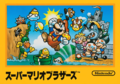 Japanese box art


Quotes
- "To make Mario jump extra high, hold the B button down while you run and jump." — Nintendo Game Pack with Top Secret Tips!, Card no. 7
- "Even if it says "Game Over" you can hold A and press Start. You'll continue on Level 1 of the last world you were on." — Nintendo Game Pack with Top Secret Tips!, Card no. 13
- "In every world, within invisible blocks, on extra life is concealed (possibly more). Keep your eyes peeled!" — Nintendo Game Pack with Top Secret Tips!, Card no. 19
- "You'll gain more points the higher you jump on a flagpole. Try accelerating first, the jump for all you're worth!" — Nintendo Game Pack with Top Secret Tips!, Card no. 31
- "We wanted to make a big Mario running around beneath a blue sky. We squeezed as much as we could out of the NES technology." — Shigeru Miyamoto, Super Mario History 1985-2010 booklet
- "Developing this game was fun because it felt like we were solving a puzzle as we were making it." — Takashi Tezuka, Super Mario History 1985-2010 booklet
- "There was so much enthusiasm on this project because we were trying to create something that had never been done before." — Koji Kondo, Super Mario History 1985-2010 booklet
- "Thank you Mario! But our princess is in another castle!" — Mushroom Retainer, Super Mario Bros.
- "Thank you Mario! Your quest is over. We present you a new quest." — Princess Toadstool, Super Mario Bros.
Names in other languages
| Language | Name | Meaning | Note(s) | Ref. |
|---|---|---|---|---|
| Japanese | スーパーマリオブラザーズ Sūpā Mario Burazāzu | Super Mario Bros. | [93] | |
| スーパーマリオブラザーズ1 Sūpā Mario Burazāzu Wan | Super Mario Bros. 1 | [94] | ||
| Chinese (Simplified) | 超级马力欧兄弟 Chāojí Mǎlì'ōu Xiōngdì (Mandarin) Chīukāp Máhlihk'āu Hīngdaih (Cantonese) | Super Mario Bros. | [95] | |
| Chinese (Traditional) | 超級瑪利歐兄弟 Chāojí Mǎlì'ōu Xiōngdì (Mandarin) Chīukāp Máhleih'āu Hīngdaih (Cantonese) | [96] | ||
| Korean | 슈퍼 마리오브라더스 Syupeo Mario Beuradeoseu | Super Mario Bros. | [97] |
Notes


- Despite being unmentioned in the Japanese manual,[98] the Mushroom King appears in Asian-drawn strategy guide illustrations.
- The South African release of Super Mario Bros. in 1993 reuses the European version's packaging, the only NES game to do so in the region; all other South African NES games feature a red "South African Version" banner on the box art and cartridge label.[99]
- In a 2011 United States Supreme Court case, Brown v. Entertainment Merchants Association (which overturned a California law banning the sale of violent video games to children without parental supervision), the Electronic Frontier Foundation submitted an amicus brief citing social research that declared Super Mario Bros. to be a violent video game. In the brief, it was stated that the game contained cartoon violence similar to that found in various Saturday morning television shows, the Road Runner and Wile E. Coyote cartoons, and the Mighty Mouse series, which garnered little negative reaction from the public in their own times.[100][101]
- A piece of promotional artwork for the "Mario Pikachu" line of merchandise, based on the artwork for the Famicom release of Super Mario Bros., replaces the game's characters and objects with Pokémon and other objects from the Pokémon franchise. The changes are the following:
- Mario is replaced by Pikachu.
- Bowser is replaced by Blastoise.
- Princess Peach is replaced by Diancie.
- The Toads are replaced by two Foongus.
- The Koopa Paratroopa is replaced by Wartortle.
- The castle is replaced by the Bell Tower.
- A flower is replaced by Flabébé.
- The Goomba is replaced by Shroomish.
- The Bullet Bill is replaced by Beldum.
- The Super Mushroom is replaced by a Big Mushroom.
- The Blooper is replaced by Inkay.
- The hill is orange instead of green.
- The Warp Pipe is replaced by the Slowpoke Well.
- The Koopa Troopa is replaced by Squirtle.
- The Cheep Cheep is replaced by Qwilfish.
- The Hammer Bro is replaced by Psyduck.
- The cliff is a cave.
- The Spiny is replaced by Ferroseed.
- The Lakitu is replaced by Landorus.
Footnotes and references
Footnotes


References
- ^ スーパーマリオブラザーズ. Nintendo Japan (Japanese). Retrieved August 13, 2024.
- ^ a b Mario through the years. mario.nintendo.com. Retrieved July 9, 2026. (Archived July 6, 2026, 18:59:38 UTC via Wayback Machine.)
- ^ «Data di uscita in Europa:05.15.1987» – Nintendo365 (September 13, 2025). Super Mario Bros.. Nintendo Today! (Italian).
- ^ Tim Biggs (July 7, 2017). Nintendo's NES launched 30 years ago this month in Australia, or did it?. The Sydney Morning Herald. Retrieved July 1, 2026.
- ^ a b Rogers, Joshua Alexander (April 16, 2020). Video Games around the World. LinkedIn. Retrieved March 23, 2024. (Archived September 25, 2022, 15:36:58 UTC via Wayback Machine.)
- ^ ウワーマン (February 21, 2026). ファミコン ディスクシステム40周年。500円の書き換えサービスが安価で便利だった。ローンチタイトルの目玉は初代『ゼルダの伝説』【今日は何の日?】. Famitsu (Japanese). Retrieved July 1, 2026.
- ^ August 1986. Cash Box 1986-08-30. Retrieved May 31, 2024.
- ^ ファミコンミニ/スーパーマリオブラザーズ. Nintendo Co., Ltd. (Japanese). Retrieved January 16, 2025.
- ^ Super Smash Bros. Brawl Chronicle
- ^ Super Mario Bros. | Game Boy Advance | Games | Nintendo. Nintendo UK (British English). Retrieved May 31, 2024.
- ^ VCスーパーマリオブラザーズ. Nintendo Co., Ltd. (Japanese). Retrieved January 3, 2026. (Archived September 13, 2007, 04:12:01 UTC via Wayback Machine.)
- ^ Steven Rodriguez (December 26, 2006). Virtual Console Mondays: December 25, 2006. Nintendo World Report (American English). Retrieved January 3, 2026. (Archived September 9, 2014, 23:02:27 UTC via Wayback Machine.)
- ^ a b c d Super Mario Bros. | NES | Games | Nintendo UK. Nintendo UK. Retrieved January 3, 2026. (Archived November 28, 2025, 04:11:32 UTC via Wayback Machine.)
- ^ Vuckovic, Daniel (January 5, 2007). VC Friday Whats new this week!. Vooks (Australian English). Retrieved June 30, 2026. (Archived May 21, 2026, 05:26:10 UTC via Wayback Machine.)
- ^ Wii. Nintendo of Korea (Korean). Archived January 31, 2009, 10:44:42 UTC from the original via Wayback Machine. Retrieved January 3, 2026.
- ^ ニンテンドー3DS アンバサダー・プログラム|ニンテンドー3DS|Nintendo. Nintendo Co., Ltd.. Retrieved July 1, 2026.
- ^ Pedro Hernandez and Matt Walker (July 28, 2011). Nintendo Introduces Ambassadors Program for 3DS. Nintendo World Report (American English). Retrieved January 3, 2026. (Archived December 23, 2025, 14:30:51 UTC via Wayback Machine.)
- ^ July 28, 2011. [EU] Nintendo 3DS Ambassador Programme. Nintendo World Report (American English). Retrieved January 3, 2026. (Archived December 23, 2025, 14:42:22 UTC via Wayback Machine.)
- ^ July 28, 2011. [AU] Price Drop for Nintendo 3DS. Nintendo World Report (American English). Retrieved January 3, 2026. (Archived September 1, 2023, 00:30:37 UTC via Wayback Machine.)
- ^ スーパーマリオブラザーズ | ニンテンドー3DS | 任天堂. Nintendo Co., Ltd. (Japanese). Archived April 6, 2016, 21:33:53 UTC from the original via Wayback Machine. Retrieved January 3, 2026.
- ^ Super Mario Bros. for Nintendo 3DS - Nintendo Game Details. Nintendo of America (American English). Archived December 14, 2020, 20:13:13 UTC from the original via Wayback Machine. Retrieved January 3, 2026.
- ^ Scott Dowson (February 29, 2012). Thought the Wii Virtual Console was dead? Think again…. Vooks. Retrieved September 1, 2026.
- ^ NINTENDO 3DS. Nintendo of Korea (Korean). Archived August 23, 2019, 17:13:35 UTC from the original via Wayback Machine. Retrieved January 3, 2026.
- ^ スーパーマリオブラザーズ | Wii U | 任天堂. Nintendo Co., Ltd. (Japanese). Archived March 17, 2017, 08:35:23 UTC from the original via Wayback Machine. Retrieved January 3, 2026.
- ^ Vuckovic, Daniel (September 12, 2013). Nintendo Download Updates: It’s Turbo Toki Tori Time. Vooks (Australian English). Retrieved June 30, 2026. (Archived December 16, 2025, 17:35:02 UTC via Wayback Machine.)
- ^ Nintendo.com – Super Mario Bros. – Game Info. Nintendo of America (American English). Archived October 19, 2013, 13:40:48 UTC from the original via Wayback Machine. Retrieved January 3, 2026.
- ^ Nintendo 公式チャンネル (September 29, 2016). ニンテンドークラシックミニ ファミリーコンピュータ 紹介映像. YouTube. Retrieved June 30, 2026.
- ^ Bring back memories and make brand new ones with Nintendo’s ultimate retro gaming experience. Nintendo of Australia (Australian English). Archived September 30, 2016, 07:19:56 UTC from the original via Wayback Machine. Retrieved June 30, 2026.
- ^ Nintendo of America (July 21, 2016). Introducing the Nintendo Entertainment System: NES Classic Edition. YouTube. Retrieved June 30, 2026.
- ^ Nintendo. (July 14, 2016). Nintendo Classic Mini: Nintendo Entertainment System. Nintendo UK. Retrieved June 30, 2026.
- ^ Nintendo of America (September 13, 2018). Nintendo Direct 9.13.2018. YouTube. Retrieved June 30, 2026.
- ^ Nintendo 公式チャンネル (September 13, 2018). Nintendo Direct 2018.9.14. YouTube (Japanese). Retrieved June 30, 2026.
- ^ Nintendo UK (September 13, 2018). Nintendo Direct - 13.09.2018. YouTube. Retrieved June 30, 2026.
- ^ NintendoAU (September 13, 2018). Nintendo Direct - 14.09.2018. Retrieved June 30, 2026.
- ^ a b Iggy (April 2, 2019). Nintendo Switch Online Launches April 23 In South Korea And Hong Kong, Pricing And Offers Announced. NintendoSoup. Retrieved June 30, 2026.
- ^ September 9, 2025. Nintendo Switch 2、Nintendo Switch更有趣、更方便,「Nintendo Switch Online」於2025年9月9日開始服務. Nintendo of Taiwan (Traditional Chinese). Retrieved June 30, 2026.
- ^ November 18, 2025. Nintendo Switch Online now available―making Nintendo Switch 2 and Nintendo Switch more fun and more convenient. Official news page via Nintendo Singapore website (English). Retrieved June 30, 2026.
- ^ November 18, 2025. Nintendo Switch Online now available―making Nintendo Switch 2 and Nintendo Switch more fun and more convenient. Official news page via Nintendo Malaysia website (English). Retrieved June 30, 2026.
- ^ November 18, 2025. Nintendo Switch 2 และ Nintendo Switch จะสนุกยิ่งกว่าเดิม สะดวกยิ่งกว่าเคย Nintendo Switch Online เริ่มให้บริการแล้ว. Official news page via Nintendo Thailand website (Thai). Retrieved June 30, 2026.
- ^ North American Classic NES Series box cover
- ^ Famicom Mini box cover
- ^ Super Mario Bros. | NES | Spiele | Nintendo DE. Nintendo DE (German). Retrieved May 14, 2026. (Archived April 22, 2026, 03:21:39 UTC via Wayback Machine.)
- ^ Super Mario Bros. | NES | Игры | Nintendo. Nintendo of Europe GmbH. Archived March 8, 2022, 04:10:05 UTC from the original via Wayback Machine. Retrieved June 30, 2026.
- ^ Portal de consultas públicas. gov.br. Retrieved June 28, 2026.
- ^ July 3, 2015. 게임물 상세정보. GRAC (Korean). Retrieved May 22, 2026. (Archived May 22, 2026, 15:27:30 UTC via Wayback Machine.)
- ^ Australasian Classic NES Series box cover
- ^ Cifaldi, Frank (March 28, 2012). Sad But True: We Can't Prove When Super Mario Bros. Came Out. Gamasutra. Archived September 3, 2014 from the original via Wayback Machine. Retrieved February 3, 2026.
- ^ Guinness World Records Gamer's Edition. PC World from DG. Archived October 30, 2020, 14:38:56 UTC from the original via Wayback Machine. Retrieved May 31, 2024.
- ^ Ed Acosta (January 25, 2015). Super Mario Bros a+start level restart. YouTube. Retrieved May 31, 2024.
- ^ a b c 1985. Super Mario Bros. instruction booklet. Nintendo of America. Retrieved July 2, 2026.
- ^ おにくてゃん (April 15, 2007). 神業(?)やり込み・マリオ裏技動画. Nicovideo (Japanese). Retrieved May 31, 2024.
- ^ a b Iwata Asks: New Super Mario Bros Wii, volume 2, part 1 "It All Began In 1984". Nintendo of America. Retrieved June 28, 2026.
- ^ a b Iwata Asks: New Super Mario Bros Wii, volume 2, part 4 "It Started With A Square Object Moving". Nintendo of America. Retrieved June 28, 2026.
- ^ Iwata Asks - Volume 2 : The History of Handheld The Legend of Zelda Games. Nintendo. Retrieved June 29, 2026.
- ^ a b Iwata Asks: Super Mario 25th, volume 5, part 3 "The Grand Culmination". Nintendo of America. Retrieved June 28, 2026.
- ^ a b Developer Interview: Super Mario Bros. – Nintendo Entertainment System. NES Classic Edition – Official Site. Archived November 11, 2016, 05:44:27 UTC from the original via Wayback Machine. Retrieved May 31, 2024.
- ^ HSALS (May 22, 2015). EXCLUSIVE: Interview with Toru Iwatani, creator of Pac-Man. Geek Culture (English). Retrieved May 31, 2024.
- ^ Iwata Asks: Super Mario 25th, volume 5, part 1 "Using the D-pad to Jump". Nintendo of America. Retrieved June 28, 2026.
- ^ a b c Iwata Asks: New Super Mario Bros Wii, volume 2, part 5 "Adjusting the Map In A Daily Cycle". Nintendo of America. Retrieved June 28, 2026.
- ^ Iwata Asks: New Super Mario Bros Wii, volume 1, part 4 "Letting Everyone Know It Was A Good Mushroom". Nintendo of America. Retrieved June 30, 2026.
- ^ Nintendo of America (June 16, 2015). Super Mario Bros. 30th Anniversary Special Interview ft. Shigeru Miyamoto & Takashi Tezuka. YouTube. Retrieved May 31, 2024.
- ^ a b Iwata Asks: New Super Mario Bros Wii, volume 2, part 6 "Applying A Single Idea To Both Land And Sky". Nintendo of America. Retrieved June 28, 2026.
- ^ Iwata Asks: Super Mario 25th, volume 5, part 4 "Designing Levels Together". Nintendo of America. Retrieved June 28, 2026.
- ^ Iwata Asks: Super Mario 25th, volume 5, part 5 "To Save Memory". Nintendo of America. Retrieved June 28, 2026.
- ^ Koji Kondo – 2001 Composer Interview. shmuplations. Retrieved May 31, 2024.
- ^ 「Shigeru Miyamoto: もともと『マリオブラザーズ』は、土管がいっぱいあるニューヨークの地下で活躍する兄弟、ニューヨークのなかでもたぶんブルックリン、というところまで勝手に決めていて。『ドンキーコング』は舞台がニューヨークですし。その土管が不思議な森(キノコ王国)につながったのが、『スーパーマリオブラザーズ』なんです。 ("Originally, I arbitrarily decided that Mario Bros. has the brothers being active in the underground of New York, which is full of pipes, probably in Brooklyn in New York. Donkey Kong is also set in New York. In Super Mario Bros., those pipes lead to the mysterious forest (Mushroom Kingdom).")」– April 25, 2023. インタビュー マリオ映画公開記念!宮本茂さんインタビュー 制作の始まりから驚きの設定まで. Nintendo Dream Web (Japanese). Retrieved April 25, 2023.
- ^ 「Shigeru Miyamoto: これは映画化とかは一旦別にして、影の設定として決めていたんですよ。実は大昔にライセンスで作られたマリオの映画も、そういうストーリーになってるんです。元々ゲームのストーリーでも「土管がいっぱいある、ニューヨークの地下で活躍する1作目マリオブラザーズ」から、「その土管が不思議な世界に繋がっていく2作目スーパーマリオブラザーズ」に繋いでいました。『ドンキーコング』も舞台はニューヨークですし、そこから「舞台は、ニューヨークの中でもブルックリンやろうな」と決めて行ったり……その辺りの舞台設定やストーリーはすんなり決まっていましたね。 ("I had decided on that as a shadow setting, putting aside the film adaptation for a moment. In fact, the Mario movie that was made a long time ago under license also had such a story. Originally, the stories of the games were connected via 'The first Mario Bros., which takes place underground in New York City, full of pipes', to 'the second Super Mario Bros., in which the pipes lead to a mysterious world'. Donkey Kong was also set in New York, and from there we decided, 'Let's make the setting Brooklyn in New York'... A setting around that area and a story were decided easily.")」– April 28, 2023. 宮本茂はどうやって「ゲームの映画化は面白くない」に立ち向かったのか――『ザ・スーパーマリオブラザーズ・ムービー』がちょっと面白すぎたので、宮本さんに直接訊いてみた. Den-Faminicogamer (Japanese). Retrieved May 31, 2024.
- ^ Iwata Asks: New Super Mario Bros Wii, volume 2, part 7 "No Rest After Completing Super Mario Bros.". Nintendo of America. Retrieved June 28, 2026.
- ^ https://web.archive.org/web/20210622110258/https://www.flyerfever.com/vs-marios-adventure/
- ^ Supper Mario Broth (November 19, 2020). The European version of Super Mario Bros. is almost imperceptibly more difficult than the US/Japanese versions due to adding an extra pixel to the hitboxes of various enemies. Details in image.. X. Retrieved May 31, 2024.
- ^ Pelland, Scott, George Sinfield, Leslie Swan, and Dan Owsen, editors (1991). The Nintendo Mario Mania Player's Guide. Redmond: Nintendo of America. Page 31.
- ^ April 12, 2023. National Recording Registry Inducts Music from Madonna, Mariah Carey, Queen Latifah, Daddy Yankee. Library of Congress (American English). Retrieved April 12, 2023.
- ^ October 1987. ANALOG Computing No. 58. Analog Publishing (American English). Page 64. (Archived via Wayback Machine.)
- ^ April 1986. Games Issue 74. Playboy Enterprises, Inc. (American English). Page 51. (Archived via Wayback Machine.)
- ^ July 1987. Family Computing Volume 5, No. 7. Scholastic Inc. (American English). Page 16. (Archived via Wayback Machine.)
- ^ March 1986. Computer and Video Games issue 53. EMAP (British English). Page 83. (Archived via Wayback Machine.)
- ^ July 1987. Crash No. 42. Newsfield (British English). Page 103. (Archived via Wayback Machine.)
- ^ August 2004. Play issue 32. Fusion Publishing (American English). Page 61. (Archived via Wayback Machine.)
- ^ Reed, Kristan (January 24, 2007). Virtual Console: NES review. Eurogamer (British English). Retrieved August 3, 2026. (Archived May 22, 2024, 05:17:55 UTC via Wayback Machine.)
- ^ Bivens, Danny (October 2, 2011). NES Ambassador Games Edition. Nintendo World Report (American English). Retrieved August 3, 2026. (Archived June 17, 2016, 12:50:00 UTC via Wayback Machine.)
- ^ September 2004. テレビゲームのちょっといいおはなし. CESA (Japanese). Retrieved June 30, 2026.
- ^ Sonic the Hedgehog – Developer Interview Collection. shmuplations. Retrieved July 9, 2026. (Archived July 10, 2026, 02:54:22 UTC via Wayback Machine.)
- ^ Pelland, Scott, Jason Leung, Terry Munson, Paul Shinoda, writers (September 1990). Nintendo Power, vol. 100. M. Arakawa. Page 90.
- ^ Crispin Boyer, senior editor (February 2006). Electronic Gaming Monthly, vol. 200. Ziff Davis Media. Page 96-97.
- ^ 3. Super Mario Bros. - Top 100 NES Games. IGN. Page 96-97. Retrieved May 31, 2024.
- ^ Gigazine (November 9, 2019). "Super Mario Brothers Street" is born in Spain, pictures of Mario pleased at the commemoration ceremony. Gigazine. Retrieved May 31, 2024.
- ^ Super Mario Bros.. The Strong National Museum of Play. Retrieved June 29, 2026.
- ^ December 1987. The Games Machine issue 2. Newsfield (British English). Page 39. (Archived via Wayback Machine.)
- ^ December 1, 2001. どうぶつの森+のゲーム内で遊べるファミコンソフトが判明. N-Styles (Japanese). Retrieved May 4, 2024.
- ^ October 27, 2003. ファミコン生誕20周年記念第2弾、「ホットマリオキャンペーン」が11月7日より開始!. Dengeki Online. Retrieved May 31, 2024.
- ^ Niizumi, Hirohiko (October 27, 2003). Nintendo puts original Super Mario on GBA. GameSpot. Retrieved May 31, 2024.
- ^ Nintendo Entertainment System™ - Nintendo Switch Online. Nintendo Official Site (American English). Retrieved May 31, 2024.
- ^ スーパーマリオブラザーズ. Mario Portal (Japanese). Retrieved December 20, 2025 from nintendo.com.
- ^ November 13, 2020. 『ゲーム&ウオッチ スーパーマリオブラザーズ』は本日発売。知っているとより楽しめる、”あそびのヒント”をご紹介。. Nintendo (Japanese). Retrieved November 14, 2020.
- ^ In-application Simplified Chinese title for Super Mario Bros. on Family Computer Nintendo Classics. Retrieved December 20, 2025.
- ^ 瑪利歐網頁. Mario Portal (Traditional Chinese). Retrieved December 20, 2025 from nintendo.com.
- ^ 히스토리. Mario Portal (Korean). Retrieved December 20, 2025 from nintendo.com.
- ^ Mandelin, Clyde (6 Feb. 2013). Super Mario Bros. Translation Comparison: Manuals. Legends of Localization. Retrieved 31 May 2024.
- ^ Rogers, Joshua Alexander (April 16, 2020). Video Games around the World. LinkedIn. Retrieved March 23, 2024. (Archived September 25, 2022, 15:36:58 UTC via Wayback Machine.)
- ^ Hoffman, Gene (September 27, 2010). How the Wrong Decision in Schwarzenegger v. EMA Could Cripple Video Game Innovation. Xconomy. Archived September 30, 2010, 15:09:15 UTC from the original via Wayback Machine. Retrieved May 31, 2024.
- ^ Supreme Court of the United States Docket No. 08-1448 (PDF). EFF. Retrieved May 31, 2024.
External links


- Mario Portal Game Archive (EN)
- Mario Portal Game Archive (JP)
- Famicom 40th Anniversary site
- Nintendo UK Game Boy Advance site
- Japanese Famicom manual
- North American NES manual
- Super Mario Bros.
- Games
- Family Computer games
- Family Computer Disk System games
- Nintendo Entertainment System games
- Nintendo PlayChoice-10 games
- Launch titles
- Virtual Console games
- Wii Virtual Console games
- Nintendo 3DS Virtual Console games
- Wii U Virtual Console games
- Nintendo Switch Online games
- Platforming games
- 1985 games
- 1987 games
- 1993 games
- Classic NES Series
- 3DS Ambassador games
- Amiibo tap: Nintendo's Greatest Bits
- Game & Watch: Super Mario Bros.
- Super Smash Bros. Brawl stickers