Bunchabee
This article is about a subject in an upcoming or recently released game. After the game is released on May 21, 2026, or more information about this subject is found, this article may need major rewriting.
This notice should be removed after a month has passed since the game was first released.
| Bunchabee | |||
|---|---|---|---|
 Artwork from Yoshi and the Mysterious Book | |||
| Appears in | Yoshi and the Mysterious Book (2026) | ||
| |||
Bunchabees[1] are grape-like bees that appear in Yoshi and the Mysterious Book. They have small teardrop-shaped bodies with pointed heads, and they fly in large groups. Bunchabees appear in the form of grape cluster-like structures hanging from trees. When touched, several of them pop out of the branch and begin flying.[2] As they mature, Bunchabees become big Bunchabees, and eventually stick into the ground to become trees upon which new Bunchabee hives grow.
While flying, Bunchabees follow Yoshi around, swooping down to attack him. Each Bunchabee can be eaten by Yoshi and transformed into an egg. Bunchabees can get stuck on large nuts, creating cracks in them. Bunchabees and their clusters can be defeated by being hit by eggs.
Bunchabees can be distracted by Crazee Dayzees, the flowers bloomed by them, and the flower crowns they create. They also swarm onto apples and hot peppers. When fed a hot pepper, Bunchabees will become enraged and attack faster, also gaining the ability to create cracks in rocks. They can be calmed from their enraged state by guiding them into flowers, or into pools of honey.
In their level, several Bunchabees steal five Smiley Flowers, and Yoshi must recover all of them.
On the Chapter 1: Wildwoods page, they are shown traveling in a swarm with a Smiley Flower following them.
List of levels[edit]
Bunchabees are found in the following levels:
- Bunchabee Habitat
- Glubbit Habitat
- Plumebrella Habitat
- Nep-Enut Habitat
- Shy Guy Abode
- Mawstalk Habitat
- Goopsie Habitat
- Billeau Habitat
- Piranha Plant Habitat
- Wash Squash Habitat
- Magnified Floofly
List of discoveries[edit]
- Initial description: "What kind of wriggling, fidgeting fruit is this?"
- "Sweet like honey."
- "No defense against an airborne egg."
- "Avid flower fanatics."
- "Hives have a interesting texture."
- "Smiley Flower saved!"
- "Smiley Flower saved before it buzzed off!"
- "Saved all Smiley Flowers before abduction!"
- "Best buds with the Crazee Dayzee!"
- "Slurped up a swarm."
- "Flocked to fruit."
- "One big Bunchabee."
- "Covered in honey!"
- "Removed the big huddle of hives!"
- "Swarms enjoy nectar from flowering trees."
- "Removed the hives inside the cave."
- "Stings can help break nuts open."
- "Whole swarm hit with a single egg!"
- "Spicy snacks make 'em extra mad!"
- "Stings so strong they can help break rocks!"
- "Nectar cools its temper."
- "Heavy crown for the Bunchabee."
- "Removed all the hives!"
- "Bested every single Bunchabee!"
- "Beat the big swarm!"
- "Saved a Smiley Flower without being spotted!"
- "Removed all big Bunchabee hives and swarms!"
- "Handled each big Bunchabee!"
- "Hides in the Crazee Dayzee tree!"
- Goal discovery: "Saved all of the Smiley Flowers!"
- After description: "Hangs like fruit before taking flight. Try not to get stung!"
Gallery[edit]

Yoshi swallowing a Bunchabee
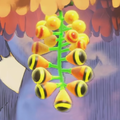
A cluster of Bunchabees


Naming[edit]
"Bunchabee" is a contraction of the words "bunch of bees" and a play on "bunch of grapes".
When the name is suggested by Mr. E, he says the following:
- “It forms a hive by bunching together like fruit on a vine...so how about Bunchabee?”
- —Mr. E
Names in other languages[edit]
| Language | Name | Meaning | Note(s) | Ref. |
|---|---|---|---|---|
| Japanese | ブドウバチ Budōbachi |
Compound of 「 |
[3] | |
| Chinese | 葡萄蜂 Pútáo Fēng (Mandarin) Pòuhtòuhfūng (Cantonese) |
Grape Bee | [4] | |
| Dutch | Bendebij | From bende ("group"/"bunch") and bij ("bee"); may also be a corruption of ben d'rbij ("[I] am included") | [5][6] | |
| French | Ribambeille | From ribambelle ("bunch") and abeille ("bee") | [7][8] | |
| German | Traubina | From Traube ("bunch") and Biene ("bee"); Traube specifically refers to a bunch of grapes, but it can be used on its own to refer to a bunch in general | [9] | |
| Italian | Apegrappola | Bunch-bee | [10] | |
| Korean | 포도벌 Podo Beol |
Grape Bee | [11] | |
| Portuguese | Abelhuva | From abelha ("bee") and uva ("grape") | [12] | |
| Spanish | Uveja | From uva ("grape") and abeja ("bee") | [13][14] |
References[edit]
- ^ Nintendo of America (March 10, 2026). Yoshi and the Mysterious Book – Creature Discovery! – Nintendo Switch 2 (0:21). YouTube (American English). Retrieved March 18, 2026.
- ^ VGC (April 22, 2026). Yoshi and the Mysterious Book - Exclusive Switch 2 gameplay. Retrieved April 22, 2026.
- ^ Nintendo 公式チャンネル (March 11, 2026). ヨッシーとフカシギの図鑑 調査の様子をご紹介 (0:21). YouTube. Retrieved March 20, 2026.
- ^ 「既然他們巢穴就像一串果實,叫他葡萄蜂如何?」– Mr. E (21 May 2026). Yoshi and the Mysterious Book. Good-Feel (Traditional Chinese).
- ^ Nintendo Nederland (March 10, 2026). Yoshi and the Mysterious Book – Verkrijgbaar vanaf 21 mei (Nintendo Switch 2) (0:21). YouTube. Retrieved May 2, 2026.
- ^ "Het zijn trosjes insecten die er allemaal graag bij willen zijn... Misschien kunnen we did de Bendebij noemen!" – Mr. E (21 May 2026). Yoshi and the Mysterious Book. Good-Feel (Dutch).
- ^ « Cette abeille semble toujours se déplacer en groupe... Que penses-tu de Ribambeille? » – Mr. E (21 May 2026). Yoshi and the Mysterious Book. Good-Feel (Canadian French).
- ^ Nintendo France (March 10, 2026). Yoshi and the Mysterious Book – Sortie le 21 mai (Nintendo Switch 2) (0:21). YouTube. Retrieved March 21, 2026.
- ^ Nintendo DE (March 10, 2026). Yoshi and the Mysterious Book – Abe 21. Mai erhältlich (Nintendo Switch 2) (0:21). YouTube. Retrieved May 2, 2026.
- ^ «Forma un alveare raggruppandosi come degli acini d'uva, quindi che ne dici di Apegrappola?» – Mr. E (21 May 2026). Yoshi and the Mysterious Book. Good-Feel (Italian).
- ^ "열매를 모은 것처럼 생긴 집을 만들고 있었으니 포도벌은 어떨까?" – Mr. E (21 May 2026). Yoshi and the Mysterious Book. Good-Feel (Korean).
- ^ "Ela forma uma espécie de colmeia que lembra cachos de uvas... Que tal Abelhuva?" – Mr. E (21 May 2026). Yoshi and the Mysterious Book. Good-Feel (Portuguese).
- ^ "Como crea pequeñas colmenas con forma de racimo, ¿qué tal Uveja?" – Mr. E (21 May 2026). Yoshi and the Mysterious Book. Good-Feel (Latin American Spanish).
- ^ «Como crea pequeñas colmenas con forma de racimo, ¿qué te parece Uveja?» – Mr. E (21 May 2026). Yoshi and the Mysterious Book. Good-Feel (European Spanish).

