Super Mario 64 1
The title of this article is official, but it comes from a Japanese source.
If an acceptable English name is found, then the article should be moved to the new title.
This article needs Super Mario Kodansha manga improvement and is being worked on by Mariuigi Khed (talk). Specifically:
- Add missing information
| Super Mario 64 1 | |
|---|---|

| |
| Series | Super Mario |
| Artists | Kazuki Motoyama Igaiga |
| Publisher | Kodansha |
| Label | KC Deluxe |
| Release date |  November 6, 1996[1] November 6, 1996[1] |
| ← Previous Super Mario: Yoshi Island 3 |
Next → Super Mario 64 2 |
Super Mario 64 1 is the thirty-sixth volume of Kodansha's Super Mario manga published under the KC Deluxe label.
This volume covers the first part of the Super Mario 64 story arc, and a prologue to illustrate the new functions of the Nintendo 64.
The introduction and the first chapters were originally serialized in Comic BomBom from july to August 1996 while the last two chapters were released both in Comic BomBom Natsu no Zōkan-gō of the same year (released in August).
Contents[edit]
Walkthrough[edit]
スーパーマリオ


Character list[edit]

スーパーマリオ64キャラクター
|
|
Chapters[edit]
Introduction[edit]

Baby Mario is ready for another quest for the Yossy Helper Team, but Princess Peach arrives telling him it is time for another adaptation. Excited, Mario (grown back to his regular age) picks up the Super Mario RPG: Legend of the Seven Stars equipment, ready to adapt it, but Peach shoots down that adaptation as well: it is time to enter the Super Mario 64 arc. But Mario points out that, despite the circulation of the game guides, most gamers have yet to pick up the game yet, so he proposes to turn this chapter into a training session for the new Nintendo 64's mechanics.
Peach explains that the innovation of the Nintendo 64 lies in its ability to freely manipulate a 3D world, it analyzes data from other players, and the controller can be customized to any specifications. These features significantly expand gameplay possibilities, enhancing enjoyment and encouraging players to continue playing. Mario fails to follow the explanation, but understands that this would make Bowser even stronger than before, so he needs to become stronger as well: with a quick training session, Mario can now throw punches that break statues, he can karate-chop a stack of GoroGoro magazines, and can even hop and jump like a rabbit. A strange individual with an eyeball for a head laughs at them, telling them Mario is not at all ready with such silly training and offers them to enter in his training room inside a giant Nintendo 64.
Inside, Mario and Peach find themselves inside Super Mario 64, amazed by the details and to be able to see their own sole of the shoes. While attempting to walk towards Peach's Castle, Mario suddenly hugs a tree in his way, and climbs it, amazed once again to be able to look 360° around him, but from the top of the three he also sees the game's enemies glaring at him, ready to beat him up. Scared, Mario proposes to exit the training hall, but the eyeball-headed person reappears, stopping them from leaving: he states that this will be the gaming standards so he will have no choice but to face those hoards of enemies. Mario and Peach refuse, claiming to be pacifist, so the individual drops his disguise, revealing himself to be the new and imposing Bowser.
Bowser starts to chase the two down, burning Mario's behind with his Fire Breath. Hurt, Mario jumps into the water and swims (with extreme difficulty) to the other side of the water body, only for him and Peach to find themselves on the edge of a cliff. As Bowser gets closer and closer, Peach gives Mario a couple of Super Mushrooms. He grows bigger, but even then he still appears smaller than Bowser, who sends him flying with a single punch. Mario does not give up, pleading the game to make him stronger, and thus he turns into Metal Mario. Impervious to Bowser's fire, Metal Mario headbutts him off the cliff, but Bowser performs a bunch of summersaults and jumps back to the cliff. The Metal form expires, so Mario and Peach continue to run away from Bowser.
While escaping, Mario and Peach come across Toad giving a 64 Power-up Gibusu away. Peach takes it and puts it on Mario, then Toad passes her a controller, explaining she can control Mario's movements with it, then instructs her to grab Bowser's tail and spin by rotating the stick. After building up enough speed, Mario throws Bowser against a wall, breaking him into pieces. It is revealed that Bowser was one of Luigi's robots as he wanted to help Mario familiarize with the new mechanics. Peach gets mad, mistakenly believing Luigi acted as Bowser even during Super Mario RPG, but Toad explains that, due to Luigi having less and less major roles in recent games, he was one of the lucky guys to get a Nintendo 64 and has already completed Super Mario 64 so he was the right person to train Mario. Luigi is forgiven, so the characters prepare to properly initiate the story arc the next chapter.
Chapter 1[edit]

Peach has sent Mario an invitation for the following day to come to her castle to eat a home-made cake, but by nighttime, Peach is still making the cake, while the Toads ask her to go to bed, but she refuses. Suddenly, a strange eye pops out from the kitchen's wall, telling Peach that she could take a cake from the painting dimension instead of slaving to make one by hand, showing the painting of a massive two-layer cake. Peach walks inside the painting and disappears. The eye then looks at the capsule containting the Power Stars, the energy source of the castle, destroys it, and absorbs the Stars into the painting. As the Toad murmurs, this is a very terrible situation for them.
The next day, postman Booster delivers the letter to Mario. Upon reading it, Mario quickly dresses up elegantly and goes to Peach's Castle. Once inside, Mario finds the castle deserted, but then he sees Toad stuck in the wall, slowly being dragged inside it. He explains that the Power Stars were stolen along with Princess Peach. Just then, a hologram of Bowser appears, mocking Mario to go home, then disappears after Mario fails to punch it. As Toad sinks more and more into the wall, he explains that Bowser is using the Power Stars to create a painting dimension from which to summon an army of minion to invade the castle with, so he needs to find the lost Power Stars, restore the castle, and free everyone. After Toad completely sinks inside the wall, on closer inspection Mario notices the other Toads and Kinoppe stuck inside. Furious, Mario goes to check the castle's rooms, but only one door opens, the others remain locked. Inside the room, finds a painting with three Bob-ombs and enters it, getting warped to Bob-omb Battlefield.
Not even one second in, Mario almost gets hit by a barrage of water bombs. A group of Red Bob-ombs warn him to be careful, then proceed to present themselves: they are a group of peaceful Bob-ombs, always bullied by the black Bob-ombs, and now that their King have got his hands on a star, they are getting more and more violent. Hearing that, Mario asks for the location of the Bob-omb king, but two Goombas try to attack him, gloating that he will never reach the hilltop fort over the bridge. Having obtained the necessary information, Mario stomps the Goombas and continues on, only to be stopped by a giant Chain Chomp. The beast explains to Mario that its rabid nature is due to the inability to go freely out for walks, so Mario offers to remove the pole it is attached to. Grateful, the now-free Chain Chomp destroys a gate, which will let Mario proceed on to the Bob-omb fortress.
Over the gate, Mario arrives at the base of the Bob-omb mountain fortress, and meets a giant Koopa Troopa named Koopa the Quick: he challenges Mario to a race to a flagpole located halfway through the mountain, promising to reveal something useful if Mario beats him. The race begins, and Mario takes advantage of Koopa the Quick by using him as a shield from the incoming iron balls, then, once undedrneath the flagpole, Mario performs a backward-somersault to jump to it, beating Koopa the Quick. Koopa the Quick's reward consists in revealing the original pen name of various mangaka, but Mario already knows each one he proposes, so he reveals that with the Power Stars he can unlock the locked doors in Peach's Castle. Before continuing to the top, a Red Bob-omb offers to shoot Mario to the floating island with a cannon. Mario accepts and, from up there, Mario spots the Big Bob-omb on top of the mountain.
While getting down from the island, Mario makes the painful discovery that is fall damage, but quickly gets up, just with the thought of seeing Peach again, and gets to the top. Face to face with Big Bob-omb, the boss uses his booger-stained finger to pick up Mario and throws him to the ground to scrape him to death. Pained by the experience, Mario runs under the boss' legs and picks him up and does the same thing. Big Bob-omb surrenders and gives up the Power Star given to him by Bowser. Mario is excited, ready to explore the rest of the castle, starting with the Princess's room.
Chapter 2[edit]

ペンギン
Having accessed the Princess' room, Mario finds the kitchen, with the half-prepared cake for him and a letter pleading him to restore the castle's power. Just then, Mario spots something hiding in the corner and chases it inside another painting, ending up in Whomp's Fortress. From the top of the fortress, the Whomp King flaunts to Mario the Power Star in his possession, so Mario begins to climb the structure. While traversing a path, a Pushy Wall shove him off the path, but Mario manages to hold to the edge, right underneath a Thwomp. The Thwomp falls on his fingers to make him fall down the abyss, but Mario skillfully jumps up and reach the top, coming face to face with the Whomp King. Whomp King attempts to squash Mario with a belly flop, but Mario, once again, passes between his legs and delivers a Ground Pound on his back, destroying the Whomp King, much to the shock of all the enemies present. Mario takes the Power Star, but the mysterious figure from before snatches it, revealing itself to be a Baby Penguin, who escapes in another painting.
Mario chases it to Jolly Roger Bay's waters. He demands the Power Star back, while the little Baby Penguin explains that he got lost and was starving. Hearing that, Mario exchanges the Power Star for a more edible mushroom, but just then the giant Unagi passes by, and the Power Star ends up stuck to the eel's tail. Mario and the Baby Penguin chase down the Unagi to a sunken ship where the eel hides inside. After swimming inside the ship's hold, Mario and the Baby Penguin spot five treasure chests. As he begins to drown, Mario opens one, discovering air bubbles inside. Upon opening the others, the ship gets filled with air and starts to float again, reemerging on the surface. Due to the lack of water, the Unagi slithers away from the ship to go back into the sea, and Mario is able to pick the Star attached to its tail.
Back to the castle, the little Penguin begins to miss his father, so Mario offers to look for him. With only one painting to inspect, Mario and the Baby Penguin jump together inside, but they get separated during the warp, so Mario ends up alone at the base of Cool, Cool Mountain, in front of the father Penguin, who promises to give Mario a juicy reward if he brings his son back. Only then Mario notices he got separated from the Baby Penguin, and tries to offer a Mr. Blizzard as a substitute, but it does not work. Another Penguin, who calls himself the Champion Penguin, admits to have seen where the Baby Penguin landed, but will reveal it if Mario beats him in a slider race. Mario accepts and the two go to the top of the mountain and the sliding competition begins. After the first curve, the friction causes Mario's bottom to burn. Scared by the fire, the Champion Penguin flinches and Mario takes the lead, winning the race. The Big Penguin keeps his promise and points to the Baby Penguin's location: the top of an icy crevice, filled with Spindrifts at the bottom. The Penguin Dad throws Mario in the crevice, but he has trouble proceeding, until the Penguin tells him that he can kick up the walls to proceed. Realizing that, Mario wall kicks his way to the Baby Penguin and rescues him. Grateful, the Penguin Dad gives Mario seven Power Stars, and he returns to the Castle. The Spindrifts lament their loss, but claim that Mario is destined to lose, but the Penguins are not so sure about it.
Back at the castle, only two doors remain to be checked: the first one is a door that leads to a locked door in the basement, the other is a Big Star Door in the mezzanine. Over the door, Mario finds a long hall with a portrait of Princess Peach. Believing to have found her, Mario runs towards the painting, only to fall down a trapdoor, while the painting changes to Bowser's face. So, Mario ends up in Bowser's lair in the Dark World. Mario swiftly arrives at Bowser's arena. He explains that they are the Castle's Basement, but the only real way to access it is through the locked door from before, and he is holding the key. After avoiding Bowser's flames and stomps, Mario spots the spiked orbs around the arena: Bowser explains those to be bombs designed for him, but Mario uses them against Bowser by picking him up by his tail, after (once again) slipping between his legs, and throws him at it. Bowser blows up, dropping a Power Star and the key behind him. While Mario picks them up, Bowser flees, promising that the next time it will not be that easy.
Chapter 3[edit]

スーパーマリオ64 コマヨンサービス
- ニンテンドウ64 ("Nintendo 64"): Peach is showing a drawing of something to Mario and Luigi. To them, it looks like the face of a koala or bear. Peach leaves in frustration, while Bowser correctly guesses it to be a Nintendo 64 console seen from above.
- 64コントローラ ("Nintendo 64 Controller"): Peach is showing a drawing of something to Mario and Luigi. To them, it looks like the Batman logo. Peach leaves in frustration, while Bowser correctly guesses it to be a Nintendo 64 controller.
編集 会議 ① ("Meeting with the editors 1"): while playing Super Mario 64, Mototin and his editors questions what Mario says after collecting a Power Star. After none of them gets it right, believing it to be a Japanese sentence, Bowser, from the game, has to tell them that is "Here we go" in English.編集 会議 ② ("Meeting with the editors 2"): after losing a life, Mario exclaims "Mamma mia", to which Mototin thinks he is refering to Mamiya Rinzō. Once again, Bowser has to yell at them that it is not a Japanese exclamation, but an Italian one that means "Oh, my mother". Hearing this, Peach becomes surprised in learning that Mario was born in Kyoto but it is also Italian-American.- サンディは
日曜日 ? ("Is Sandy on Sunday?"): - マリオ
新 〇本 プロレス入 りか? ("Is Mario joining the New J*pan Pro-Wrestling?"): - おまわりさん ("Police officer"):
- お
仕事 中 のある編集 者 ("An editor at work"): 羽 マリオ ("Wing Mario"):金属 マリオ ("Metal Mario"):- スケスケぼうしの
使 い道 ("How to use the Vanish Cap"): 取説 よめよ ("Read the manual"):- イライラ ("Irritation"):
- つまらないものですが ("It's not much, but..."):
世界 の果 て ("The world's edge"):正義 のクッパ ("Bowser of Justice"):- よりハードに ("More and more intense"):
- よりリアルに ("More and more realistic"):
金田 一 マリオ ("Kaneda Ichi Mario"):- かかってきなさい ("Bring it on"):
副 編 に久慈 さまとよばせる男 ("A man who makes the associate editor call him "Mr. Kuji.""):- ノコノコの
目玉 って・・・・ ("Koopa Troopa's eyes..."): - ピーチの
愛 ("Peach's love"): - リフト ("Lift"):
- すてきな1
日 ("One wonderful day"): - ああ かんちがい ("Oh, what a misunderstanding"):
- ウルトラ
C ("Ultra C"): 続 ウルトラC ("Continuing Ultra C"):- ピーチの
正体 !? ("Peach's true identity!?"): - みんな
病院 にいけ ("Everyone go to the hospital"): - ルイージより
影 のうすい人 ("A person with a weaker presence than Luigi"): - 八ナにチュッで
終 わりかよ ("Does it really end with a kiss on the nose?"):
Fanarts[edit]
マリオイラストスペシャルギャラリー ("Mario's special illustration corner")

Cameos and caricatures[edit]
Fictional charactes[edit]
- Medama-Oyaji (GeGeGe no Kitarō): GeGeGe no Chichi is a nod to Kitarō's father, beign designed like him (except for the clothing).
- Nobita Nobi and Gian Gōda (Doraemon): when Super Mario attempts to take down Bowser, the Koopa King, still towering over him, compares him to the weak Nobita, while a tag compares Bowser to the big and mean bully Gian. He then mocks Mario to "call Doraemon", as that is what Nobita usually does in order to challenge or escape Gian.
- Irasshai Machine (SMBC Consumer Finance Co., Ltd.): upon seeing the deserted castle, Mario yells they should have left a "Welcome machine." Irasshai Machine was a TV commercial mascot, played by actor Michael Tomioka, that was an anthropomorphic version of the loan machine by the same name.
- Nurikabe (GeGeGe no Kitarō): King Whomp's belly flop attack is known as the "Nurikabe attack," which serves as the primary offensive move for Nurikabe, a supporting character in the GeGeGe no Kitarō series. Nurikabe is a member of the yokai species by the same name, the same species was also the main inspiration for the Whomps.
- Batman and Robin: while mistakenly guessing the Nintendo 64 Controller to be Batman's logo, Mario and Luigi wear Batman and Robin's outfit and even have the Batmobile in the background. Both the costumes and the car seem to be directly inspired from the Adam West TV series.
Real-life people[edit]
- Yukio Iketani: while he explains how he jumped back to the platform, Bowser gloats that not even the gymnast Olympic medalist could even replicate what he has done.
- Hoshino Ryuuichi, Hiroshi Obi, and Gen Satō: Koopa the Quick's reward originally consisted in revealing the some mangaka's pen names, but Mario reveals to already know each of the names he proposes. For Kodansha, Ryuuichi's made the chibi-styled Knight Gundam series, Obi made the Ganbare Goemon manga adaptation, while Satō Gen also contribuited to the Super Mario 4-koma Daikōshin and its sequel.
- Mamiya Rinzō: while mistakenly guessing what "Mamma mia" means, Mototin presumes it is a reference to the Japanese explorer from the Edo period, famous for mapping Sakhalin island.
Other[edit]
- CoroCoro Comic (Shogakukan): while training, Mario karate-chops a stack of "GoroGoro" magazines. This is a clear nod to the rival of Kodansha's Comic BomBom, Shogakukan's CoroCoro Comic, who was also publishing at the same time their own Super Mario manga: Super Mario-kun. On one of the GoroGoro covers, a knock-off version of Doraemon (one of the biggest mascots of CoroCoro) can be spotted.
Gallery[edit]
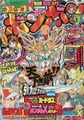
Comic BomBom (July 1996)
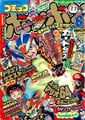
Comic BomBom (August 1996)
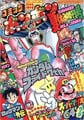
Comic BomBom Haru no Zōkan-gō (August 1996)
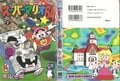
Full cover
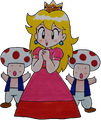
Princess Peach and Toads
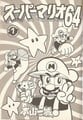
Story arc cover
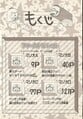
Table of contents


Descriptions[edit]
- Cover flaps
▣キノコ
城 の各 部屋 にかさられた絵 のむこう側 は、こわくてつらくて・・・・そして楽 しい3D の世界 !!クッパに幽閉 されたピーチ姫 をさがして、マリオの超 冒険 がスタートだ!!Beyond the paintings hanging in each room of the Mushroom Castle lies a scary, painful... and fun 3D world! Mario's super adventure begins as he searches for Princess Peach, who has been imprisoned by Bowser!!

★
作者 からきみへ
ついにでました、64ビットのニンテンドウ64!!なにがスゴイって、3D スティックの斬新 さ。どうして今 までだれも気 がつかなかったのか、このグリグリ!!とても気持 ちいいっス!!A word from the author
It's finally here, the 64-bit Nintendo 64!! What's amazing is the innovative 3D stick. How did no one notice this before?! It feels so good!!

Names in other languages[edit]
| Language | Name | Meaning | Note(s) | Ref. |
|---|---|---|---|---|
| Japanese | スーパーマリオ64① Sūpā Mario 64 1 |
Super Mario 64 1 | [1] |
References[edit]
- ^ a b Motoyama, Kazuki (6 Nov. 1996). Super Mario 64 1, Super Mario, vol. 36. Tokyo: Kodansha (Japanese). ISBN 4-06-319751-4. Page 140.

