Spark
- This article is about the enemies introduced in Donkey Kong Jr. For other uses, see Spark (disambiguation).
- Not to be confused with Sparx or Sparkle.
| Spark | |||
|---|---|---|---|
 Artwork from Super Mario Advance | |||
| First appearance | Donkey Kong Jr. (1982) | ||
| Latest appearance | The Legend of Zelda: Echoes of Wisdom (2024, overall) Mario vs. Donkey Kong (Nintendo Switch) (2024), Super Mario franchise) | ||
| |||
| |||
| |||
Sparks are orb-shaped creatures that emit pulses and flashes of electricity continually. They are mostly found crawling around walls and ceilings and moving across wires. Sparks are the first in a series of enemies in the Super Mario franchise that are balls of electricity, including Li'l Sparkies and Amps.
History[edit]
Donkey Kong series[edit]
Donkey Kong Jr.[edit]

Sparks first appear in Mario's Hideout of Donkey Kong Jr. where two variants appear. The red Sparks (known as Globes in Atari-developed ports)[1]:7
Donkey Kong (Game Boy)[edit]


Both variants return in the Game Boy version of Donkey Kong. Only one crawling Spark appears in Stage 6-4, rotating clockwise at a medium pace around a small platform in the path of a Conveyor Belt. The Spark has a similar behavior to red Sparks from the previous game. The Spark also has the same behavior as the Sniper and Sukōpī seen earlier in the game, except losing a life from the Spark displays an electrocution animation. The rope-moving type is first seen in Stage 1-3. These Sparks travel from the left to the right of their rope, disappearing once they reach the end, and spawn at regular intervals. Upon contact, Sparks can shock Mario and cause him to lose a life. This type resembles balls with four diagonal needle-like protrusions that constantly emit electricity between them in a pattern resembling that of a Jacob's ladder.
Super Mario series[edit]
Yume Kōjō: Doki Doki Panic / Super Mario Bros. 2[edit]

Sparks appear in Yume Kōjō: Doki Doki Panic and Super Mario Bros. 2, usually underground or in buildings. Sparks circle platforms, though some can hover in the air if a Mushroom Block is pulled out from beneath them. Sparks cannot be jumped on and damage the player character when touched. A Spark is defeated if either hit by an object or from a POW Block being used nearby. A Spark is defeated automatically if the screen scrolls while they are in a specific position.[2] In original versions, Sparks have red outlines around their eyes; in the Super Mario All-Stars version and other subsequent remakes, they have yellow outlines as well as an orange outer body outline. In the remake, touching a Spark knocks the player back as the screen briefly pixelates, and an item named the Spark Chaser can expel them from jar interiors.
This design of Sparks (a black ball with white eyes wearing a red mask and surrounded by electricity) has become the main design, being used in almost all subsequent appearances of Sparks in the Super Mario franchise, even being used as a reference for variants.
Super Mario Sunshine[edit]

Sparks, called Wire Traps,[3][4] are obstacles in Super Mario Sunshine. They are encountered in Bianco Hills and Noki Bay. Wire Traps are either red or blue in color and resemble spiral-shaped seashells that are covered in spikes. Glowing sparks of electricity emit from their centers as they cling to a rope and move along it by spinning themselves. Red ones are the most common, and they normally grow from a funnel on one side, travel to the other, and then disappear. However, ones found in Noki Bay instead slowly follow Mario along the rope. Blue Wire Traps, also exclusive to Noki Bay, are bigger and much slower than their red counterparts, and they constantly go back and forth between ends of the rope without disappearing. If Mario touches a Wire Trap, he will get burned and may fall off the rope. The player can slightly hinder the Wire Traps' progress by spraying water on them with FLUDD. The only way to avoid them is to jump over them. As they move, they make a low chirping noise, similar to that of a real-life hermit crab.
The Super Mario Bros. Super Show![edit]

- “Spark on the warpath!”
- —Mario, "On Her Majesty's Sewer Service"
A Spark appears in the episode "On Her Majesty's Sewer Service" in The Super Mario Bros. Super Show! It does not discharge any electricity. The Spark is encountered by Mario and Luigi in the Tunnel of Doom as they run from a Goomba. Both are avoided when Mario and Luigi create a grappling hook out of a super spy hose nozzle and mini plunger; apparently unable to stop moving, the Spark and Goomba subsequently crash into one another, causing an explosion.
Super Mario Bros. (Valiant Comics)[edit]

Sparks appear prominently in comics of the Super Mario Bros. series of comics, appearing in such stories as "The Legend," "Bedtime for Drain-Head," and "A Mouser in the Houser." Like most enemies featured in the stories, they are shown to be intelligent and fully capable of speech.
Yoshi series[edit]
Super Mario World 2: Yoshi's Island / Yoshi's Island: Super Mario Advance 3[edit]
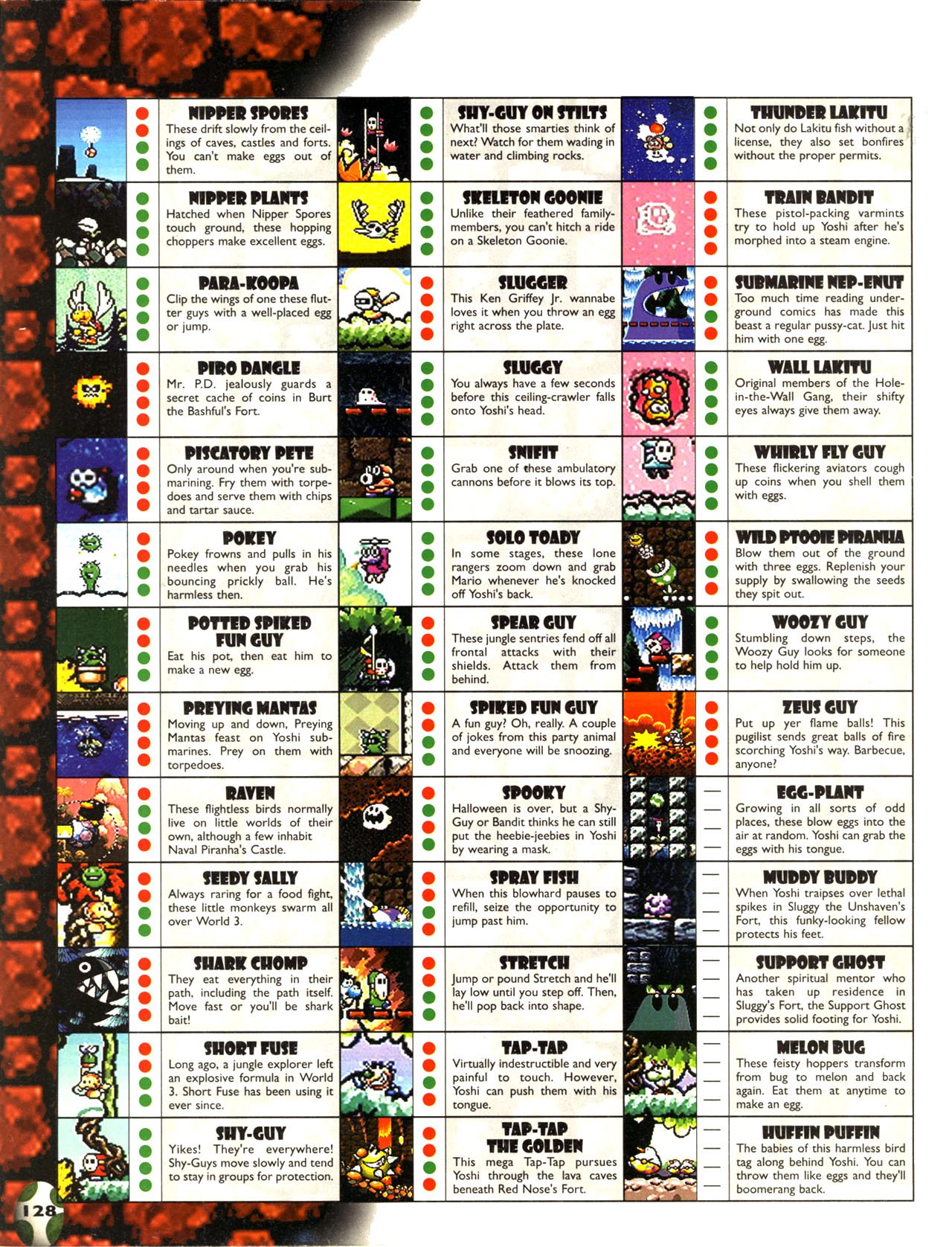
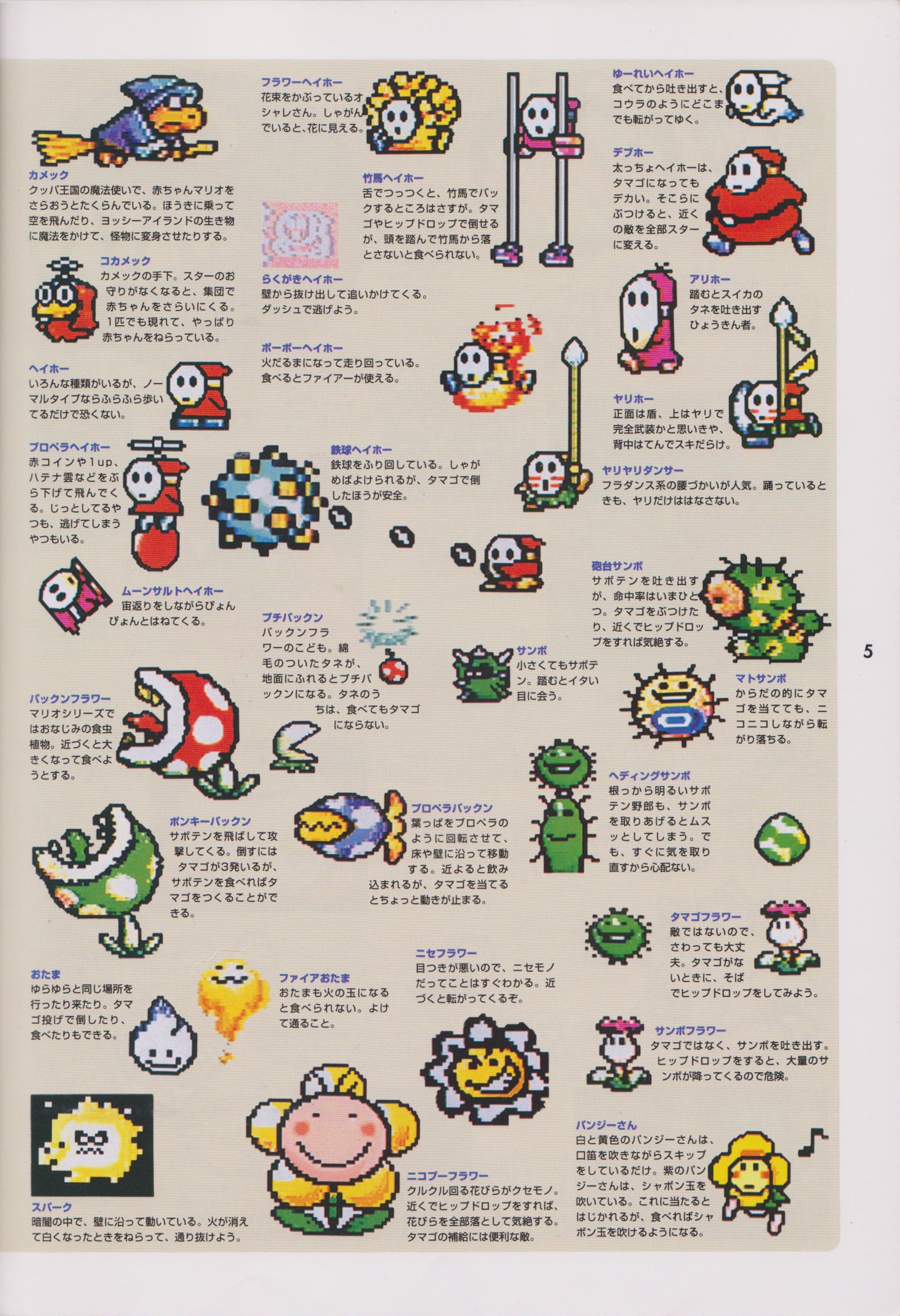
Piro Dangles[5] appear in Super Mario World 2: Yoshi's Island as uncommon enemies. They emit a flame blaze and have faces similar to that of Fryguy. Occasionally, their blaze temporarily goes out, revealing that underneath they are white spheres. During this time, they are harmless. They only appear on square or rectangular platforms where they move slowly around. Piro Dangles cannot be defeated by normal attacks, even in their harmless phase. They can only be defeated by using Super Blue Watermelons on them, causing them to freeze and fall from the platform, or by using an Anywhere POW to turn them into stars. Piro Dangles appear only in Burt The Bashful's Fort, in a secret room where three of them appear guarding a cache of coins. In the remake, they also appear in Endless World of Yoshis. There is also an unused variant of Boo Blah that has a Piro Dangle on its head. Like most enemies in the game, Piro Dangles are based on a Super Mario Bros. 2 enemy.
Yoshi's New Island[edit]
In Yoshi's New Island, Piro Dangles maintain their appearance and behavior from Super Mario World 2: Yoshi's Island, and appear only within dark rooms in Beware the Boo Brigade and Fort Key Calamity.
Mario vs. Donkey Kong series[edit]
Mario vs. Donkey Kong[edit]

Sparks, called Sparkies, appear as obstacles in Mario vs. Donkey Kong and its remake, now appearing simply as a ball of electricity. They are first encountered in Level 1-4. These Sparkies are based on the type that periodically travel through wires in the Game Boy Donkey Kong, and retain their ability to shock Mario upon contact, which causes him to lose a life.
Mario vs. Donkey Kong 2: March of the Minis/Mario vs. Donkey Kong: Mini-Land Mayhem![edit]
A variant that moves along magnetic objects, known as Magnet Sparky, appears in Mario vs. Donkey Kong 2: March of the Minis and Mario vs. Donkey Kong: Mini-Land Mayhem! The design of the Magnet Sparky is based on the Super Mario Bros. 2 Sparks.
The Legend of Zelda series[edit]
- Zelda Wiki article: Spark
Sparks appear with a similar wall-crawling behavior in multiple games in The Legend of Zelda series. In The Legend of Zelda: A Link to the Past, Sparks flash between orange and blue and are completely invincible, appearing in a few dungeons. In this game, they also share the same graphics as the segmented fire bars and Fire Snakes, which stay orange. Sparks are more common in The Legend of Zelda: Link's Awakening, The Legend of Zelda: Oracle of Seasons/Ages, and The Legend of Zelda: The Minish Cap, and can be destroyed with the boomerang, which turns them into fairies.
Profiles and statistics[edit]
Super Mario series[edit]
Super Mario Bros. 2[edit]
- Instruction booklet description:
- English:
He shines and moves in a circular motion around the walls and floors of the underground. He moves fast or slow.[6] - Other languages:
- Dutch:
Hij vonkt en vliegt rondjes bij de muren en vloeren in de onderwereld. Hij beweegt snel of langzaam.[7]
(Translation: He sparks and rushes in circles on the walls and floors in the underworld. He moves fast or slow.) - French:
Il brille en tournant autour des murs et planchers du monde souterrain. Il se déplace vite ou lentement.[7]
- Dutch:
- English:
- Super Mario Advance
- Instruction booklet description:
- English (United Kingdom):
You'll find Sparks circling blocks and steps. It's best to use POW blocks to turn off their power.[8]:11
- English (United Kingdom):
Perfect Ban Mario Character Daijiten[edit]
Donkey Kong series[edit]
| スパーク (JP) / Spark (EN) | |||
|---|---|---|---|

| |||
| Original text (Japanese) | Translation | ||
| ウエポン |
Tribe | Weapon clan | |
| Disposition | Straight line | ||
| Game appearances | Jr., GB Donkey | ||
| A lump of electricity that emits sparks In JR, they are running around on the floor, so you have to run past them at once when you see a chance; in GB, they are moving over the ropes, so avoid them at all costs. In both cases, you will be electrocuted if you touch them. | |||
Super Mario USA[edit]
| スパック (JP) / Spark (EN) | |||
|---|---|---|---|

| |||
| Original text (Japanese) | Translation | ||
| ウエポン |
Tribe | Weapon clan | |
| あきらめが |
Disposition | Reluctant to give up | |
| Game appearances | USA | ||
| アメリカ スパークと |
American-born Globe Like Globe, it is a mass of electricity that runs around blocks. Jump to avoid them as you go. If you have a key or Mushroom Block, you can hit it with them to defeat it. | ||
Yoshi series[edit]
Super Mario World 2: Yoshi's Island[edit]
- Shogakukan guide (Japanese): 暗闇の中で、壁に沿って動いている。火が消えて白くなったときをねらって、通り抜けよう。[10]
(Translation: They move along walls in the dark. Try to get by when their blaze goes out and they turn white.) - Player's Guide: Mr. P.D. jealously guards a secret cache of coins in Burt the Bashful's Fort.[5]
Yoshi's Island: Super Mario Advance 3[edit]
- Shogakukan guide (Japanese):
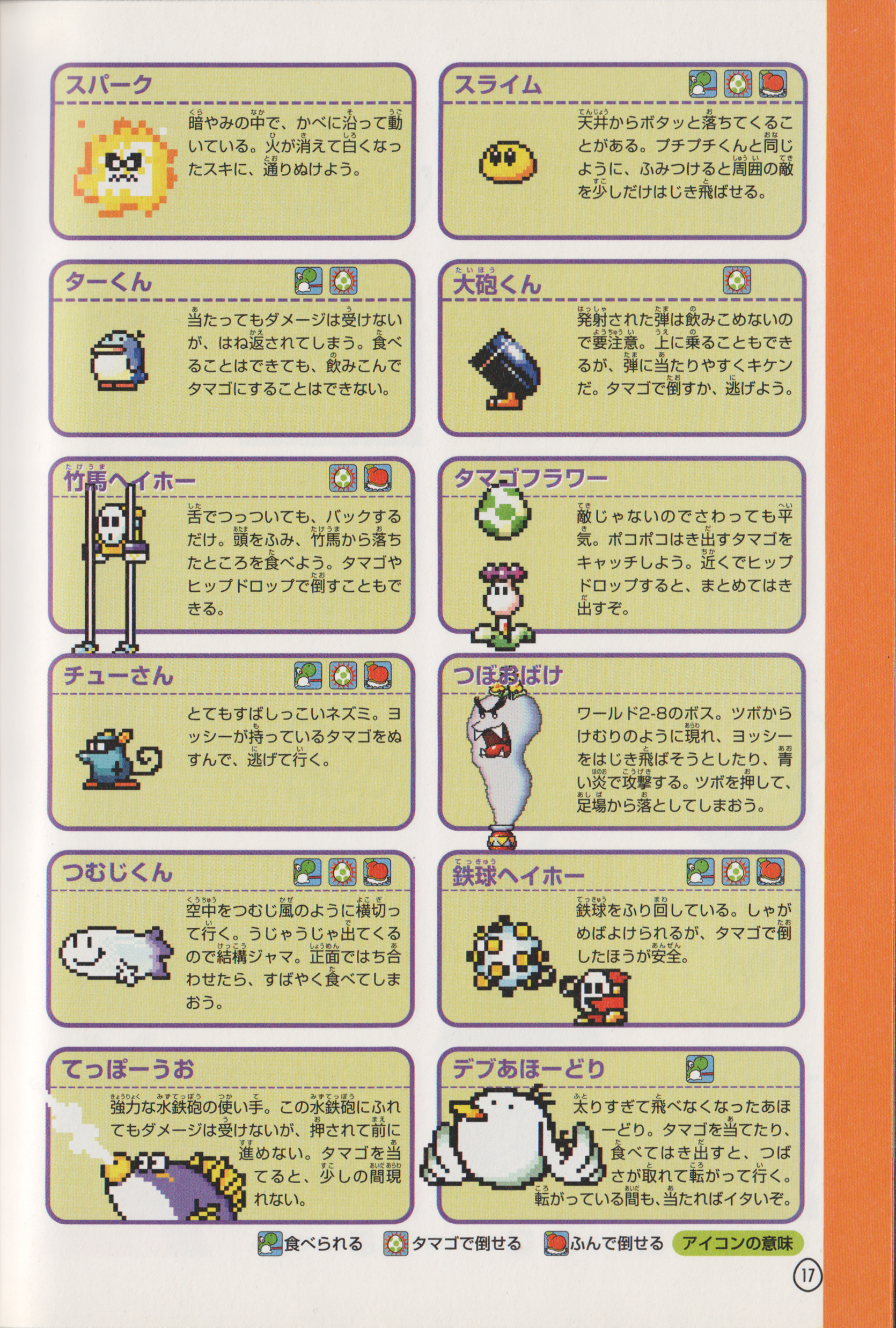
暗 やみの中 で、かべに沿 って動 いている。火 が消 えて白 くなったスキに、通 りぬけよう。[11]
(Translation: They move along walls in the dark. Get by when their blaze goes out and they turn white.)
Yoshi's New Island[edit]
- Shogakukan guide (Japanese):
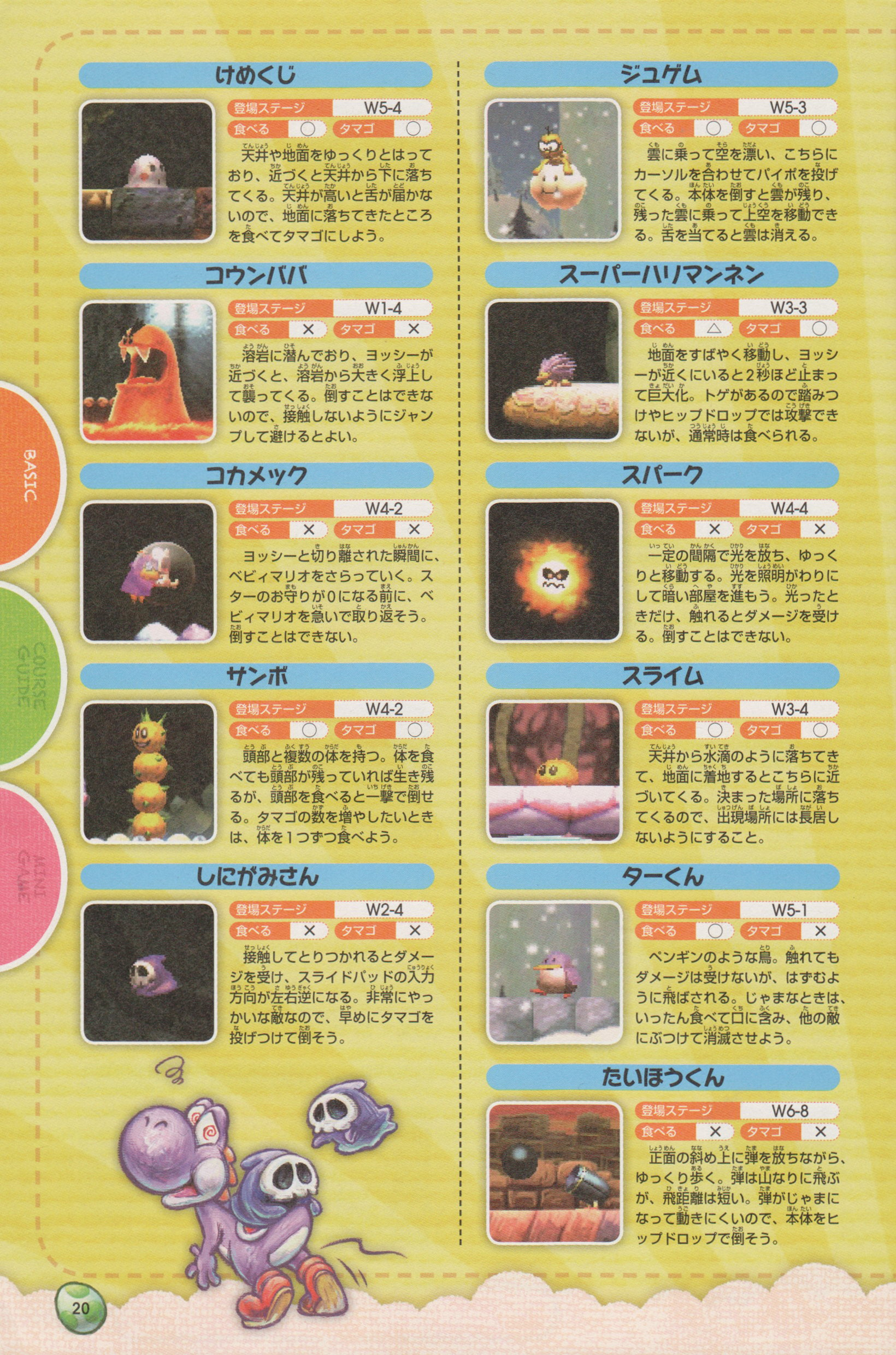
一定 の間隔 で光 を放 ち、ゆっくりと移動 すろ。光 を照明 がわりにして暗 い部屋 を進 もう。光 ったときだけ、触 れるとダメージを受 ける。倒 すことはできない。[12]
(Translation: Emits a blaze at regular intervals and moves slowly. Use the blaze as a light source to advance through the dark room. If you touch it, you will take damage only when it blazes. It cannot be defeated.)
Gallery[edit]
- For this subject's image gallery, see Gallery:Spark.

Donkey Kong Jr. (Famicom 40th Anniversary)

Donkey Kong Jr. (arcade, red)

Donkey Kong Jr. (arcade, blue)

Donkey Kong Jr. (NES, red)


Naming[edit]
Internal names[edit]
| Game | File | Name | Meaning
|
|---|---|---|---|
| Super Mario Sunshine | wiretrap/wire_trap[13] | wire_trap | Wire Trap |
| Mario vs. Donkey Kong | string in ROM (SPARKY_LOOP) | SPARKY_LOOP | Sparky |
| Mario vs. Donkey Kong (Nintendo Switch) | Pack/Actor/Sparky.pack.zs | Sparky | - |
Names in other languages[edit]
The contemporaneous name for each language is listed first. Subsequent names are listed in chronological order for each language, from oldest to newest.
| Language | Name | Meaning | Note(s) | Ref. |
|---|---|---|---|---|
| Japanese | スパーク Supāku |
Spark | [9] | |
| Italian | Scintilla | Spark | [14][15] | |
| Scarica elettrica | Electrical charge | Donkey Kong II | [16] | |
| Spark | - | [17][18] |
Spark/Globe (Donkey Kong Jr. for Atari)[edit]
"Globe" refers to the red type of Spark in the Atari versions of Donkey Kong Jr., where "Spark" is only applied to the blue ones. In all other versions of the same game, both types share the name "Spark."
- Spark
| Language | Name | Meaning | Note(s) | Ref. |
|---|---|---|---|---|
| French (European) | Eclair | From éclair ("sparkle") | [1]:7 | |
| German | Funke | Spark | [1]:7 | |
| Italian | Scintilla | Spark | [1]:8 | |
| Spanish (European) | Chispa | Spark | [1]:8 |
- Globe
| Language | Name | Meaning | Note(s) | Ref. |
|---|---|---|---|---|
| French | Boulet | Ball | [1]:7 | |
| German | Feuerkugel | Fireball | [1]:7 | |
| Italian | Globo | Globe | [1]:8 | |
| Spanish | Globo | Globe | [1]:8 |
Spark[edit]
The type of Spark from Super Mario Bros. 2 is consistently depicted as a black ball with white eyes wearing a red mask and surrounded by electricity. Their behavior consists of crawling alongside walls quickly. The designs of Piro Dangle and Magnet Sparky are based on this Spark.
| Language | Name | Meaning | Note(s) | Ref. |
|---|---|---|---|---|
| Japanese | スパック Supakku |
A corruption of "Spark" | [19][9]:96, 225 | |
| Chinese (Simplified) | 火花 Huǒhuā |
Spark | [21] | |
| Dutch | Spark | - | [7] | |
| French | Spark | - | [7][8]:51 | |
| German | Spark | - | [22][8]:31 | |
| Portuguese | Spark | - | [24] | |
| Spanish (European) | Spark | - | [25][8]:91 |
Wire Trap[edit]
"Wire Trap" refers to the shell-like wire-travelling Sparks found in Super Mario Sunshine.
| Language | Name | Meaning | Note(s) | Ref. |
|---|---|---|---|---|
| Japanese | スパーク Supāku |
Spark | [26][27] | |
| Italian | Trappole di corda | Wire trap | Super Mario Sunshine | [28] |
| Wire Trap | - | Super Mario Bros. Encyclopedia | [29] | |
| Spanish (European) | Wire Trap | - | Super Mario Bros. Encyclopedia | [30] |
Piro Dangle[edit]
"Piro Dangle" refers to the fiery type of spark found in the Yoshi series.
| Language | Name | Meaning | Note(s) | Ref. |
|---|---|---|---|---|
| Japanese | スパーク Supāku |
Spark | [10][11][12] | |
| German | Pyro Head | - | Super Mario World 2: Yoshi's Island | [31] |
Sparky[edit]
"Sparky" refers to the wire-travelling Sparks that simply look like a ball of electricity in Mario vs. Donkey Kong. The name is later used for a different Spark variation in Mario vs. Donkey Kong 2: March of the Minis, which is renamed "Magnet Sparky" in Mario vs. Donkey Kong: Mini-Land Mayhem!.
| Language | Name | Meaning | Note(s) | Ref. |
|---|---|---|---|---|
| Japanese | スパーキー Supākī |
Sparky | [32] |
References[edit]
- ^ a b c d e f g h i 1983. Donkey Kong Junior by Nintendo: ATARI Computers. Sunnyvale: ATARI, Nintendo of America (English, French, German, Italian, Spanish).
- ^ Small Mario Findings. Video. Tumblr (English). Retrieved July 4, 2024.
- ^ Bogenn, Tim, and Doug Walsh (2002). Super Mario Sunshine Official Strategy Guide. BradyGAMES (American English). ISBN 0-7440-0180-3. Page 7.
- ^ Hodgson, David S J, Bryan Stratton, and Stephen Stratton (September 3, 2002). Super Mario Sunshine Prima's Official Strategy Guide. Prima Games (American English). ISBN 0-7615-3961-1. Page 18.
- ^ a b Miller, Kent, and Terry Munson (1995). Super Mario World 2: Yoshi's Island Player's Guide. Nintendo of America (American English). Page 128.
- ^ 1988. Super Mario Bros. 2 Instruction Booklet (PDF). Redmond: Nintendo of America. Page 26. Retrieved March 28, 2022 from nintendo.co.jp.
- ^ a b c d 1989. Super Mario Bros. 2 Handleiding / mode d'emploi. Brussels: Nintendo (Dutch, French). Page 30.
- ^ a b c d 2001. Super Mario Advance Instruction Booklet (PDF). Großostheim: Nintendo of Europe GmbH (English, German, French, Spanish, Italian). Retrieved April 17, 2025 from nintendo.com.
- ^ a b c d November 20, 1994. Perfect Ban Mario Character Daijiten. Shogakukan (Japanese). ISBN 4-09-259067-9. Page 96 and 225. Retrieved April 24, 2018 from imgur.
- ^ a b September 20, 1995. 「スーパーマリオヨッシーアイランド任天堂公式ガイドブック」(Super Mario: Yossy Island Nintendo Kōshiki Guidebook). Shogakukan (Japanese). ISBN 4-09-102523-4. Page 5.
- ^ a b November 20, 2002. 「スーパーマリオアドバンス3任天堂公式ガイドブック」(Super Mario Advance 3 Nintendo Kōshiki Guidebook). Shogakukan (Japanese). ISBN 4-09-106701-4. Page 17.
- ^ a b August 9, 2014. 「ヨッシー New アイランド 任天堂公式ガイドブック」(Yoshi's New Island Nintendo Kōshiki Guidebook). Shogakukan (Japanese). ISBN 978-4-09-106542-1. Page 20.
- ^ Super Mario Sunshine, internal filename root/data/scene/bianco2.szs/scene/wiretrap/wire_trap.bmd
- ^ Donkey Kong Jr. (3DS - Virtual Console) Italian e-manual. Page 8.
- ^ The Legend of Zelda: Enciclopedia di Hyrule. Page 205.
- ^ Donkey Kong II Italian manual
- ^ 1989. Super Mario Bros. 2 Libretto di Istruzioni. Oleggio Castello: Nintendo (Italian). Page 26.
- ^ The Legend of Zelda: Minish Cap figurine gallery: "080 - Spark"
- ^ Itoi, Shigesato, Ryo Kagawa (APE), Hideaki Nishitani, Masatoshi Watanabe, Koichi Sugiyama (Supersonic), Junichiro Okubo, and Shigeo Tanabe (Shogakukan), editors (1993). 『任天堂公式ガイドブック スーパーマリオコレクション』. Tokyo: Shogakukan (Japanese). ISBN 4-09-102444-0. Page 142.
- ^ Sakai, Kazuya (ambit), kikai, Akinori Sao, Junko Fukuda, Kunio Takayama, and Ko Nakahara (Shogakukan), editors (2015). "Super Mario USA" in 『スーパーマリオブラザーズ百科: 任天堂公式ガイドブック』. Tokyo: Shogakukan (Japanese). ISBN 978-4-09-106569-8. Page 67.
- ^ From the ending scenes of Super Mario Advance as localized by iQue. 无敌阿尔宙斯 (August 28, 2013). 神游 超级马力欧2敌人官译. Baidu Tieba (Simplified Chinese). Archived February 26, 2017, 16:11:09 UTC from the original via Wayback Machine. Retrieved August 6, 2024.
- ^ 1990. Super Mario Bros. 2 Speilanleitung. Großostheim: Nintendo of Europe GmbH (German). Page 27.
- ^ Matsumoto, Atsuko, Rie Ishii, and Claude Moyse, editors (1992). Der Spieleberater Super Mario Power. Großostheim: Nintendo of Europe GmbH (German). ISBN 3-929034-02-6. Page 118.
- ^ Gaglianone, Arthur, and Francisco Pellegrini Jr., directors (1991). Super Mario Bros. Livro Ilustrado. Rio de Janeiro: Multi Editora (Brazilian Portuguese). Page 9, 18.
- ^ 1989. Super Mario Bros. 2 Libro de Intrucciones. Madrid: Nintendo (Spanish). Page 26.
- ^ Takashi, Watanabe, Noriko Oketani, Geesen Ueno, Mitsuharu Orihara, Tatsuhiko Mizutani, and Yasushi Nakahara, editors (2002). 『スーパーマリオサンシャイン 任天堂公式ガイドブック』. Tokyo: Shogakukan (Japanese). ISBN 4-09-106064-1. Page 19. Retrieved from imgur.
- ^ Sakai, Kazuya (ambit), kikai, Akinori Sao, Junko Fukuda, Kunio Takayama, and Ko Nakahara (Shogakukan), editors (2015). "Super Mario Sunshine" in『スーパーマリオブラザーズ百科: 任天堂公式ガイドブック』. Tokyo: Shogakukan (Japanese). ISBN 978-4-09-106569-8. Page 99.
- ^ Hodgson, David S. J., Bryan Stratton, and Stephen Stratton (2002). Super Mario Sunshine Guida Strategica Ufficiale realizzata da Prima Games. Translated by Associazione Culturale Go!. Giaveno: Yoo Too Videogames, Prima Games (Italian). ISBN 88-900922-1-1. Page 18.
- ^ Sakai, Kazuya (ambit), kikai, Akinori Sao, Junko Fukuda, Kunio Takayama, Ko Nakahara (Shogakukan), and Marco Figini, editors (2018). "Super Mario Sunshine" in Super Mario Bros. Enciclopedia. Translated by Marco Amerighi. Milan: Magazzini Salani (Italian). ISBN 889367436X. Page 99.
- ^ Sakai, Kazuya (ambit), kikai, Akinori Sao, Junko Fukuda, Kunio Takayama, and Ko Nakahara (Shogakukan), editors (2017). "Super Mario Sunshine" in Enciclopedia Super Mario Bros. 30ª Aniversario. Translated by Gemma Tarrés. Barcelona: Editorial Planeta, S.A. (European Spanish). ISBN 978-84-9146-223-1. Page 99.
- ^ Menold, Marcus, John D. Kraft, and Thomas Görg, editors (1995). Der offizielle Nintendo Spieleberater "Super Mario World 2 – Yoshi's Island". Großostheim: Nintendo of Europe GmbH (German). Page 17.
- ^ Mario vs. Donkey Kong Shogakukan book[page number needed]
External links[edit]

| Donkey Kong Jr. | ||
|---|---|---|
| Characters | Donkey Kong Jr. • Donkey Kong • Mario | |
| Enemies | Bird • Drop* • Egg • Nitpicker • Snapjaw • Spark | |
| Items | Fruit • Key | |
| Objects | Chain • Jump Board • Pole • Vine | |
| Rounds | Vine Scene • Jump Board Scene • Mario's Hideout • Chain Scene | |
| Other | Donkey Kong Classics • Donkey Kong, Donkey Kong Junior, Mario Bros. • Donkey Kong Jr. (board game) • Donkey Kong Jr. + Jr. Sansū Lesson • Donkey Kong Junior (playing cards) • Gallery • Game Sound Museum: Donkey Kong Jr. • Multimedia • Nintendo Music (soundtrack) • Pre-release and unused content • Staff | |
| Adaptations | Donkey Kong Junior (coloring/activity books) • Saturday Supercade | |
- Electrical creatures
- Fire creatures
- Hazardous objects
- Shells
- Donkey Kong Jr. enemies
- Donkey Kong (Game Boy) enemies
- Super Mario Bros. (Valiant Comics) enemies
- Super Mario Bros. 2 enemies
- Super Mario World 2: Yoshi's Island enemies
- Super Mario Advance enemies
- The Super Mario Bros. Super Show! enemies
- Yoshi's Island: Super Mario Advance 3 enemies
- Mario vs. Donkey Kong objects
- Super Mario-kun
- Super Mario Sunshine objects
- Yoshi's New Island enemies